Menu

Property Tax Resources

May
08

Property Assessments Present Opportunities to Reduce Taxes

The tax assessor's notice arrives in the mail with the seemingly inevitable increase in your property's assessment. Is this just another expense line item creeping upwards? Should you start budgeting now for an increase in next year's real estate taxes?

Not so fast. Taking the time to review the notice with an experienced property tax professional could reveal opportunities for significant savings.

What Can I Gain?
Successful appeals can generate thousands or even hundreds of thousands of dollars in tax savings per year. Property taxes are one of the few expense line items that a property owner can manage with an eye toward not just keeping the expense flat, but in many cases actually reducing taxes compared with the current and prior years. Yet property taxes are often overlooked as a controllable expense. As Robert L. Gordon, a partner who specializes in property tax with the law firm of Michael Best & Friedrich LLP in Wisconsin, says, "One of the things I continue to see is that clients who are sensitive to the smallest increments in their income taxes, and engage in highly sophisticated planning to manage their income taxes, will at the same time accept property tax assessment increases as an inflexible cost that cannot be managed or addressed."

For many companies, a reduced assessment is the equivalent of "found money" and is a great boost to the bottom line.

Why Assessments Change
Typical conditions triggering an assessment change include new construction, renovation or demolition. More unusual cases can occur in places like California, where a change in ownership will generate a change in the assessment. Another reason for assessment change is error correction, as when an assessor finds that they had missed the existence of a building in previous assessments.

But the No. 1 reason for assessment changes is periodic district-wide reassessments. Most states have mandatory reassessment cycles while a few do not (see table).
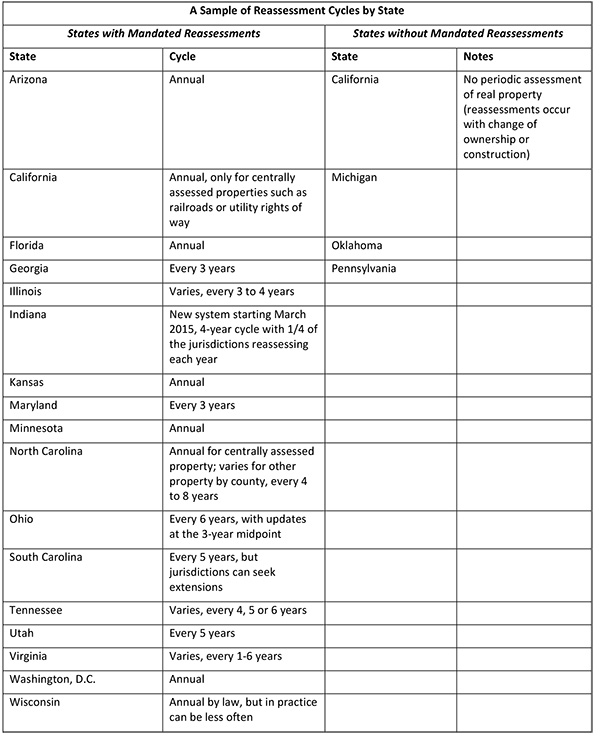
 Sharon-Di-Paolo-chart

In Pennsylvania, which doesn't require periodic reassessment, assessments can get far afield from actual market value, contends attorney M. Janet Burkardt, managing partner of Weiss Burkardt Kramer LLC, which advises Pennsylvania counties on reassessment. "Not reassessing regularly means taxing inefficiently, because counties are not capturing changes in value," Burkardt says. "The more often a county reassesses, the more equitable and uniform the values."

Pennsylvania, Oklahoma and California are examples of states that lack mandated reassessments. States that do reassess vary widely in frequency: Florida, Minnesota, Arizona, Kansas and Washington, D.C., are some states that reassess every property, every year. Some others – Wisconsin, for example – require annual reassessments, but in practice those don't always happen.

Don't Miss an Opportunity to Appeal
Even if an assessment goes unchanged in a given year, there may still be opportunities to reduce real estate taxes. In many states, like Pennsylvania, there is a ratio calculation that does change annually. For example, a property in Butler County, Penn., generated the same $100,000 assessment in 2012 and in 2014. By application of this ratio calculation for each year, the property is on the tax rolls at a fair market value of $523,000 and $740,000 for these years, respectively. If the property is worth $600,000, that would mean an appeal opportunity in 2014, but not in 2012.

Practices vary widely by state and even within states, so reviewing all assessments annually can turn up opportunities that might otherwise be missed.

What Will it Cost?
Filing fees for property appeals are modest, and in many jurisdictions the initial appeal is free. Fees in other places average about $100. The cost of the appraisal will vary based on the property's type, uniqueness, and the relative ease or difficulty of the valuation calculation. Commercial appraisals can range from $2,500 to $25,000 or more. Legal fees vary, but it is common for property tax attorneys to work on a contingency-fee basis, where there is no fee unless an appeal achieves tax savings.

Experience Matters
Asking an experienced property tax professional to evaluate assessment notices pays off. Working with a professional who knows the nuances of the jurisdiction, the law, how the system works in practice, which appraiser is right for the job, and who has a working relationship with the government employees that administer that system can be the difference between winning and losing appeals. Finding the right person to evaluate your assessments on a regular basis is the first step toward realizing tax savings.

dipaolo web Sharon F. DiPaolo is a partner in the law firm of Siegel Siegel Johnson & Jennings, the Ohio and Western Pennsylvania member of American Property Tax Counsel, the national affiliation of property tax attorneys. She can be reached at sdipaolo@siegeltax.com.

Continue reading
Mar
11

Kansas Legislature To Reform Property Tax Appeals Process?

In the nearly 200 years since the U.S. Supreme Court's ruling in McCulloch v. Maryland, pundits, attorneys, courts and others have deliberated Chief Justice John Marshall's assertion that "the power to tax is the power to destroy."

Today the issue is front and center in Kansas, where the state Legislature seems poised to enact sweeping reform legislation governing tax appeals. The contemplated measures would provide substantive due process in an attempt to level the playing field for taxpayers that seek to challenge state and local property, excise and income taxes.

The current tax appeal system in Kansas combines informal hearing processes at the county level in property tax issues and at the state level on appeals involving excise and/or income taxes. These are followed by an appeal to the Kansas Court of Tax Appeals (COTA), an administrative agency in the executive branch of state government. If a party is displeased with a COTA decision, the prescribed recourse is a direct appeal to the state Court of Appeals.

Mounting Concerns Over COTA
Tax consultants and commercial taxpayers alarmed by recent COTA decisions originated the call for reform. The grassroots effort spotlighted COTA's efforts to deny taxpayers the right to contract with tax consultants that use fee-based contracts.

COTA had ruled that the contracts violated public policy, and voided them. It then refused to hear pending cases where a tax consultant was involved. COTA also sought to deny taxpayers the ability to retain attorneys that took referrals from tax consultants.

Next, COTA dismissed appeals where the tax consultant had signed the appeal form, refusing to recognize the state-issued power of attorney forms the consultants had taxpayers execute.

Taxpayer grievances also extend to the time taken to resolve property tax appeals. A law requires COTA to issue a decision no later than 120 days after a tax hearing, but the law fails to penalize the agency in the event that it exceeds the deadline. Consequently, many cases linger beyond the 120-day mark.

Taxpayer Relief May Be Imminent
House Bill 2614 was introduced to address these issues. As currently written, the bill will make the following changes:

  • Provide for a de novo appeal to the District Court. This change will ensure that a court of competent jurisdiction hears the taxpayer's evidence and makes findings and conclusions, rather than non-lawyer employees appointed by the governor deciding the case.
  • Require a presumption of correctness for any appraisal submitted by a state-licensed appraiser.
  • Permit taxpayers to employ the tax professional of their choosing without interference from COTA.
  • Require tax appeal decisions to be issued within 120 days and, if not, all filing fees paid by the taxpayer will be refunded.
  • Waive the filing fee in the event that a protective appeal for the following year must be filed because the prior year's appeal is still pending.
  • Require COTA to provide for a simultaneous exchange of evidence. This would replace the current method, which requires the taxpayer to provide evidence months before the hearing while protecting the county from disclosure until 20 days prior to the hearing.
  • Change the agency name from the Court of Tax Appeals back to the Board of Tax Appeals, to avoid the suggestion that COTA is a court within the judicial branch. This point also includes a staff salary reduction.
  • Provide a method whereby a party could file to have a board member removed for cause, defined to be failing to issue orders timely or failing to maintain continuing educational requirements.
  • Make cases valued at $3 million or less eligible for filing with the small claims division. This would be an increase from the current cutoff of $2 million.
  • Require the agency to promptly approve stipulations between the taxpayers and the taxing body.

The initial group of taxpayers, tax consultants and attorneys contacted Kansas legislators directly and urged their support for tax appeal system reform. The Kansas Chamber of Commerce later picked up the grassroots effort.

In its "Legislative Agenda 2014 For A Healthy Economy," the chamber endorsed COTA reform to "provide an affordable, accessible and impartial system that can resolve state and local tax disputes expeditiously and efficiently."

Other groups including the lobby for the Kansas Association of Realtors joined the call for reform. Now the legislation has widespread support throughout the business and real estate communities.

TerrillPhoto90Linda Terrill is a partner in the Leawood, Kansas. law firm Neill, Terrill & Embree, the Kansas and Nebraska member of American Property Tax Counsel, the national affiliation of property tax attorneys. She can be reached at lterrill@taxappealfirm.com.

Continue reading
Mar
11

Rocky Top Tax Relief

"Reappraisal process allows Shelby County taxpayers to appeal assessed values every year."

Tennessee's fiscally strapped cities and counties are pressuring assessors more than ever before to aggressively value commercial property. Taxpayers must be aware of their rights under state law, lest an assessor attempt to prematurely capture any value increases prior to the next scheduled reappraisal.

With a proper understanding of the reappraisal process, commercial property owners in Memphis and Shelby County could get some property tax relief over the next three years, whether the fair market value of their properties increase or decrease.

Work the Reappraisal Cycle

Many states require assessors to reappraise property values annually. In Tennessee, counties have the option to reappraise property every four, five or six years. Shelby County reappraises every four years; its last reappraisal was in 2013 and the next one will be in 2017.

The purpose of reappraisals is for the assessor to adjust values for tax assessment purposes to actual fair market value. In a market that is moving up or down, the effect of a four-year reappraisal cycle is that appraised values fall out of sync with the market in between reappraisals.

Shelby County's reappraisal process is designed to favor taxpayers by enabling them to appeal assessed values every year, while the assessor can only adjust values in a reappraisal year (with some exceptions). This means that taxpayers can account for decreases in value annually, but the assessor can only capture increases in value every four years — when values increase.

The commercial real estate market in Memphis has been improving, and values have been steadily increasing, for certain types of property for the past year or two. For example, recent sales of medical office buildings indicate a much stronger market than in prior years. Demand for Class A multifamily properties have likewise increased, driving up sales prices. In the sought-after Poplar Avenue/240 corridor, vacancy in Class A+ office buildings had fallen to 7.7 percent in the third quarter of 2013, down from a peak of 20 percent in 2010, according to Cushman & Wakefield.

Owners have a right to an official notice from the assessor if the value on a property changes. The owner may then file an appeal with the Board of Equalization to contest the value change.

Owners should scrutinize the basis of a change in value by the assessor. Although there are certain times the assessor can change a value in a non-reappraisal year, there are other times when a change is not appropriate.

For example, an assessor should not "chase sales" to value a recently sold property at its sale price. Such a revaluation would constitute an illegal spot reappraisal. Also, the assessor should not revalue a property to reflect ongoing maintenance or repairs due to a turnover in tenants. Such actions by owners are ongoing and the revaluation of these properties would essentially amount to a reappraisal.

In what circumstances can the assessor revalue a property prior to the next reappraisal date? One example is when an addition or renovation is made to a property. In that case, the assessor may legally revalue the property because its physical condition has changed. Another example is when the Board of Equalization has reduced the value of a property due to its circumstances, such as being completely vacant. If the property is leased up, the assessor may revalue the property in subsequent years, even if not a reappraisal year.

Some property types in Memphis are still languishing under depressed values. The industrial vacancy rate stood at 14.1 percent in the third quarter of 2013, Cushman & Wakefield found. Industrial rents remained soft, as many users have relocated south of Memphis, across the state line in DeSoto County, Miss. Class C and D multifamily properties are still suffering from elevated vacancy and collection issues. Expenses, such as insurance, are rising at faster rates than rents. Many former tenants of Class C and D apartments have taken advantage of the institutional purchase and rental of single-family homes.

Fortunately, Tennessee law allows owners of these properties to file appeals every year. The assessor is not required to send an official notice to the taxpayer when the value stays the same, however. This means that taxpayer must remain vigilant to prevent the assessor from leaving the value for tax assessment purposes unchanged when the true fair market value of the property is decreasing. Taxpayers in this situation should exercise their annual right to appeal in order to avoid paying the same amount of property taxes on a property that is not worth as much as it was a year ago.


araines Andy Raines is a partner in the Memphis, Tennessee law firm of Evans Petree PC, the Tennessee member of American Property Tax Counsel (APTC), the national affiliation of property tax attorneys. He can be reached at araines@evanspetree.com.

Continue reading
Mar
10

Utah Assessors Argue Against Fair Market Value

Utah taxpayers could soon be required to conduct an item-by-item appraisal of personal property in order to contest its taxable value if Utah assessors have their way. Utah imposes property tax on a business' tangible personal property based upon the personal property's fair market value. Fair market value means the value a knowledgeable, willing buyer would pay a knowledgeable, willing seller for the property operating at its highest and best use.

The taxable value of a business' personal property is self-reported and self-assessed using state guidelines. Every year, a business must submit a signed personal property statement to each county in which it owns property. These statements must include the year of acquisition and purchase price for each item of personal property. The taxpayer then multiplies the prices by a provided percent-good factor to determine its estimated fair market value.

Unfortunately, simply applying the percent-good factor does not always equal the property's fair market value. For example, there may be additional functional or economic obsolescence for which the percent-good factors do not account. Consequently, a taxpayer is allowed to dispute the resulting value.

Some taxing jurisdictions, however, have recently argued that taxpayers may only dispute the resulting value if they prepare an item-by-item appraisal, rather than valuing all the personal property subject to tax as a group or operating unit.

Utah State Tax Commission to Decide
In a case pending before the Utah State Tax Commission, the taxpayer disputed the assessed value of its personal property, arguing that such property suffered from functional and economic obsolescence above that accounted for in the percent-good factors. Consequently, the taxpayer argued that its property was valued above fair market value.

In challenging the value, the tax-payer had an appraisal performed. The appraiser determined that the personal property would most likely be sold as a group of assets operating together, and thus valued the personal property as an operating unit. While the appraisal looked at every piece of personal property, the valuation reflected its aggregate value rather than values placed on each specific piece of personal property. Likewise, in applying obsolescence adjustments, the appraiser applied them to the whole, rather than to specific items of personal property.

The county which imposed the tax argued that such an appraisal was improper and deficient because it failed to appoint a value to each item of personal property separately, and as a result, the taxpayer did not meet its burden of proving that the personal property was over-assessed.

The county's argument appears to lack any precedent. The Utah Constitution and the Utah Code only require that property be valued at its fair market value operating at its highest and best use. The highest and best use value for the separate items of tangible personal property in this case was achieved when the properties were viewed as operating together as a unit. Furthermore, the Utah Constitution and Utah Code do not mandate itemized valuations.

In a 2011 case (T-Mobile USA Inc. vs. Utah State Tax Commission), the Utah Supreme Court stated that "the code simply provides that property shall be assessed by the Commission at 100 percent of fair market value. Requiring the Tax Court to use a specific valuation method ignores the reality that certain methodologies are not always accurate in every circumstance."

In the case pending before the Commission today, a ruling in favor of the taxing entity would drastically change the manner in which a taxpayer is to dispute the value of its personal property. Whereas now, there is no specific method that must be followed in order to determine the fair market value. If the Commission rules in favor of the taxing entity, taxpayers would be required to separately value each item of personal property listed on its personal property signed statement. Then tax-payers would have to add those values together to derive the value estimate for all of the personal property regardless of whether that summation is the fair market value at which the personal property would likely sell.

A ruling in favor of the taxpayer, however, maintains the status quo and further emphasizes that the standard for valuation in Utah is fair market value. So long as that is achieved, it does not matter which valuation method is used.

A decision from the Utah State Tax Commission is expected later this year.

dcrapo David J. Crapo is the managing partner at Crapo Smith PLLC, Utah Member of American Property Tax Counsel. He can be reached at djcrapo@craposmith.com

Continue reading
Feb
12

Pittsburgh Taxpayers Face Double Jeopardy on Assessments

Pittsburgh-area commercial property owners who received dramatic increases in their 2013 real estate assessments may see those taxable values go even higher. This wave reflects the growing nationwide issue of changes in property values and how they are assessed.

In the case of the Steel City, Allegheny County's first revaluation in 10 years dramatically increased assessments, which had remained static even during market highs in the mid-2000s and the crash in 2008 and 2009. While the overall increase in county assessments was 35 percent, commercial owners bore the brunt of the increase, seeing their assessments rise 54 percent overall.

More recently, however, local legislators enacted an unusual deadline extension that has effectively put property owners — especially commercial owners — at risk for even higher assessments.

Note that, rather than rely upon a central tax authority, each of Pennsylvania's 67 counties sets its own assessment. Because the state lacks a mandate for periodic revaluation, counties normally only undertake revaluation when a taxpayer files suit but will occasionally do so on the county's own initiative. Historically, reassessments are so infrequent in Pennsylvania (sometimes a decade or more passes between reassessments) that property values spike when a county eventually does reassess, which leads to public outcry and confusion.

Following publication of the new 2013 assessments for Pittsburgh-area properties, property owners filed 100,000 appeals before the original deadline on April 1, 2012. Then, in early 2013, Allegheny County's chief executive asked the county council to reopen the filing of 2013 appeals until April 1, 2013, ostensibly to help property owners.

At the time, the chief executive told local reporters that the deadline extension would give taxpayers another opportunity to appeal. What he didn't say, however, is that extending the deadline also opened the door for school districts to file appeals.

Increases in Store for Property Owners
Reopening the appeals process hurt more property owners than it helped. Most taxpayers who needed to appeal had already filed, but Pennsylvania law gives school districts a right of appeal as well. When the county council voted to reopen the deadline and allow new appeals, thousands of school appeals followed. School districts filed most of the 7,000 new appeals in 2013.

What's more, Pittsburgh's office market was hot in the latter part of 2012. The districts tracked sale prices in the last three quarters of 2012 and subsequently appealed to increase the property owners' new assessments based on these sale amounts. Most of these appeals to increase valuations target commercial owners.

Of the new appeals filed by property owners, the vast majority are attempts to re-hear appeals that were previously filed. Those are likely to be thrown out by the courts. That will leave mostly school-initiated appeals.

As of this writing, administrative hearings are complete for the original 100,000 appeals, and administrative decisions that caused the taxpayer or school district to be unhappy with the outcome are already pending in court. Hearings on the 7,000 new appeals are underway.

What to Do
When a taxing district files an appeal, state law requires it to send notice of the appeal to the address listed in county records as the property's Change Notice Mailing Address, which is published on the county's website (alleghenycounty.us). Some of the county records are outdated as to owners' addresses and, in those instances, some new owners are unaware of appeals on their properties.

New owners should check the address the county has on record for their properties and watch for notices sent to this address in the coming months. If a school district does appeal, the property owner would be wise to seek counsel, appear at hearings and defend his property's taxable value, otherwise risk having his assessment increased even more.

dipaolo web Sharon F. DiPaolo is a partner in the law firm of Siegel Siegel Johnson & Jennings Co., LPA, the Ohio and Western Pennsylvania member of American Property Tax Counsel, the national affiliation of property tax attorneys. She can be reached at sdipaolo@siegeltax.com.

Continue reading
Jan
19

Highest And Best Property Use: Why Does It Matter?

"Any investor wants to maximize his property's value and income-producing potential, but many fail to take this concept seriously — until they realize what they could be missing out on"

Who cares about the highest and best use of a property? Well, appraisers certainly care, and when a property ends up in litigation, the judge cares. Understanding how these authorities determine value will make it clear that commercial property owners should care about highest and best use, too.

I learned the importance of highest and best use during my first year at the Department of Justice, in a small condemnation or government taking case. The property owner had a single-family home on a prime piece of commercial real estate, and a highway expansion was bringing traffic lanes to within 12 feet of the house. The property had been rezoned commercial and was surrounded by other commercial uses.

As a residential asset, the entire property before partial condemnation had appraised at $140,000, whereas the land as a commercial site was worth double that amount. Because the highest and best use of the property was redevelopment as a commercial site, the value for the land taken as right of way was worth more than the residential value of the entire, previously undivided property.

Not all analyses of highest and best use are so simple and obvious. This is particularly true in the context of appraising an industrial property for a property tax appeal. The standard test for determining highest and best use has four prongs, and each can be critical to the valuation of the property.

That question is: What use is legally permissible, physically possible, financially feasible and maximally profitable?

The first prong, what is legally permissible, refers to zoning or other governmental restrictions, as well as the deed restrictions, and the uses that those parameters allow for the property. In a recent case, a 57-acre property was zoned industrial, which allowed for offices as an accessory use to the industrial use. Improvements included several older flex manufacturing buildings totaling close to 600,000 square feet. The condition and use of the flex buildings varied but the need to use the structures primarily for manufacturing no longer existed.

The Oregon Department of Revenue's appraisal valued the majority of the 600,000 square feet as office use. This did not meet the test for what is legally permissible, because the zoning only allowed office as an accessory to an industrial use.

What is financially feasible? In this same case, the appraiser for the Department of Revenue also failed to address if it was cost effective to reconfigure several 80,000-square-foot, two-story flex manufacturing facilities for multitenant use. The government's appraisal lacked any discussion of the basic demising costs to create smaller rentable spaces, including common areas for hallways, lobbies, and relocation of elevators and restrooms.

What is physically possible? Many of the industrial buildings in this example were interconnected. They had shared utilities, were situated on a single tax lot and offered only limited access without dedicated parking for a given building. Separation of the buildings into viable stand-alone parcels may have been prohibited by the physical location of the utilities, the placement of the buildings on the lot, or by parking, ingress and egress to the site.

The fourth prong is often the simplest to address. Of the possible uses meeting the first three facets of the highest-and-best-use test, which offers the maximum profit for the owner?

An appraiser's failure to do a highest-and-best-use analysis and appropriately support its conclusions can be fatal in a trial setting. In a 1990 decision, Freedom Federal Savings & Loan vs. Department of Revenue, the Oregon Supreme Court held that highest and best use of the property subject to evaluation is the first question that must be addressed in a credible appraisal. This set the critical framework for valuation, and determines what other comparable properties can be used to value the subject property.

These highest-and-best-use tests must be appropriately supported. In the context of an investment property, for example, would an investor deem the current use to be most productive from a financial or physical basis for the property, or would an alternative use be preferable?

If a careful highest-and-best-use analysis is done at the beginning, the appraiser can select credible comparable sales or leases for use in valuation. The property owner, in turn, will be treated fairly, whether in a tax assessment appeal or an eminent domain acquisition.

CfraserCynthia M. Fraser is an attorney at Garvey Schubert Barer where she specializes in property tax and condemnation litigation. The firm is the Oregon and Washington member of the American Property Tax Counsel the national affiliation of property tax attorneys. Ms. Fraser can be reached at cfraser@gsblaw.com.

Continue reading
Jan
18

Bay Area Real Estate Recovery Bolsters Proposition 13

The recovery of the Bay Area's real estate markets has muted the public outcry to change Proposition 13's restrictions on assessed value increases. Passed in 1978, Proposition 13 has come under fire for fostering unequal tax burdens.

The reasons that tax-reform fervor is weakening are twofold. First, as the recovery spurs real estate sales, properties will be reassessed at higher market values under Proposition 13's acquisition value system. Second, recent sales are also likely to increase real estate values generally, which will permit assessors to raise the assessments of other property owners. These trends have increased the values of property tax rolls and tax revenues.

Acquisition value system increases tax revenues

One under-appreciated aspect of Proposition 13 is its requirement that assessed values for property tax purposes be equated to acquisition values or sales prices. Critics of Proposition 13 contend that the law keeps values too low and reduces the amount of taxes going to government agencies. But in an active real estate market where properties are held for as little as five years, the opposite is true. In such markets, sales prices are usually climbing, assessed values increase, property tax collections rise, and local governments receive more revenues.

The recent up-tick in Bay Area real estate sales is proving the benefits of Proposition 13 because the values of tax assessment rolls have increased for all counties. For example, the 2013-2014 tax year assessment rolls increased over the previous year by 8.3 percent in Santa Clara County, by 6.0 percent in San Mateo County, by 5.0 percent in Alameda County, and by 4.5 percent in San Francisco. Statewide, assessed values increased by $191.5 billion or 4.3 percent over the prior year.

Recent sales affect assessments

The increase in real estate sales activity doesn't just impact the assessed values and taxes on properties that have sold. It can also affect the values and property taxes for real estate held by investors. Here's why.

Under Proposition 8, the bookend to Proposition 13, assessors can and have reduced real estate assessments in recent years to reflect across-the-board declines in market values. In some cases, the reductions have been considerable, well in excess of the 2 percent annual adjustments that are permitted under Proposition 13.

As real estate markets recover, the Proposition 8 reductions that assessors made in prior years to reflect market downturns usually are reversed. The Proposition 8 values of prior years can shoot up much faster than 2 percent per year for properties that are assessed below their trended Proposition 13 values, depending on where current sales show market values to be. As Proposition 8 values are reversed and values return to Proposition 13 levels, the property taxes on those assets also rise, thereby increasing tax revenues to local governments.

Split roll unnecessary

One of the changes currently advocated by opponents of Proposition 13 is to create a split tax roll which would tax commercial properties differently from residential ones, either by requiring commercial properties to be reassessed annually instead of upon acquisition, or by increasing the tax rates for commercial properties.

However, as described above, such changes are unneeded so long as there is an active market for commercial properties, and so long as sales prices generated by that market tend to increase over time, which is usually the case. When these conditions are present, assessed values will increase and property tax revenues will rise.

As markets continue to recover and assessed values rise, property owners should take stock of their assessed values. Local assessors will begin to set assessed values for the 2014-2015 tax year in January 2014. In some cases, values reduced under Proposition 8 in prior years will be restored to Proposition 13 levels. Taxpayers should ask whether those restored values represent market values, and if a value appears excessive, the property owner should file an appeal.

CONeallCris K. O'Neall is a partner in the Los Angeles law firm of Cahill, Davis & O'Neall LLP, the California member of American Property Tax Counsel (APTC), the national affiliation of property tax attorneys. Mr. O'Neall can be reached at cko@cahilldavis.com.

Continue reading
Jan
13

Owner, Beware

"When Assessors Seek Business Income Information"

Is it appropriate for a tax assessor to use income information in determining taxable value?

That question comes up frequently in property tax cases when assessors seek income information from taxpayers. The answer is that whether a request is appropriate depends on the type of property at issue and the type of income information being sought. In several recent cases involving manufacturing operations, industrial enterprises and other types of businesses, assessors have sought information on income from the business or businesses operating on the property, rather than on income from the property itself.

Often, assessors have a legitimate reason to seek certain types of income information from taxpayers. For instance, if the property type at issue is typically rented in the marketplace, as is the case with an apartment complex or an office building, it will likely be entirely reasonable for the assessor to request, and for taxpayers to use, the property's rents when evaluating its market value. Indeed, investors regularly rely on rental information to determine the price for such property.

However, some types of income data should be excluded from a property assessment. In a number of recent instances, for example, assessors attempting to value manufacturing or industrial properties have sought income and production information relating to the manufacturing process, which is unrelated to the property's income-producing capacity. Where the business is something different from the rental of property and the business income derives principally from assets other than the real estate, reliance on income information will produce misleading conclusions about the value of the real property (whether for taxation or any other purpose).

To better understand the problem, consider a hypothetical downtown office building that houses law firms, accounting firms, travel agencies, dental offices and any number of other tenants. No reasonable assessor would consider the revenues of the tenants in determining the value of the office building.

Why not? Because that business revenue would indicate only the value of the business taking place in the building. Tenant revenues do not determine the building's rent, and no reaonable investor would value the building on the basis of such income information. In short, it is irrelevant.

The same generally goes for production and income information when it comes to manufacturing proeprties. A typical manufacturing process requires personnel, machinery and equpment, managerial expertise and real property. Add to that goodwill and other intangibles that allow the manufacturer to capture market share and sell its products, and it is clear the income from product sales incorpoates value from a number of assets unrelated to the value contribution of the real property.

Special Purposes, Special Properties

Why, then, might assessors seek business income information, and how should taxpayers respond to such requests?

In many markets, manufacturing properties are more lilely to be in owner-occupied rather than leased space, so determining the equivalent of market rents for such properties is difficult. Assessors seeking production or business income information occassionally argue that they cannot use sales data because the property is a special-purpose asset. But even if the property is special purpose, the assessor should not seek and use income information unrelated to the property and its market value.

Attorneys also hear assessors argue that the property represents a special component of, or provides a particular "synergy" to, the taxpayer's business. These assessors contend they need business income information to accurantely reflect the property's true value. But such efforts to capture special value apart from the real estate itself are efforts to tax an intangible, not the property.

In some cases, it may be appropriate to consider income information to determine whether a property suffers obsolescence and is, therefore, over-assessed. For example, if the total income from all operations is insufficient even to support the real property at its current assessed value, an argumnent exists that the real property suffers obsolescence (relative to its assessed value). However, the fact that income shortfalls might indicate obsolescence does not make business income generally indicative of real estate value.

When assessors request business income unrelated to the property or its rent, taxpayers should consider objecting on several grounds: First, if the information is truly unrelated to the property or its rent, the taxpayer should explain that to the assessor \and try to provide only the property's rental information, if available.

Second, taxpayers should guard against the disclosure of proprietary business information. Many states have laws that protect confidential taxpayer data such as information relating to earnings, income, profits, losses and expenses; taxpayers are wll advised to mark that information as confidential and take other steps to avoid public disclosure of any income information they provide to the assessor.

Suess David photo

David Suess is a Partner in the Indianapolis law firm of Faegre Baker Daniels LLP, the Indiana member of the American Property Tax Counsel. He can be reached at david.suess@faegrebd.com. Suess's partner, Brent A. Auberry, contributed insights and edits to the column.

Continue reading
Dec
18

South Carolina Taxpayers Play 'Dating Game'

Inconsistencies and confusion reign in determining effective date for valuing commercial properties.

"The practical implementation of the mandated five-year county-wide reassessment program further compounds the dating confusion. Many counties delay county-wide reassessment for one year, as authorized by statute, and in some cases, two years..."

Commercial property owners in South Carolina already faced an unsettled and confusing issue in trying to determine he valuation date for ad valorem taxes. Now, the South Carolina Court of Appeals has further complicated the issue.

Determining the valuation date should be simple: South Carolina law states the pertinent date of value for a given tax year is Dec. 31 of the preceding year. For example, logic suggests the valuation date for 2013 property taxes hould be Dec. 31, 2012. But that logic is often mistaken. South Carolina statutes require local assessors to engage in a countywide reassessment every five years. The process is referred to as an "equalization and reassessment program," and is intended to equalize the tax burden on property owners. Logic suggests the equalization program will equalize values, but that logic is also mistaken.

Act No. 388 and its Wake

Approximately seven years ago, the South Carolina General Assembly passed Act No. 388 which, among other things, capped value increases resulting from a county-wide equalization and reassessment to 15 percent of the property's prior assessed value, so long as the property had not changed hands in the past five years. However well-intentioned, the effort to lower property tax burdens wrought havoc with the concept of equalization.

The legislature also created the concept of an assessable transfer of interest, which eliminated the cap in some situations, such as in certain transfers of interest within the ownership entity, or following construction of improvements. In a sense, the legislation penalizes a landowner from a tax standpoint for improving a property's economic performance with new construction.

By their nature, caps erode the principal of uniformity since taxes for some properties go uncapped. Competing properties may have identical uses and financial performance, but taxes may be capped on one property, but not on the other. Under Act No. 388, two economically identical properties could be taxed using different valuation dates.
In fact, Act No. 388 promulgates a potential for four alternative valuation dates.

In an effort to address some of the outcry over the inequality engendered by Act No. 388, the legislature in 2012 provided an exemption of up to 25 percent of the purchase price of commercial properties. Unfortunately, this provision adds yet another little-known filing deadline, since the application for the exemption is due on or before Jan. 31 of the applicable tax year. In other words, a property purchaser must file for this exemption prior to the first Jan. 31 after acquisition. Failure to do so likely invalidates the exemption.

The practical implementation of the mandated five-year county-wide reassessment program further compounds the dating confusion. Many counties delay county-wide reassessment for one year, as authorized by statute, and in some cases, two years. For example, after delaying a scheduled 2004 reassessment to 2005, Charleston County delayed its next scheduled county-wide reassessment from 2010 to 2011 and decided to use a Dec. 31, 2008 valuation date rather than Dec. 31, 2010. The question is what date to use for valuation in the county-wide reassessment. Should it be the date on which reassessment was scheduled to occur or Dec. 31 of the year prior to implementation?
The correct answer is unclear.

Interim Appeals Defy Logic

So, what happens if a property owner wants to appeal the value of a property in the middle of the fiveyear period because of a change in economic performance? For example, is it fair to tax a property based on its economic status as of the valuation date used in the last county-wide reassessment, when it may have lost its anchor tenants since then? Logic and the clear language of state statutes suggest the valuation date should be the lien date, or Dec. 31 of the year prior to the year in which taxes are due, in order to treat properties equally based on economic performance.

According to the South Carolina Attorney General, however, that logic again would be wrong. In 2010, the attorney general opined that county assessors should ignore the unambiguous statutory language regarding valuation date and use the effective date of the last county-wide reassessment. County assessors are implementing this opinion regardless of logic.

In the 2013 case of Charleston County Assessor vs. LMP Properties, the South Carolina Court of Appeals further complicated the dating problem. In this case, the parties agreed to a Dec. 31, 2003, value date because 2004 was the date of the county's last county-wide reassessment. However, the Court determined Dec. 31, 2007, was the proper date for determining the property's highest and best use. In other words, the Court held an appraiser should use one date to determine the property's value and a different date to determine the property's highest and best use. How licensed appraisers meet these requirements and satisfy professional standards under the Uniform Systems of Professional Appraisal Practice defies logic. Logic suggests that assessors should use a uniform date, the lien date, for valuing real property. Logic also suggests the property's economic performance as of the lien date should control for interim appeals. But, then again, whoever said that dating — in love or taxes — had to
be logical?

ellison mMorris A. Ellison is a partner in the Charleston, S.C., office of the law firm Womble Carlyle Sandridge & Rice LLP. The firm is the South Carolina member of American Property Tax Counsel, the national affiliation of property tax attorneys. Morris A. Ellison can be reached at mellison@wcsr.com.

Continue reading
Dec
09

Is History Repeating Itself in Multifamily Rental Space?

One of the bright spots that have emerged in the real estate market over the past five years of the economic recovery has been the multifamily rental segment. Of the 49 major metropolitan markets tracked by Cassidy Turley, only 17 have a multifamily vacancy rate above 5% and only two have a vacancy rate above 7%, according to the Firm's US Multifamily Forecast Report for Summer 2013.

Rental rates have increased in virtually all markets, with the strongest growth in top-tier cities. In Chicago, for example, rents at class A buildings have increased 21% since 2009. And at the national level, multifamily transaction volume quadrupled between 2009 and 2012. Despite these robust indicators, however, some observers worry that the industry may be overestimating the extent of the US multifamily recovery, and that developers are setting the stage for the next bubble.

Since 2012, construction has come to the fore. Almost 60,000 new multifamily units are expected to reach completion by the end of 2013 in the top 10 markets. The bulk of the new construction is class A buildings, which feature amenities such as a doorman, concierge services, work-out facilities, pools and in-unit washers and dryers.

Millenials, born between the mid-1980s and mid-1990s, appear to be driving the rental market. They are renting instead of buying for several reasons. Some have limited opportunities to finance the purchase of a home. Others want to remain mobile while pursuaing their careers. New construction is highest in cities like Austin, Washington, Chicago and New York, which are some of the prime designations for millenials.

While optimism is warranted, there are signs that the sector may have ignored the lessons of the 2008 recession. The availability of capital alone cannot be the determining factor driving development in a segment of the market that has become dominated by the addition of new supply. The real estate market must operate within the parameters of the greater economy, and that overall economy merits far less enthusiasm than the multifamily boom would suggest.

The liklihood of an over-supply in the apartment market raises interesting property tax concerns. The prospect of lower fundaments raises risk and lowers revenue expectations. Ultimately, it must be anticipated that pricing will change and values will decline.

Real estate taxes are based on market value, but the development of new values for real estate taxes lag well behind the market. In many places, the decline in value over the past five years still has not been fully recognized in the values established by assessors. Developers must have strategies in place which accelerate assessors' recognition of value changes taking place in the market. The key strategy to help owners keep real estate taxes in line with value changes is assiduous appeal of property tax assessments.

In 1989, the response to the savings and loan crises, the Uniform Standards of Professional Appraisal Practice were promulgated by the Appraisal Standards Board. These standards govern both the mass appraisal practices of assessors and the appraisal of individual properties by private appraisers, and will take into account the changes in the market as they arise. Thus apartment owners need to diligenty scrutinize their tax assessments in the next several years to ensure that these assessments reflect the changes in market values, and where they don't file an appeal.3

reganJames Regan is the managing partner of the Chicago law firm of Fisk Kart Katz and Regan, the Illinois member of the American Property Tax Counsel. He can be reached at jregan@proptax.com. His Fish Kart colleague Antonio Senagore also contributed to this article and he can be reached at asenagore@proptax.com.

Continue reading

American Property Tax Counsel

Recent Published Property Tax Articles

The Commercial Property Tax Rebellion

The property tax system in the United States, which traces its roots to colonial America, has long been the life blood of local government finance. Used to fund schools, infrastructure and vital municipal services, it is also a system fraught with controversy and mounting calls for reform.

Over the past...

Read more

How to Achieve Fair Valuation of Renewable Energy Facilities

As renewable energy assets become more prevalent in commercial real estate portfolios – especially among industrial and data center users – property owners face a critical challenge: ensuring that intangible assets are not mistakenly included in the taxable value of real and personal property.

Wind farms, solar installations, battery energy storage...

Read more

Taxing Real Estate On Redevelopment Prospects

When a property's current use isn't highest and best, New Jersey jurisdictions can assess and tax based on hypothetical redevelopment.

It's hard to imagine a more dystopian world than one in which governments base real estate tax upon a hypothetical use other than a property's current and actual use. Unfortunately, taxing...

Read more

Member Spotlight

Members

Forgot your password? / Forgot your username?