Menu

Property Tax Resources

Sep
11

What's Fair Market Value?

"Despite the law, there appears to be one abiding maxim that all tax assessors observe: Every high sale price represents a market value sale, and every low sale price is seen as a distress sale."

By John E. Garippa, Esq., as published by Real Estate New Jersey, September 2007

New Jersey, as in most other jurisdictions in the US., all real property must be valued and assessed based on market value. It's the law. Market value is defined as the price paid by a willing buyer to a willing seller, each acting knowledgeably, without duress.

Despite the law, there appears to be one abiding maxim that all tax assessors observe: Every high sale price represents a market value sale, and every low sale price is seen as a distress sale. Further, every high sale can be relied upon to set an assessment and every low sale must be disregarded because it took place under distress. However, the real issue revolves around: Is every sale a market event that represents fair market value for assessment purposes? The Tax Court of New Jersey has focused on this issue and determined that a category of events exists that rule out a sale as a reliable indicator of fair market value for assessment purposes.

A transaction set up as a 1031 tax-free exchange represents one such category identified by the Tax Court. Under 1031, sellers of investment-grade real estate may defer paying capital gains by using the proceeds from one sale as an investment in another similar property or properties. The seller has 180 days from the original closing date to complete the exchange. Also, within 45 days of closing, the taxpayer must provide the IRS a list of three or more potential replacement properties.

In a recent case, the Tax Court agreed with the taxpayers arguments that his 1031 sale price was significantly higher than market value. The court concluded that the sale price was motivated by tax and business issues rather than typical real estate motivations. The court also concluded that the tax free exchange laws placed enormous pressure on a seller to conclude a transaction within 180 days. Fundamentally, the sale took place primarily to defer gains from another sale.

Another category of sales rejected by the Tax Court compromise those that have not been properly marketed. For example, a Fortune 500 company sold a corporate headquarters for $16 million. The sale was conducted via sealed bids over a short period of time. The bid package included language that prohibited the bidders from changing any of the sale terms. The court determined that the bid package was not sent to all potential buyers. As a result of these perceived defects in marketing the property, the court rejected the sale price and concluded to a market value of $49 million.

In contrast to the prior set of facts, the Tax Court has also concluded that the sale of a complex property can be market value. In another case, an oil refinery was sold after it was marketed for more than 18 months. The owner hired an investment banker to market the property. The investment banker identified all of the potential buyers. Comprehensive information packages identifying the property were transmitted all over the world. At the end of this marketing period, the seller received two bids, eventually resulting in a sale. The court concluded that such a significant amounted to a valid sale that could be used to value the property for tax assessment purposes.

Some of the same arguments made with regard to 1031 property can also be advanced for high purchase prices paid by REITs. REITs offer significant tax advantages to shareholders; however, they must meet strict tax requirements in order to qualify for that status. A RElT must distribute 90% of its income to shareholders. Thus, in order for a RElT to grow, it must continually purchase properties, as it cannot grow via the normal accumulation of cash.

Growth is critical because it leads to higher stock prices and allows for more diversification in the portfolio. Additionally, REITs use capital markets to which most other buyers do not have access. These large capital markets fund REIT purchases at low interest rates that further the aims of the REIT. All of these issues would normally cloud the price paid by a "willing buyer, acting without duress."

In an era characterized by unusually high sales prices, tax payers need to remember an important caveat: Even the New Jersey Tax Court recognizes that not every sale represents fair market value for tax assessment purposes. Owners involved in transactions with high sales prices need to carefully examine their property tax assessments to determine whether a valid market price was used in levying their assessment.

GarippaJohn E. Garippa is a senior partner of the law firm of Garippa, Lotz & Giannuario of Montclair and Philadelphia. He is also the president of the American Property Tax Counsel, the national affiliation of property tax attorneys, and can be reached at john@taxappeal.com.

Continue reading
Jul
11

How to Fight High Property Taxes

"A sale involving a first-generation lease is more a financing operation than a transaction in real estate. In the past, many single-tenant real estate users — often retailers not wanting to tie up capital — financed their real estate through sale-leaseback transactions where they recouped the capital costs by inflating both rent and the corresponding sale price."

By Kieran Jennings, Esq., as published by National Real Estate Investor, Summer Special Edition, July 2007

In a build-to-suit transaction, the value of the property to the user who had it built is greater than the value that property holds for the next user.

For instance, a store built as a McDonald's would not have the same value to a Taco Bell. Although both users are fast-food chains, the layout, design and exterior appearance all work to identify, market or assist the first occupant's business.

The decrease in value from the original user to the subsequent user represents built-in obsolescence. Failure to recognize this obsolescence often subjects first generation owners to excessive property tax assessments.

A triple-net-lease property that was a build-to-suit may be sold to a new owner, even if the original user remains the tenant. In this case, the sale price reflects the value of the tenant's lease. The assets involved in the purchase include both the lease and the real estate.

Because the revenue created by the lease primarily drives the price of the deal, an assessment based on sale price can result in an illegal assessment when it is based on the value of the property to the user.

Fighting back

The first step in reducing improper taxes requires that owners prove to the assessor or the courts that the rent and/or sale represent value to the user, not the market value of the property. The next task is to prove actual market value for the real estate.

A sale involving a first-generation lease is more a financing operation than a transaction in real estate. In the past, many single-tenant real estate users — often retailers not wanting to tie up capital — financed their real estate through sale-leaseback transactions where they recouped the capital costs by inflating both rent and the corresponding sale price. This practice is still prevalent today. The user currently has a relationship with a local developer who will acquire the site and build the property on behalf of the user to suit the user's needs. As with a sale-leaseback transaction, the user will enter into a long-term lease based on the costs of building the property to meet the user's specific needs.

The developer then either retains the property or sells it with the lease in place. Thus, the tenant has outsourced to the developer the financing, site selection, construction and other exterior and interior finishes. The third-party purchaser sees the transaction as essentially buying a bond secured by real estate.

Until the first-generation user vacates the property and the real estate is exposed to the open market, the real estate value has not been tested. Furthermore, because the lease drives the sales price of a net-lease property, only a second generation lease reveals true market value and produces a correct assessment.

Case study makes the point

Data from a recent drug store case illustrates the difference in first- and second generation leases for comparable properties built as national retail drug stores. The average drop of $19 per sq. ft. in rent from the first-generation user to the second generation illustrates the difference between value in use and market value.

The difference is due to obsolescence, a fact first-generation tenants must demonstrate to assessors. Data like that shown in the accompanying chart prove the existence and value of the obsolescence.

JenningsNREI_Fair_Taxation_clip_image002Not only are the rents affected by the first-generation tenant, the capitalization rate is significantly lower than market rates. The net-lease market into which these properties are sold is among the most active and developed in the real estate market, allowing for substantial liquidity, efficient pricing, and tax deferral through 1031 exchanges.
As a result, the capitalization rates have been reduced to exceedingly narrow margins. Therefore, cap rates derived from sales of first-generation property should not be used in determining assessments.

Proving market value

Assessment laws generally provide that property must be valued using market terms and conditions. Therefore, market rents, those paid by tenants in comparable properties, not contract rents, those paid by the net-lease tenant, determine the income attributable to the real estate.

The difference between market rents and contract rents demonstrate the amount of the obsolescence. Furthermore, the differences in sales prices of property from first-generation users to the next generation can also be used to prove obsolescence.

The road to a fair and honest assessment is not easy, but as illustrated in the accompanying chart, the difference between use value and market value can be substantial.


KJennings90J. Kieran Jennings, partner at Siegel Siegel Johnson & Jennings, a law firm with offices in Cleveland and Pittsburgh. The firm is the Ohio and Western Pennsylvania member of the American Property Tax Counsel, the national affiliation of property tax attorneys. He can be reached at kjennings@siegeltax.com.

Continue reading
Jun
13

Tips for Reducing Affordable Housing Property Taxes

"The first thing any taxpayer needs to know to determine if they want to appeal their taxes is whether a reduction in assessed value yields tax savings. In states that place no limits on the amount of tax increase possible, owners can be certain that reduction in assessed value will generate a tax savings. However, several states' laws require the taxes rise by only a limited percentage in a given year."

By J. Kieran Jennings, Esq., as published by Affordable Housing Finance, Summer Special Edition 2007

Affordable housing owners looking for ways to save money and eliminate non-productive overhead should start by examining their property taxes. That doesn't require taxpayers to become experts in real estate tax law; they need only a working knowledge of the issues to identify when or if should hire an expert .

The basic issues

The first step in this process is to learn how assessors determine property taxes. One of the main indicators of fair market value that assessors use is the income that could be produced from the property using current rents, vacancies, and market expenses. In most states, real estate assessments are based on some percentage of a property's fair market value. Most often, the actual taxes are calculated using a millage rate (for example, $.001) multiplied by the assessment.

Right now owners of affordable housing face unprecedented increases in fuel and utility costs. And, because net income is a key indicator of market value, an increase in operating expenses likely causes a decrease in value. That means an owner's property might not be worth what the taxman says it is, and an appeal may be necessary.

Where does the taxpayer begin?

The first thing any taxpayer needs to know to determine if they want to appeal their taxes is whether a reduction in assessed value yields tax savings. In states that place no limits on the amount of tax increase possible, owners can be certain that reduction in assessed value will generate a tax savings. However, several states' laws require the taxes rise by only a limited percentage in a given year. In such states, a complex analysis is required to determine whether a reduction in assessed value actually results in a tax savings. This type of analysis calls for the skills of a property tax professional.

Some states' assessments may be based on ratios sometimes known as sale ratios or common-level ratios. In states such as New Jersey and Pennsylvania, an assessment may have originally been based on 100 percent of the appraised market value of the property, but over time that 100 percent assessment no longer reflects market value. So, at regular intervals, each county in these states conducts a study comparing the sale prices of all properties sold in a given period with the last assessed value of these same properties. For example, if the assessed values of properties sold for an average of 50 percent of the sales prices of those same properties, then the sales ratio for that period of time will be 50 percent for all properties in the municipality. This ratio then is used to convert the assessed value back to market value. Owners will want to track down the current-year ratio percentage and then review their assessment to ensure that the correct ratio has been applied in developing their assessment.

Finally, many states establish predetermined ratios. Ohio, for instance, places its predetermined ratio of assessment at 35 percent of the appraised market value every year in all counties. Assessed market value is determined by dividing the assessed value by the ratio percentage. As an example, a $35,000 assessment divided by 35 percent yields an assessed market value of $ 100,000, which then can be compared to the actual fair market value of the property. If the assessed market value appears to be higher then the actual fair market value (what a willing buyer would pay a willing seller in an arm's length transaction), then the taxpayer should consider contesting the assessment.

What can taxpayers do when over-assessed?

If you determine that your property has been over—assessed, file an appeal to reduce your real estate taxes. In some states, that will mean filing a formal complaint by a particular date. In other jurisdictions, the filing deadline depends on the mailing date of the assessment notices. Some jurisdictions mandate that parties must appeal their assessment within 15 days of receiving notice. If the deadline passes, in most jurisdictions, the taxpayer is prohibited from contesting their taxes until the following year. It is, therefore, imperative to know the local rules.

How does the taxpayer prove the case in an appeal?

As with every aspect of assessment law, proving the case varies from jurisdiction to jurisdiction. Most typically, an appeal that has merit can be proven with a qualified appraisal. However, the rules regarding how that appraisal is prepared can vary from state to state. For instance, some states mandate that actual income and expenses be used to determine the market value of the property. In other states, an appraiser or property owner must prove the value based on unencumbered market conditions. An unencumbered market condition exists when a property built under Sec. 42, with a majority of its rents restricted, is appraised as if the property were conventional apartment. However, a property that enjoyed greater occupancy or rents because of Sec. 8 rent subsidy may be able to use a lower income figure based on prevailing market conditions. The income approach to value represents the common thread across exists the country for establishing market value.

Must an attorney file a property tax appeal?

Rules governing appeals vary greatly from state to state. In most states, an attorney is not required to file an appeal at the local level, but an appeal in court almost always requires an attorney. However, in a number of states, the courts have determined that the filing of property tax appeal is the practice of law, requiring an attorney

What risks and benefits come with contesting taxes?

Risks come into play when the appeals process is poorly handled, as that can impair a taxpayer's ability to reduce a property's value to its proper level in the future. Evidence poorly presented often remains in the record and is not retractable. Furthermore, in several states and with increasing frequency, school districts participate in the appeals process. In those states, the hearings may put the taxpayer at risk for an increase in assessment, if such is warranted.

The benefits of controlling real estate taxes far outweigh any risks involved, and by spending a little time learning the process, taxpayers can all but eliminate those risks. A newly established assessment often forms the basis for future assessment. Thus, a reduced tax this year positions an owner for future years because tax increases compound over the years. Even if assessments steadily climb in future years, having started at lower base can save money indefinitely.

Keeping real estate taxes and all non-productive expenses down becomes crucial to the economic health of an affordable housing property.

KJennings90J. Kieran Jennings, partner at Siegel Siegel Johnson & Jennings Co., LPA, with offices in Cleveland and Pittsburgh. The firm is the Ohio and Western Pennsylvania member of the American property Tax Counsel, the national affiliation of property tax attorneys. He can be reached at kjennings@siegeltax.com.

Continue reading
Jun
13

Industrial Obsolescence

Income approach to value helps reduce assessments on aging manufacturing plants

"Industrial property exists for only one reason —— to manufacture goods and provide an income for the owner. When income declines due to external factors, the market value of the plant drops. Because the trended cost investment method only looks at past investment, it can't account for the current economic reality."

By David Canary, Esq., as published by National Real Estate Investor, June 2007

Have you ever wondered why your local tax assessor has such a high opinion of the value of industrial plants in your area? This is particularly perplexing when global competition drives down the price of finished goods, energy prices skyrocket, the plant gets older and justifying further capital investment becomes difficult because of razor-thin margins.

The assessor thinks industrial properties are worth hundreds of millions of dollars because he uses the trended investment cost method to value the plant. The assessor adds up to value the plant. The assessor adds up the historical costs invested in the plant over the last 30 years, trends that cost to current dollars and depreciates the result based upon the plant's remaining physical life.

This method is a backward-looking valuation approach that does not measure the eternal economic factors that makes industrial property less competitive or even obsolete. The trended investment cost method bears no relationship to the price at which an owner could sell a plant on the open market. Yet, market value is the basis for all property tax assessments.

Industrial property exists for only one reason —— to manufacture goods and provide an income for the owner. When income declines due to external factors, the market value of the plant drops. Because the trended cost investment method only looks at past investment, it can't account for the current economic reality.

A preferred valuation method

The only way for industrial plant owners to obtain fair tax assessments is to argue for the use of the income approach o value their plants —— the same valuation approach investors use to determine the price they will pay for any investment.

Utilizing either a discounted cash flow or a direct capitalization method, the income approach projects the future income stream of the plant, capitalizes or discounts the income by the market rate of return on invested capital, taking into account current and future expected market conditions, as well as the risks and liquidity of the investment.

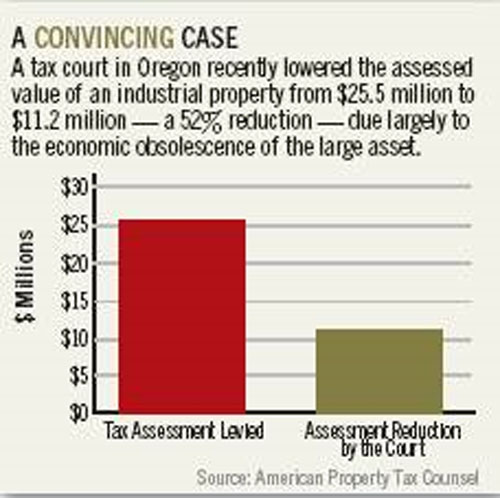
Canary2007_graphThe business value reflects all the factors of production —— land, buildings, machinery and equipment, skilled labor, managerial expertise and goodwill. It is incumbent upon owners to show assessors how to separate the value of the real and personal property from the value of the business for assessment purposes.


Bear in mind that all factors of production fall into one of three categories: working capital, intangible assets and fixed assets. Working capital and intangible assets are non-assessable in most states. The market value of working capital —— which includes cash, receivables, inventories, less current liabilities —— can be easily and accurately determined. Now, only market value of the intangible assets needs to be eliminated to arrive at the value of the fixed assets.

Why exclude intangibles?

Intangible assets include software, good-will, customer lists, contracts, patents and trademarks, assembled workforce and trade secrets. The owner of an industrial property invests in intangible assets one way or another. For example the owner pays wages to skilled workforce and invests in R &D, from which benefits and trade secrets result, in the hope the return will exceed its cost.

Because of economic obsolescence, a struggling industrial plant with low margins enjoys little return on intangible assets. And because the cost of creating and maintaining intangible assets is already reflected in the income stream as costs of doing business, their market value has already been accounted for in the business value. Even if intangible assets do have a value above their cost, the assessor will not complain the resulting valuation is too high.

The devil is in the details. The two components of the income approach —— the income stream and the discount, or capitalization rate —— must be accurately calculated to derive market value. A plant's budget or strategic plan already projects the future income of the plant.

For property tax purposes, it is the expected future debt-free, after-tax cash flow from the industrial plant that is discounted by the weighted average cost of capital. However, this approach must account for the current and expected market risks and liquidity of owning a single, stand-alone plant, not the cost of capital of a Fortune 500 company.

If the future income stream is realistic and the discount or capitalization rate reflects the inherent risks in investing in a single industrial plant, the resulting value will equal the price an investor will pay to own that industrial property.

There remains only the task of convincing assessing authorities that the income approach results in a far better and fairer, estimate of the plant's market value than the antiquated trended investment cost method.

Canary90David Canary has specialized in state and local tax litigation for the past 18 years. He has worked for the past 13 years as an owner in the Portland office of Garvey Schubert Barer and prior to that was an assistant attorney general representing the Oregon Department of Revenue. He has the distinction of trying several of the largest tax cases in Oregon's history. He is the Oregon member of American Property Tax Counsel and an active member of the Association of Oregon Industries' Fiscal Policy Council. He can be reached at dcanary@gsblaw.com.

Continue reading
Jun
12

Consolidation Raises Tax Opportunities and Challenges

"Taxpayers with multiple properties, and tax professionals, will generally find the site is worth the fee. Properties can be accessed by the PVA's parcel identification number and also by the owner's name or the property address."

By Bruce F. Clark, Esq., as published by Midwest Real Estate News, June 2007

With the January, 2003 merger of the Louisville and Jefferson County governments, Louisville/Jefferson County became the largest metro area in Kentucky. As a result, property owners in Louisville and unincorporated areas of the county now pay real property taxes to the metro government. In addition, the owners in the 83 suburban cities in the metro area may continue to pay city property taxes, similar to those that were assessed prior to the merger.

Regardless of a property's location, tax assessments are made by the Jefferson County Property Valuation Administrator (PVA). Tony Lindauer assumed the office after the November, 2006 election. The Jefferson County PVA's office has consistently been one of the most professionally-administered offices in the state, and it appears this distinction will continue under Mr. Lindauer's administration. Taxpayers in the Louisville Metro Area need to be aware of the services offered by the Administrator's office and use them to alleviate their property tax burdens.

Get Help

The PVA's website, found at www.pvalouky.org, provides an invaluable tool for taxpayers and tax professionals. In October 2006, the website won the Web Marketing Association's 2006 Government Standard of Excellence Web Award in a competition with over 2,300 other entries.

While certain information can be obtained from the website at no charge (such as parcel identification numbers and current assessments), the majority of the information is only available by subscription — $25 per month or $300 per year. Taxpayers with multiple properties, and tax professionals, will generally find the site is worth the fee. Properties can be accessed by the PVA's parcel identification number and also by the owner's name or the property address. The site provides information on the current assessment, including: a breakdown by land and improvement values; property characteristics, including acreage, building square footage and construction; sketches and photographs of the improvements; assessment history; sales history; and links to the current year's tax bills.

This information helps taxpayers challenge their tax assessments. Verifying the data on which the Administrator's office based their assessment represents one important use of the information. For example, the PVA often calculates the square footage of a building based on an exterior measurement that may not reflect the actual or usable square footage. Then, too, the possibility exists that the PVA holds incorrect information regarding some characteristics of the property, such as the percentage of an industrial property with HVAC. If the Administrator's office possesses incorrect information, the taxpayer can provide the correct information and likely obtain a tax reduction.

The PVA has underway the reassessment of nearly all the land in Jefferson County, so taxpayers may be seeing significant increases in their assessment. In some areas, 2006 land assessments increased by over 25 percent from the previous year. The PVA's values are backed by a "land study" of recent sales, but this does not mean a taxpayer lacks recourse. In some circumstances, land values can be challenged. A taxpayer may have paid a premium for a particular tract of land due to considerations such as location or market coverage (often the case with banks, service stations, etc.). Thus, the sales price might not be equivalent to the "fair cash value" (the standard for assessments in Kentucky). In such cases, a taxpayer can use the PVA's website to gather sales data on nearby tracts of land in order to demonstrate that the taxpayer paid more than "fair cash value" for the property, and that the assessment should be reduced accordingly.

For possible tax savings, owners also need to analyze the assessed value of their improvements by using depreciation or other obsolescence factors. For example, the Administrator's office placed a value on a building based on the value stated in the building permit at the time of construction. Depending on the type of building (usually industrial or warehouse properties), the taxpayer may be able to argue that the value should be decreased to account for normal or abnormal wear and tear (physical depreciation). Arguments for lower valuation also exist when changes in the market occur for that type of building (economic obsolescence) or when outdated or unusual features of the building make it less marketable (functional obsolescence).

New Requirements

The Jefferson County PVA now requires taxpayers who challenge their assessments to sign an affidavit stating an opinion of value for their property. While it has been customary for a taxpayer challenging the assessment to make a declaration of value, the fact that the PVA now demands that the taxpayer swear to that value is somewhat troubling, since filing a false affidavit could result in criminal penalties. If asked to complete the new form, taxpayers need to insure that their opinion of value rests on a reasonable basis.

The affidavit also calls for the property owner to attest that all of the taxpayer's property has been listed with the Administrator's office. This appears to put a taxpayer in the position of guaranteeing that the PVA has picked up any additions or expansions to the property. While Kentucky law always required a taxpayer to "list" all property with the PVA, this affidavit seems to put an even greater burden on the taxpayer.

The Jefferson County PVA's office remains one of the most user-friendly offices in the state. A taxpayer dissatisfied with his or her assessment should not hesitate to contact the office about protesting an assessment. By providing the Administrator's office with the right information, a taxpayer may be able to obtain a reduction in an assessment, and in any case, can get a full and satisfactory explanation as to how the Administrator assessed the property. The PVA's office offers taxpayers their first chance to obtain a property tax reduction, but remember, good documentation is critical.

BruceFClarkBruce F. Clark is a partner in the Frankfort office of Stites and Haribson, the Kentucky member of American Property Tax Counsel, the national affiliation of property tax attorneys. He can be reached at bclark@stites.com.

Continue reading
May
13

Industrial Equipment as Real Estate

"In point of fact, industrial property owners will save themselves time and trouble if they retain a knowledgeable property tax expert to help sort out the most defensible method for categorizing the various machinery, apparatus and equipment in their plants. At the same time, the New Jersey legislature would serve constituents well by clarifying once and for all the language defining what is and is not industrial machinery and equipment for property taxes purposes."

By Philip J. Giannuario, Esq., as published by Real Estate New Jersey, May 2007

Amazingly, every possibility exists that the major equipment in a New Jersey industrial plant is taxed as real property if the owner's case lands before one judge, but if a different judge hears the case, the equipment is not taxed as real property. How did New Jersey put industrial owners in this kind of dilemma and what can be done about it?

In 1990, the Tax Court heard the case of Texas Eastern v. Director, Div. Of Taxation, a case dealing with Texas Easter's gas pipeline distribution facility in New Jersey. The Court determined that the vast majority of the contested property was real property subject to local taxation. Based on the finding, Tax Eastern appealed.

In 1991, relying in part on Texas Eastern, the New Jersey Tax Court decided in the General Motors case that most of the major equipment in the case was real property subject to local taxation. Both this and the Texas Eastern decisions seemed at odds with legislative history-as far back as 1966, New Jersey sought to exclude business personal property (machinery, apparatus and equipment) from taxation as real property. No real property tax assessment can be levied on business personal property, thus, the more such property is defined as business personal property, to lower the real property tax assessment. As a result of these decision and others, in 1992, the legislature passed the Business Retention Act (BRA) to clarify what industrial equipment should be taxed as business personal property and which as real property. Despite BRA and the Appeals Court remanding the original General Motors case for retrial, the second General Motors trial, decided in 2002, resulted in a new judge ruling the same way the first judge had ruled in the original case.

As the original General Motors case, the Appeals Court remanded the Texas Eastern case to different judge for retrial. BRA, passed after both cases had been appealed, attempted to remind taxing authorities that business machinery, apparatus and equipment should not be taxed as real property but rather as personal business property. The Appeals Court appeared to understand the legislature's intent in BRA and remanded both cases to the original court for reconsideration. The new judge in Texas Eastern reconsidered the original court ruling in 2006 and concluded that none of the property was subject to taxation as real property. Much of the machinery and equipment in he Texas Eastern facility was comparable in size and quality to that in the General Motors plant. Despite the similarity, the Texas Eastern Court rendered a decision diametrically opposed to both decisions of the court in the General Motors case.

In Texas Eastern, the court stated that BRA sought more broadly to exclude from local property taxation personal property used or held for use in business. The Act came as a response to the prior decisions in General Motors and Texas Eastern and to cases like this where business equipment is taxed as real property rather than as personal property. The conflicting opinions in the General Motors case in 2002and Texas Eastern in 2006 create an anomalous situation for industrial taxpayers. Two directly opposite Tax Court decisions regarding BRA put taxpayers in a quandary. Do they account for equipment and machinery as business personal property or as real property? One judge ruled one way and another a different way. Since categorizing these assets as business personal property will reduce real property taxes, many taxpayers will, without too much thought, attempt to argue non-taxability as route to lower taxes. While simple on its face, this alterative could put some taxpayers at risk.

In point of fact, industrial property owners will save themselves time and trouble if they retain a knowledgeable property tax expert to help sort out the most defensible method for categorizing the various machinery, apparatus and equipment in their plants. At the same time, the New Jersey legislature would serve constituents well by clarifying once and for all the language defining what is and is not industrial machinery and equipment for property taxes purposes. The state needs stability in this critical area. Conflicting options on the tax law disadvantage any taxpayer that needs to make cogent decisions about investment and taxes in this state.

Philip J. Giannuario is a partner in the Montclair, NJ law firm Garippa Lotz and Giannuario, the New Jersey and Eastern Pennsylvania member of American Property Tax Counsel, the national affiliation of property tax attorneys. He can be reached at phil@taxappeal.com.

Continue reading
May
13

Direct Impact

Highway 40 reconstruction will reduce property values

"Local authorities appear to believe the interference with the traffic pattern will cause a short-term loss and a very positive long-term potential gain. However, the Federal Highway Administration concluded in a recent study that such projects result in "noise, loss of access, loss of parking, diversion of traffic, odors and emissions, loss of business profits and good will, interim construction loss, loss of use and loss of visibility."

By Jerome Wallach, Esq., as published by Midwest Real Estate News, May 2007

Owners of real property in the east-west corridor leading into the core city of St. Louis and the core city itself face a double "whammy" in 2007. First, on January 1, the two-year assessment tax cycle begins in Missouri. Then, in the spring of this year massive $535 millions rebuilding starts on the primary artery into the core city from the west. This reconstruction project on Highway 40 (also known as Interstate 64) is scheduled to close 10-and-a-half miles of this major artery into the city for at least three years. Past experience with highway projects has shown that forecasted completion dates are most often way too optimistic.

With assessors already in the process of reevaluating property for tax purposes and a major reconstruction project beginning in spring, assessors face the task projecting the impact this reconstruction project will have on property values along the Highway 40 corridor and in the core city. Office buildings, service businesses, light manufacturing and residences will suffer from dramatically decreased access, traffic jams, indirect routes extending commuting time and loss of traffic for retail and service outlets.

And all this happens just as the core area of St. Louis is beginning to feel the impact of the dramatic revitalization that has been ongoing over the last several years. One need only look at the new baseball stadium, the approved Ballpark Village with its shops and residences, the dynamic loft developments of shell buildings in the near downtown area and the expansion of Barnes Hospital in the West portion of the city. The revitalization has resulted in rising property values, representing good news for owners and investors. The good news turns bad for property values as the area contemplates the long reconstruction process.

Local authorities appear to believe the interference with the traffic pattern will cause a short-term loss and a very positive long-term potential gain. However, the Federal Highway Administration concluded in a recent study that such projects result in "noise, loss of access, loss of parking, diversion of traffic, odors and emissions, loss of business profits and good will, interim construction loss, loss of use and loss of visibility."

The negative aspects brought about by the reconstruction may well force owners of residential and commercial properties to offer rent abatements in order to hold onto tenants along the Highway 40 corridor and in the core city. Many commercial and residential tenants may just move out because of traffic snarls, noise and the mess of construction. Then, too, commercial tenants may just not be able to tolerate the diminished traffic and attendant loss of revenue and profit. All of this disruption means lower market values, which must result in lower property taxes if taxpayers are to be fairly taxed during the reconstruction period.

Owners should be alert and prepared to react to the new 2007 assessments with an appropriate tax appeal challenging the assessed valuation of a property that may be affected by the reconstruction project. The Missouri Highways and Transportation Commission itself has recognized the decline in business and in occupancy that will result from the project. Comments by public officials demonstrate that various other government agencies know the project will prove bad for business on a short-term basis. Just how bad is an open question. Therefore, taxpayers with property in the Highway 40 area and in the core city must carefully review their assessments to ensure that the assessors have taken into account in their 2007-2008 valuations the negative impact of the reconstruction.

The due date for filling appeals from the assessments is the third Monday in June for St. Louis County and the second Monday in May for St. Louis. Two separate jurisdictions assess properties in the 40 corridor and the core city —- St. Louis County and the city of St. Louis. Taxpayers may find both take the position that the long term effect of a new highway will be beneficial to property values, thus, no interim dip in assessed values are appropriate. The contrary argument, and the one that makes the most sense, holds that in the next two years the market value of most properties in the reconstruction area and the core city will decline. To state it another way, the income stream of commercial properties will not grow until the highway projects is completed.

Since reassessment comes in the odd numbered year of the two-year cycle, the assessors have another shot at determining value as of January 1, 2009. The market at that time will tell the world whether property values have held constant, grown or declined during the reconstruction, which will still be in progress at the end of 2008. Until that time, taxpayers should be on guard and proactive in seeking proper reduction of their tax burden.

Wallach90Jerome Wallach is the senior partner in The Wallach Law Firm based in St. Louis, Missouri. The firm is the Missouri member of American Property Tax Counsel, the national affiliation of property tax attorneys. Jerry Wallach can be reached at jwallach@wallachlawfirm.com.

Continue reading
Apr
14

How to Fight High Property Taxes?

Challenging the sales approach can save you big bucks

By Elliott B. Pollack, Esq., as published by Apartment Finance Today, April 2007

In many parts of the country, multifamily properties are very hot and command extremely high sale prices. These transactions often make very little sense in terms of the underlying cash flow they can generate. Indeed, there seems to be a speculative fever abroad in the land, probably resulting from investors chasing this property category due, at least in part, to asset diversification needs and other financial asset motivations.

For example, an apartment property owner is not even thinking about selling her property. Then, she receives a telephone call from the assessor advising that her property assessment will increase because of recent sales of comparable properties at relatively stratospheric levels. Can this problem be managed? A recently published case illustrates that the answer to this question is yes. In that case, the approach employed by New York property valuation attorney William D. Siegel was to attack the assessor's sales comparison approach head on. In a tax appeal filed for a 276-unit garden apartment complex in Middletown, N.Y., the property owner challenged the $15 million value estimate offered by the assessor's appraiser, using the appraisal and trial testimony of this expert. The owner's appraiser placed the property's market value at $10 million.

The assessor's expert might have thought he was sitting in the catbird seat with a number of sales at high unit values. However, the property owner's appraiser, William R. Beckmann, located a number of different sales, which resulted in a far lower range of values per apartment unit. Beckmann went even further, though, rejecting the sales approach and resting his value estimate on the income capitalization methodology.

He maintained to the court that a detailed understanding of the income and expenses of the comparable sales used in the assessor's appraisal was absolutely necessary. Otherwise, there was no factual basis for concluding that the sales in the comparable~presented were, in fact, comparable to the owner's property. This litigation suggests that when assessors use the sales approach, owners may be able to challenge increased values by arguing lack of reliability in this approach.

When owners face high valuations based on the sales approach, they should rigorously explore the following questions:

Are the comparable sales relied upon by the assessor relatively recently constructed or older properties? If the sales relied upon by the assessor were relatively newly constructed, they will likely generate higher prices per unit than would a 30-plus-year-old property due to lower repair and replacement expectations.

Pollack_HowTO_Fight_High_AFTApril07_clip_image002Just because your local assessor relied on comparable sales to give your property a higher valuation and a bigger tax bill doesn't mean you should pony up without a fight. Take a look at the comps and see how comparable they really are: You may be able to successfully argue that properties built recently, featuring larger unit sizes, or selling with Effective local tax assumable financing were able to fetch much higher sales prices than your property rates are a critical could reasonably command.


What was the average square footage of the various units in these comparables? Average unit square footage is critical because, to a certain degree, larger apartments command higher rents and are easier to lease.

Were the buyers in these sales real estate investment trusts (REITS) or private investors? If many of the buyers in the assessor's sales were REITs, this is important to note because it is well known that investment trusts generally pay significantly more for property than do private investors. They can do this because of their lower cost of funds and financial market pressure to invest.

Was below-market-rate financing in place and assumable? Assumable below-market-rate financing would undoubtedly tend to increase the sales price because, in effect, the buyer's cost of funds is being subsidized by the assumable financing. (The same issue would arise in the event of significant seller financing in the sale.)

Are the capitalization rates apparently revealed by the assessor's sales fairly comparable to the rate which could be commanded by the property? The capitalization rates paid for more attractive, larger, more newly constructed properties tend to eclipse the rates associated with older property sales for many of the reasons discussed in this article. This is true even though cash-on- cash returns will not differ significantly.

Was there significant deferred maintenance? The existence of marked deferred maintenance will almost always affect the purchase price due to the investor's expectations that significant funds will have to be devoted to the property after purchase to bring it up to snuff.

What were the effective real estate tax rates in the communities in which the sale properties were located? Effective local tax rates are a critical element in determining sales prices because properties in low-tax towns tend to sell at higher unit values and at lower cap rates than do properties in more heavily taxed communities. Put differently, investors are frequently willing to pay more to be taxed less. While a number of these issues are beyond the knowledge base of the average property owner, expert appraisal, legal, and other market-oriented consultants' efforts may be helpful in distinguishing an owner's property from those sky-high sale properties relied upon by the assessor.

Of course, if an apartment complex stacks up favorably on most counts to the sales used by the assessor, there will be less running room within which to dialogue with the assessor.

Pollack_Headshot150pxElliott B. Pollack is a partner at Pullman & Comley in Hartford, Conn. He is the Chairman of the firm's Property Valuation Department. Pullman & Comley is the Connecticut member of American Property Tax Counsel, the national affiliation of property tax attorneys. He can be reached at ebpollack@pullcom.com.

Continue reading
Mar
15

Don't Get Boxed in By Excessive Taxes

Retail Owners Can Fight Assessors' High Valuations

"All too often assessors get away with over assessing big-box properties owned or occupied by national chains. Assessors see cost of construction, sale-leaseback rents or the capitalized value of the lease and just use the information without looking at the relevancy of those figures to market value."

By Linda Terrill, Esq., as published by National Real Estate Investor, March 2007

All too often assessors get away with over assessing big-box properties owned or occupied by national chains. Assessors see cost of construction, sale-leaseback rents or the capitalized value of the lease and just use the information without looking at the relevancy of those figures to market value.

To bring fairness to the property taxation of big boxes, taxpayers need to understand a number of key issues. The following tax appeal case serves as an example of how taxpayers should approach their property tax assessment, even if they think it appears fair.

TerrillLowesPhoto110

Store Victory: Home improvement retailer Lowe's recently won a property tax appeal case, resulting in a valuation reduction of $2.2 million

In 1997, a developer constructed a large retail warehouse building for a Lowe's. The 133,000 sq. ft. building was built to this user's specifications at a cost in excess of $8 million. A 20-year lease was entered into with a triple-net rental rate of $7.25 per sq. ft. One year prior to the tax appeal, the property was sold for about $9.2 million. The assessor valued the property at $8.5 million, even though it was marketed for $15 million.

At first blush, the facts in this case appear not to warrant a property tax appeal. The assessor valued the property at about what it cost to build, and less than the price at which it sold. This scenario represents the trap that ensnares all too many big-box owners.

However, in this particular case, the taxpayer correctly analyzed the facts, decided an appeal was warranted and successfully litigated a reduction in value to $6.3 million. In litigating the case the assessor and the taxpayer both relied heavily on the market and income approaches to value, but each with a different take.

The market approach

The assessor argued that the capitalized value of the lease was equal to the value of the real estate. Since the value of the lease could be established by the sale, it was crucial for the taxpayer to identify and remove from the sales price any value attributable to the lease in place.

Here the taxpayer had an advantage because the company owned a number of similar properties in different locations. As the market for larger boxes increased, the taxpayer closed the smaller ones and marketed them for sale. There were enough sales to prove two important points. First, the sales were never to another national retailer. Second, these properties always sold for substantially less than their cost to construct.

So, the court had evidence showing the amount the buyer paid for the leased property and what similar buildings sold for without any leases in place. The court ruled that the difference between the selling price of a property with a lease and one without a lease represents the intangible value attributable to the lease in place. The value of the lease isn't the value of the real estate, and only real estate market value is subject to property tax.

The income approach

The battle here was a familiar one. Does the contract rent, the actual rent paid by the lessee, represent market rent? The assessor relied on other build-to-suit and sale-leaseback rental rates. Conversely, the taxpayer argued that these types of rental rates are irrelevant as they are based on financing costs and are not market-driven rates.

The cost to finance construction of a property forms the basis for establishing the lease rental rate, whereas market rates are a function of buyers and sellers agreeing on a rental rate. The taxpayer relied exclusively on marketplace leases as evidence of what one could expect to receive in rent. Again, the taxpayer's argument prevailed.

Scholarly advice

As taxpayers receive their new assessment notices, they need to remember these general principles:

  • For property tax purposes, leased fee and fee simple are different. Don't assume a leased fee sale will also represent the value of the fee simple. If they are the same amount, it's coincidental.
  • Some rents are functions of financing, others are a function of market. Financing rents are prevalent in build-to-suit and sale-leaseback arrangements. If financing rents are equal to market rents, it's coincidental.
  • Remember, the value of the property to the taxpayer is irrelevant. The only relevant issue is what buyers are willing to pay for the property. If the amount a buyer would pay to buy a property equals the taxpayer's investment in it, it's coincidental.

An experienced property tax professional can help with the factual and legal arguments raised here. As a taxpayer, don't let coincidence or other irrelevant issues become the basis for a property's real estate value.

TerrillPhoto90Linda Terrill is a partner in the Leawood, Kansas law firm Neill, Terrill & Embree, the Kansas and Nebraska member of American Property Tax Counsel. She can be reached at lterrill@taxappealfirm.com.

Continue reading
Mar
15

Defending Against Property Taxes

Many now believe that filing a tax appeal in the Tax Court remains their only salvation from the ever increasing property tax burden.

"The courts have given significant protection to the assessments. To offer meaningful defense against these protections, a team effort is generally required right from the inception of the appeal. This team should include the taxpayer, property tax counsel and expert witnesses."

By John E. Garippa, Esq., as published by Real Estate New Jersey, March 2007

Legislation in New Jersey inflicts an ever-increasing property tax burden on commercial and industrial property owners. Many now believe that filing a tax appeal in the Tax Court remains their only salvation. With the deadline for filing appeals approaching quickly, owners need to understand the issues and the process involved.

All tax appeals in New Jersey must be filed by April 1st of each new year. At the time of the filing, all taxes due must be paid. having filed an appeal, a chronology of events takes place that ultimately leads to the court determining the value of the property.

Within four months of filing the appeal, the taxpayer will answer interrogatories relating to substantive issues regarding the property. These interrogatories normally focus on specific aspects of the property including the income and expenses.

Since most tax appeals relate to value, the taxpayer at some point needs to retain a real estate appraiser to value the property. This step should be taken in conjunction with a tax attorney. The taxpayer should choose an appraiser who understands the court's expectations as well as the rules of evidence.

These forensic appraisals are considerably different than the garden variety appraisals used in other settings such as financing, insuring and determining value for property sale purposes. In a forensic appraisal, the property must be valued on a standard of value based on competent market evidence. This evidence should include recent comparable sales data and recent competent lease transactions.

Throughout the tax appeal, the property owner must focus on the fact that the burden of proof always remains on the taxpayer - the assessment levied by the assessor is considered presumptively correct. Only cogent and probative evidence can overcome this presumption of correctness.

Taxing jurisdictions do not rely on testimony of the assessor in tax appeals. Rather, they retain independent appraisers to complete a forensic appraisal, which they use in defense against the appeal. Often, the spread between the assessor and the tax jurisdiction's appraisal can be enormous.

For many types of ordinary income-producing property, the appeal trial can be completed in one day. As the complexity of the property increases, the time required to complete the trial also increases. It's unusual for trials involving some of the more complex commercial and industrial property to take several days or more. These more complex properties include corporate headquarters, super-regional malls and major industrial complexes.

Much of the trial's time is devoted to cross-examination of expert witnesses, where every component of the appraisal is subject to intense scrutiny. Often, prior appraisals and testimony by the appraiser comes before the court to demonstrate inconsistencies in the theories espoused by the appraiser. Anyone involved in this process on a regular basis understands that real estate appraising is an art, not a science.

At the end, the court renders a final judgment. If the taxpayer is successful, the jurisdiction will have 45 days to refund the overpayment. Also, the taxpayer receives interest at the rate of 5% a day from the date the original tax payment was made. More importantly, once the court renders final judgment, under New Jersey law, that judgment will not only cover the years appealed, but also two succeeding years. This is called the Freeze Act, and it significantly helps taxpayers in bringing stability to a property tax assessment.

Only rarely can a jurisdiction void application of the Freeze Act. One exception is when a jurisdiction completes a municipal-wide revaluation on all property. The other is if a significant change occurs in the value of the property at a rate higher than other properties in that jurisdiction.

Prevailing in a New Jersey tax appeal has become a Herculean task. The courts have given significant protection to the assessments. To offer meaningful defense against these protections, a team effort is generally required right from the inception of the appeal. This team should include the taxpayer, property tax counsel and expert witnesses. In the end, the team effort should produce a significant return, well justifying the expenditure of time and money.

The views expressed here are those of the author and not of Real Estate Media or its publications.

GarippaJohn E. Garippa is a senior partner of the law firm of Garippa, Lotz & Giannuario of Montclair and Philadelphia. He is also the president of the American Property Tax Counsel, the national affiliation of property tax attorneys, and can be reached at john@taxappeal.com


Continue reading

American Property Tax Counsel

Recent Published Property Tax Articles

The Commercial Property Tax Rebellion

The property tax system in the United States, which traces its roots to colonial America, has long been the life blood of local government finance. Used to fund schools, infrastructure and vital municipal services, it is also a system fraught with controversy and mounting calls for reform.

Over the past...

Read more

How to Achieve Fair Valuation of Renewable Energy Facilities

As renewable energy assets become more prevalent in commercial real estate portfolios – especially among industrial and data center users – property owners face a critical challenge: ensuring that intangible assets are not mistakenly included in the taxable value of real and personal property.

Wind farms, solar installations, battery energy storage...

Read more

Taxing Real Estate On Redevelopment Prospects

When a property's current use isn't highest and best, New Jersey jurisdictions can assess and tax based on hypothetical redevelopment.

It's hard to imagine a more dystopian world than one in which governments base real estate tax upon a hypothetical use other than a property's current and actual use. Unfortunately, taxing...

Read more

Member Spotlight

Members

Forgot your password? / Forgot your username?