Menu

Property Tax Resources

Feb
08

When the Cost Approach Proves Unfair

Using comparable market sales for taxation can correct errors assessor errors.

"The tax professionals' initial work identified three relatively recent sales of comparable properties that suffered from functional and external obsolescence, much like the taxpayer's property."

By Stewart L. Mandell, Esq., as published by National Real Estate Investor, February 2008

Assessors typically value industrial and commercial properties using a cost approach that starts with land value, adds the cost of property improvements and subtracts some physical depreciation, often based on the property's age. Deducting only the physical depreciation from a property tax valuation often results in egregiously excessive taxation. However, by applying data regarding comparable market sales, taxpayers can remedy this problem, sometimes with extraordinary results.

Seldom are such factors as functional or external obsolescence, which can dramatically diminish property values, used in assessors' property tax valuations. Functional obsolescence arises from the flaws that exist in a property. Examples include an abnormal size, shape, or height, concrete floors that are exceptionally deep or too shallow and so forth.

External obsolescence results from outside forces such as industrial properties becoming vacant because production moves offshore, or a change in tax laws that reduces commercial property values. Fortunately, data from comparable property sale can be used to identify specific amounts of functional and external obsolescence; amounts that must be deducted from assessors' valuations to eliminate unlawfully excessive taxation.

Consider an industrial facility with above market operating expenses that houses manufacturing barely surviving global competition. In an actual case similar to this example, the assessor made a mere 4% reduction for functional and external obsolescence even after the taxpayer had fully described the obsolescence. Ultimately the taxpayer retained property tax professionals who knew how to use sales of comparable properties to demonstrate the diminished values the obsolescence caused.

How the process works

Assessor's records commonly contain errors in a property's age, total square footage, net leasable area, number of units, unit mix, and facility amenities. An error in the property's basic data can significantly increase a property's overall assessment. Providing a current rent roll to the assessor can help correct mistakes in a property's basic data. An owner may also wish to produce a site plan for the property along with the most recent marketing materials that show the project's different floor plans and amenities. Correcting basic errors in the assessor's records remains the simplest path to lower a tax assessment.

The tax professionals' initial work identified three relatively recent sales of comparable properties that suffered from functional and external obsolescence, much like the taxpayer's property. The professionals used these sales to quantify depreciation in a way that enabled them to reasonably estimate the obsolescence in the taxpayer's property. Using the steps followed by the professionals, taxpayers can garner stunning property tax reductions. Here's how:

  • Determine the value of improvements by subtracting the value of the land from its sale price for each of the comparable properties.
  • Determine the construction cost of improvements when new by researching construction costs in national estimating services such as Marshall Valuation.
  • Calculate the property's total depreciation by subtracting the value of the improvements today from the cost to construct the improvements.
  • Ascertain physical depreciation by dividing the property's effective age by its life expectancy.
  • Estimate functional and economic obsolescence by subtracting the physical depreciation from its total depreciation.

The taxpayer's reward

Completing this analysis for the three comparable sales produced an indication of functional and external obsolescence that was far greater than the assessor recognized in his assessment. Having established a 40% to 48% range for obsolescence, the professionals then determined whether any further adjustments were warranted such as those due to differences between the sold properties and the taxpayer's property.

For example, unlike the sold properties, the taxpayer's property was both excessively large and had an unusual shape. These features would cause the taxpayer's property to suffer from even greater obsolescence than the sold properties.

As a result of the analysis, the assessor agreed that a proper cost approach required both the physical depreciation originally calculated plus an additional 40% reduction for obsolescence, an $8 million assessment reduction.

This example demonstrates that the property owner was able to deduct functional and external obsolescence without relying on an income analysis. In this case, property was located in a market where virtually all of the industrial properties were either owner occupied or vacant, making it impossible to obtain income information.

In the cost approach, where physical depreciation represents the only deduction, taxpayers should expect that properties with functional and external obsolescence will be overvalued.

When that happens it is crucial that taxpayers take action. To paraphrase the renowned philosopher, Mick Jagger, when it comes to property taxation, taxpayers may not be able to get what they want, but armed with the right information and professional assistance, they may be able to get what they need.


MandellPhoto90Stewart L. Mandell is a partner in the law firm of Honigman Miller Schwartz and Cohn LLP, the Michigan member of American Property Tax Counsel (APTC). He can be reached at slmandell@honigman.com.

Continue reading
Feb
08

ICAP Would Trim Developers' Incentives

Under the proposed ICAP legislation, retail facilities benefits would be dramatically reduced

"Most knowledgeable developers disagree with restricting the program's benefits and eligibility and want the program extended unchanged."

By Joel R. Marcus, Esq., as published by Real Estate New York, February 2008

The Industrial and Commercial Incentive Program is New York City's largest commercial real estate incentive program, with approximately 15,000 applications filed since its 1984 inception. KIP provides partial real estate tax exemptions for new and renovated industrial and commercial buildings in most areas of the city. While the program's renewal seems certain, it's likely to undergo significant legislative revisions.

Critics contend that lClP operates at a substantial fiscal loss for the city, with approximately $371 million in real estate tax revenues foregone in 2006 alone. The city demands reforms to the current ICIP. Specifically, they want to restrict benefits to commercial and manufacturing buildings in geographic areas that truly require special real estate tax incentives to encourage construction, stimulate employment and foster significant new economic activity. Most knowledgeable developers disagree with restricting the program's benefits and eligibility and want the program extended unchanged. In the proposed legislation, three elements are particularly noteworthy:

1. Abatement vs. Exemption

The current IClP offers tax exemption for new and renovated buildings based upon building assessment increases directly attributable to construction, i.e. "physical increases" described in the application. Industrial and commercial buildings located in special exemption areas also qualify for exemption from assessment increases arising from inflation or market value appreciation, i.e. "equalization increases." It appears ICIP amendments will provide a tax abatement rather than an exemption. For that reason, the revised legislation is generally referred to as the Industrial and Commercial Abatement Program. While exemptions reduce the amount of assessment subject to real estate taxation, abatement's are tax credits that directly reduce tax liabilities imposed upon the property. A project's abatement base will reflect the difference between the assessed value of the completed building and 11 5% of its pre-construction assessed value.

2. Reduction of Retail Eligibility

Under the proposed new lCAP legislation, benefits for retail facilities would be dramatically reduced and would depend upon the type of project and its location. Critics of KIP contend that new retail facilities frequently displace sales from existing locations in the city rather than create new economic activity. Retail space within newly constructed or renovated commercial buildings in Manhattan south of City Hall would remain eligible for [CAP benefits. Commercial buildings in Manhattan between City Hall and 59th Street would not be eligible for abatement benefits on any retail space greater than 5% of the total floor area. In regular commercial benefit areas, retail space in excess of 10% of the building's floor area would not qualify for abatement benefits.

3. Reduction of Eligible Construction Period

The old ICIP program called for commercial or industrial construction work to be performed between the date the first building permit is issued and the sixth taxable status date (Jan. 5) there after. Failure to meet these construction benchmarks would not mean denial of benefits but merely serves as a cap on the exemption base.

Under ICAP, owners generally would have to complete new buildings within five years of the permit date and renovation projects within two years of the permit date. Failure to complete construction within these periods would mean revocation of all abatement benefits granted from inception. The abatement base would be limited to physical assessment increases within three years after the permit date for new buildings and one year after the permit date for renovations. ICAP would reduce the lClP construction period from almost six years to one to three years, depending upon whether the project is a new or renovated structure. Clearly, ICAP offers far less generous benefits than those available under KIP. To capture lClP benefits, owners must 1) file a preliminary application with the New York City Department of Finance prior to June 30,2008 and 2) obtain a building permit no later than July 31,2008. These dates are critical if owners want to qualify their projects under IClP rather than ICAP.

MarcusPhoto290Joel R. Marcus is a partner at the law firm of Marcus & Pollack LLP: a member of American Property Tax Counsel, an affiliation of property tax attorneys. He can be reached at jmarcus@marcuspollack.com.

Continue reading
Dec
11

Big Boxes and Industrial Plants Unfairly Taxed

Assessors' misuse of highest and best use principle proves costly.

"To support inflated values, taxing units attempt to narrowly define the highest and best use of the property."

By Michael Shapiro, Esq., as published by National Real Estate Investor, December 2007

In many states, the war over property tax assessments based on "value to the owner" as opposed to "market value" has ended with a clear victory for market value. Nonetheless, some jurisdictions continue to try changing this outcome by misusing "highest and best use."

Assessors' attempts to misuse highest and best use can be seen most often in buildings used by big-box retailers and manufacturers, as opposed to properties such as hotels, office buildings and shop-

ping centers, typically valued using the income approach.

To support inflated values, taxing units attempt to narrowly define the highest and best use of the property. They claim that a taxpayer's comparable sales aren't evidence of market value because the sale properties have a different highest and best use than the property being assessed.

Two methods, two results

An assessor may contend, for example, that only stores purchased by Jones Corporation can be used to value a store used by Jones Corporation. This effectively eliminates comparable sales as a basis for valuation. One tax court addressed this issue when it held that a property's highest and best use cannot be defined "so narrowly that it precludes analysis and value based on market data."

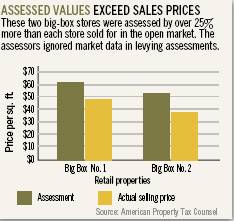
The accompanying chart demonstrates the difference between the assessor's valuation of two big-box stores based on his narrow definition of highest and best use and the actual selling price of those same stores in the open market.

The assessor defined highest and best use as that use being exercised by that specific retailer. That definition led the assessor to value big-box store No. 1 at $62 per sq. ft. and big box store No. 2 at $58 per sq. ft. Actually, store No. 1 sold to another retailer for $49 per sq. ft. and store No. 2 was bought by a different retailer for $38 per sq. ft.By narrowly defining highest and best use, the assessor ignored market data and over assessed the property.

The relevance of a comparable sale's highest and best use was addressed in the case of Newport Center v. City of Jersey City. The New Jersey Tax Court held that a comparable sale should be admissible evidence of value, regardless of its highest and best use, if the claimed comparable sale provides logical, coherent support for an opinion of value.

Many jurisdictions want to effectively reinstate value to the owner, in legal terms called "value-in-use," as the lawful standard for property tax valuations, thereby inflating assessments by eliminating from consideration the sales-comparison approach to value. In the sales comparison approach, sales often provide the best indication of a big box or manufacturing property's market value.

Sales prices reflect loss in value from replacement cost due to obsolescence. That obsolescence generally includes a significant amount of external obsolescence, which represents loss in value caused by some negative influence outside the property.

For example, external obsolescence could result from limited market demand for a big-box store or manufacturing plant built to meet the needs of a specific user. Value may also be adversely influenced by functional obsolescence, a loss in value due to design deficiencies in the structure, such as inadequate ceiling heights, bay spacing or lighting.

Shapiro_Big_Boxes_NREI_Dec07_clip_image002

What's a comparable sale?

Appraisers are taught to only use sales comparables with the same or similar highest and best use to that of the property being appraised. However, even this limitation is too restrictive.

For example, years ago a former automobile assembly plant was offered for sale and eventually sold for demolition and construction of a shopping center. No automobile manufacturer, or for that matter any other manufacturer, was willing to pay more for this property than the developer who bought it to build a shopping center.

Thus, the market spoke and defined the market value of the former automobile plant. In short, if a property is physically similar to the property being valued, but sells for an unusual use, that sale should not necessarily be disregarded as a comparable sale.

The sale of the former automobile assembly plant for use as a shopping center may not be the ideal comparable sale to value industrial property. However, that sale certainly puts a cap, or limit, on the value of a similar industrial facility, subject of course to adjustments for relevant differences such as location or size.

By understanding the issues involved in using comparable sales to achieve market value assessments, taxpayers can successfully appeal property tax assessments when they are based on the misuse of highest and best use.

SHAPIRO_Michael2008Michael Shapiro is a partner in the law firm of Honigman Miller Schwartz and Cohn LLP, the Michigan member of American Property Tax Counsel (APTC). He can be reached at mshapiro@honigman.com.

Continue reading
Dec
08

Freeze Act May Reduce Your Property Taxes

"When the taxpayer rejects the protection of the Freeze Act, they must file a tax appeal and prosecute it in the normal course of events. More often than not, a taxpayer thinks twice, or maybe more, about rejecting the Freeze Act's protection, since filing tax appeals requires significant expenditures of time and capital."

By John E. Garippa, Esq., as published by Real Estate New Jersey, December, 2007

New Jersey taxpayers have long struggled against high tax assessments and property taxes imposed by the tax authorities. Historically, even when taxpayers successfully reduced high assessments, there were taxing jurisdictions that filed appeals year after year to increase those reduced assessments. Despite the fact that a taxpayer successfully reduced his assessment in a court proceeding, there was nothing to prevent an increase in assessment for the following tax year.

As a result of this abuse of the system, the Legislature passed New Jersey Statute 54:51A-8, a law commonly referred to as the Freeze Act. The single greatest defensive tool any taxpayer in New Jersey can employ, it was passed to protect taxpayers from the need to file and prosecute annual tax appeals. Now more than ever, it has become crucial that taxpayers have a clear understanding of how the Freeze Act works and under what conditions it may not work.

For the Freeze Act to apply, a final judgment by the Tax Court must have been rendered regarding a real property tax assessment, and that judgment must be binding and conclusive on all parties, including the taxing district and municipal assessor. Generally, the Act makes that final judgment of the Tax Court binding for the next two successive assessment years.

However, exceptions exist to this general rule. If the taxpayer's property increased in value more than the general rate of increase in value of all other property in that taxing jurisdiction, the jurisdiction must file an appeal to void the Freeze. For the most part, the Tax Court has strictly interpreted this change in value standard in a manner that protects taxpayers.

The appeal process requires the tax authority to take two steps. In the first, they have to prove an increase in value more than other properties in the area. Second, they still bear the burden of proof in substantiating the correctness of their valuation of the property.

Some unusual external changes have precipitated the voiding of the Freeze Act protection. For instance, the increase in value of property in close proximity to the proposed casino district in Atlantic City gave rise to an increase in property value that voided the Freeze Act protection.

Another example of how the Freeze act was voided involved the development of a super regional mall near a commercial property that was protected under the Freeze Act. The court concluded that the construction of the super-regional mall and the development of the casino district in Atlantic City, in each instance, caused a substantial change in property values to commercial property in those vicinities.

The following four other conditions cause the Freeze Act to be voided: A complete reassessment or revaluation of all property in the taxing jurisdiction, the subdivision of a property, a zoning change to the property and any construction change to the property that results in an added assessment. In each of these conditions, the taxing jurisdiction merely asserts that one of these is met at the subject property. No need then exists for the court to determine if a change in value has occurred.

In certain circumstances, the taxpayer may determine that it is in their best interests to waive the protection of the Freeze and seek an even lower assessment. This situation may take place where real estate values continue to deflate. When the taxpayer rejects the protection of the Freeze Act, they must file a tax appeal and prosecute it in the normal course of events. More often than not, a taxpayer thinks twice, or maybe more, about rejecting the Freeze Act's protection, since filing tax appeals requires significant expenditures of time and capital.

The use of the Freeze Act and the decision to waive its protection requires an exercise of professional due diligence, which calls for the taxpayer to appraise the property to determine whether continued erosion in the value of the property or a change in the ratio of assessment to value in that taxing jurisdiction has been experienced. If a review of either of these determinants indicates that the property continues to be over assessed, it might be prudent to forsake the protection of the Freeze Act and proceed in filing an appeal.

However, this is not a step to be taken lightly because, in dealing with New Jersey property taxes, prudence is often the better part of valor.

GarippaJohn E. Garippa is a senior partner of the law firm of Garippa, Lotz & Giannuario of Montclair and Philadelphia. He is also the president of the American Property Tax Counsel, the national affiliation of property tax attorneys, and can be reached at john@taxappeal.com.

Continue reading
Dec
08

421a Changes Increase Property Taxes

By Joel R. Marcus, Esq. as published in Real Estate New York, December 2007

The new law also curtails exemption benefits for as-of-right areas

"The new law, however, greatly expanded the exclusion zones throughout the city to include all of Manhattan and most of Brooklyn's Carroll Gardens, Cobble Hill, Boerum Hill, Park Slope, Sunset Park and Downtown Brooklyn; along with parts of Long Island City, Astoria, Woodside, Jackson Heights and Willets Point in Queens."

On Aug. 24, Gov. Eliot Spitzer signed into law three bills that dramatically revamped New York City's 421a exemption program. The program was created in 1971 to encourage the construction of new multifamily dwellings by granting a partial exemption from increases in real estate taxes resulting from the new residential construction.

The new law compared to the old law. The previous law covered only projects commend prior to July 1,2008 and made 421a benefits available in any area of the city, except for those areas identified as geographical exclusion areas. The areas not classified as exclusion areas are commonly called "as-of-right' areas. The exclusion areas generally included portions of Manhattan between 14th and 96 th streets and the Williamsburg-Greenpoint areas of Brooklyn. Projects qualified for benefits in the exclusion zones if at least 20% of the units were created as affordable housing or if the developer purchased negotiable certificates for creation of affordable housing units off-site.

The new law, however, greatly expanded the exclusion zones throughout the city to include all of Manhattan and most of Brooklyn's Carroll Gardens, Cobble Hill, Boerum Hill, Park Slope, Sunset Park and Downtown Brooklyn; along with parts of Long Island City, Astoria, Woodside, Jackson Heights and Willets Point in Queens. Projects started between July 1,2008 and Dec. 27,2010 in these areas qualify for benefits only if at least 20% of the building's units are affordable to families whose income at initial occupancy doesn't exceed 60% of the area median income.

The new law reduces 421a benefits outside the exclusion zones. The controversy surrounding the new citywide exclusion zones may obscure the fact that the new law dramatically curtails 421a exemption benefits for as-of-right areas.

Under the old law, all assessment increases in excess of the pre-construction assessment, commonly known as the mini-tax, were exempt. Under the new law, benefits for as-of right projects are restricted to the first $65,000 in assessed valuation per dwelling unit. The cap increases by 3% each year, beginning in 2009/10. For the current tax year, the cap is equal to $7,750 in actual taxes per unit ($65,000 x 11.928%).

The new law also dramatically reduces tax benefits for nonresidential space in new multifamily dwellings. Under the old law, up to 12% of the building area could be used for commercial purposes, without loss of exemption. Developers often incorporated valuable retail space in their buildings to lease at market rates while enjoying full 421a exemption benefits. Under the new law, all commercial space in a building is considered one unit and is subject to the $65,000 exemption cap, greatly reducing the tax break for commercial space.

To demonstrate the effect of the exemption cap, consider a new 100,000-sf condominium building with 100 dwelling units and one retail unit constructed in an as-of-right area. The building includes 12,000 sf of retail space and carries a $100,000 mini-tax. The completed building is assessed for $1 5 million. Under both the old and new laws, the project would qualify for a 15-year exemption benefit.

Under the old law, taxes during the construction period and for the first 11 years after completion equaled the mini-tax multiplied by the tax rate. Assuming that the 2007/08 tax rate of 11.928% remains in effect, annual taxes for the entire building would equal $1 1,9280 approximately $118 per residential and retail unit. The exemption would not be affected by the retail space as it does not exceed 12% of the building's floor area. Under the new law, taxes for the entire building, including the retail space, would still be the same mini-tax ($100,000) each year during construction. However, for the first 11 years after construction is completed, the 101 - unit building would be subject to the exemption cap, as adjusted. For the first year, only $6,565,000 (101 units x $65,000) of the building's $15-million assessment qualifies for exemption. Taxes for the fiat year of the benefit period would exceed $1 million for the building or approximately $9,960 per residential and retail unit, a 1,000% increase. The new law will likely affect the feasibility and pricing of all new projects.

MarcusPhoto290Joel R. Marcus is a partner at the law firm of Marcus & Pollack LLP: a member of American Property Tax Counsel, an affiliation of property tax attorneys. He can be reached at jmarcus@marcuspollack.com.

Continue reading
Nov
14

Property Tax Bills Arrive, as Does the Deadline to Appeal

Frustrated by your assessment? You've got until Dec. 31 to fight it.

"To successfully appeal, you need to prove that the actual price for which you could sell your property, its "real" real Market value, is below the assessed value. How do you determine the real market value?"

By David Canary, Esq., as published by Daily Journal of Commerce, November 14th, 2007

Your property tax bills have arrived in the mail and, understandably, you're upset with the amount you're paying on your real and personal property. But there is some good news: You have a right to appeal.

So, what are you appealing? Unfortunately, not the tax itself. The amount of property tax you pay cannot be the basis for an appeal. A property tax is the product of multiplying two numbers, the tax rate and the assessed value of the property. Measure 5 limits the tax rate to 1.5 percent of real market value plus any local option property tax. Only in very limited circumstances may property owners challenge the rate.

What you are appealing is the property's assessed value. The assessed value is the lower of two figures: the maximum assessed value (MAV) or the real market value (RMV) of the property.

Under 1997's Measure 50, except for six exceptions, assessed value cannot increase more than 3 percent per year — which becomes the property's maximum assessed value. Real market value, on the other hand, is the amount the property would sell for between a willing buyer and a willing seller in the open market in an arm's length transaction.

Both the real market value and the assessed value appear on the property tax bill. Typically, the assessed value will be below real market value, in which case you are being assessed on the property's maximum assessed value.

To successfully appeal, you need to prove that the actual price for which you could sell your property, its "real" real Market value, is below the assessed value. How do you determine the real market value? First, if you recently bought the property for less than the assessed value, the sale price is a good indication. However, don't base your appeal upon the assessed value of other properties. The Oregon Tax Court has ruled that the assessed value of other properties isn't a sufficient legal basis for seeking a property tax reduction.

An examination of the income generated by your income-producing property may give you an indication that the assessed value is too high. Income may be generated by lease or rental rates of commercial real estate or, in the case of owner-occupied industrial property, by the cash flow generated by the operating facility. If the income generated from the property is far below the expected rate of return of the debt and equity capital invested in the property, this may indicate that the property is over-assessed because it suffers from functional or economic obsolescence.

The best evidence of the property's real market value is an appraisal by a qualified expert for property tax purposes. It may be that your property has been appraised already for other purposes — insurance, partnership buyout, or estate planning purposes. These appraisals may give you an indication whether the assessment of your property is inappropriately high. But appraisals for property tax purposes require that the appraiser render an opinion of the real market value of the fee simple interest of the property as of January 1 st of the tax year. An insurance appraisal that estimates insurable or replacement value is not sufficient. Likewise, an appraisal for estate planning or investment purposes may not fit the requirements necessary for an appeal.

A competent appraiser will determine the real market value of the property by use of one or more of the three approaches to value: the cost approach, the sales comparison approach, and the income approach. The cost approach adds the land value to the depreciated cost of the property's improvements. The sales comparison approach compares the sale price of comparable properties with the property being appraised and makes adjustments for any differences between the two. Finally, the income approach capitalizes either the market rental rate or the cash flow of the property by an appropriate rate of return that reflects the return on, and return of, the investment.

Taxpayers who own residential or commercial properties must first appeal their assessments to the County Board of Property Tax Appeals. Owners of the industrial property can either appeal to county bard, or appeal directly to the Magistrate Division of the Oregon Tax Court. However you chose to proceed, please remember that your appeal must be filed no later than December 31, 2007.

Canary90David Canary has specialized in state and local tax litigation for the past 18 years. He has worked for the past 13 years as an owner in the Portland office of Garvey Schubert Barer and prior to that was an assistant attorney general representing the Oregon Department of Revenue. He has the distinction of trying several of the largest tax cases in Oregon's history. He is the Oregon member of American Property Tax Counsel and an active member of the Association of Oregon Industries' Fiscal Policy Council. He can be reached at dcanary@gsblaw.com or 503-228-3939.

Continue reading
Nov
11

Cha-Ching

"The Kentucky General Assembly authorized cities and urban county governments to establish programs that grant property tax moratoriums for existing residential or commercial properties "for the purpose of encouraging the repair, rehab, restoration or stabilization of existing improvements."

By Michele M. Whittington, Esq., Bruce F. Clark, Esq., as published in Midwest Real Estate News, November, 2007

The Louisville-Jefferson County Metro Government offers a property tax incentive designed to encourage redevelopment of economically-blighted properties. While not a widely advertised offer, property owners and developers should be aware of this opportunity to reduce their property taxes.

The Kentucky General Assembly authorized cities and urban county governments to establish programs that grant property tax moratoriums for existing residential or commercial properties "for the purpose of encouraging the repair, rehab, restoration or stabilization of existing improvements." This program was established as the result of an amendment to the Kentucky Constitution passed in 1982 by Kentucky voters.

In 1983, Jefferson County was one of the very few local governments to implement the newly passed legislation, and in 2003, the then-merged Louisville-Jefferson County government continued the program. In essence, it encourages redevelopment of existing properties by "freezing" for five years a property's tax assessment at pre-rehab levels. Unfortunately, the moratorium applies only to the "county" portion of the tax assessment, which currently amounts to $0.125 per $100 of assessed value. Efforts to extend the moratorium to other portions of the total property tax assessment have thus far been unsuccessful. Nevertheless, the moratorium presents an additional incentive for a property owner to rehabilitate an eligible property.

The moratorium program is jointly administered by the Jefferson County Property Valuation Administrator ("PVA") and the Louisville-Jefferson County Metro Government's Inspections and Licensing Department ("IPL"). The eligibility requirements for the moratorium are relatively straightforward. First, the existing residential or commercial structure(s) must be at least twenty-five years old. Second, either (a) the cost of the repair or rehab must be at least twenty-five percent of the pre-rehab value (as determined by the PVA's assessment); or (b) the property must be located within a "target area," an economically-depressed area based on residents' income. In the latter case, the cost of the repair or rehab must be at least ten percent of the pre-rehab value.

A property owner wishing to apply for the moratorium needs to submit an application to the IPL. In addition to other requirements, the application must include proof of the building's age, a description of the proposed use of the property, a general description of the work that will be performed to repair or rehabilitate the property and a schedule for completion of the proposed work. The owner should also obtain the necessary building permits and submit them to IPL. Once the application has been submitted, the owner has two years to complete the project. Upon completion of the project, the owner notifies the IPL, which inspects the property for compliance with the rehab plan set out in the application. If the project has been successfully completed, the IPL notifies the PVA, and they issue a moratorium certificate.

The moratorium's benefits can be calculated by determining the difference between the property's pre-rehab and post-rehab value. The PVA certifies the pre-rehab assessment of the property as part of the application process. Once the project is completed, the PVA reassesses the property at the higher post-rehab value; however, with the moratorium in place, the assessment for the county portion of the taxes will be "frozen" at the pre-rehab value. For example, assume that a developer purchases a qualifying property for $1,000,000. After rehab, the PVA reassesses the property for $10 million. With the moratorium in place, the assessment remains at $1,000,000 for purposes of the county portion of the tax, while the assessment for all other property taxes (state, school and others) increases to $10 million. The resulting tax savings for the property add up to approximately $11,250 per year for five years, or a total tax savings of over $55,000.

Property owners considering rehab of an eligible property should pay particular attention to the pre-rehab assessment. If the owner believes the property may be over-assessed, she should meet with the PVA and present evidence of the true value of the property prior to applying for the moratorium. Given the fact that the moratorium freezes the assessment at the pre-rehab value, a decrease in the assessment results in a corresponding increase in the tax savings, once the moratorium certificate is issued.

Conversely, a developer planning to purchase a property for redevelopment should be aware that the PVA's pre-rehab assessment will most likely be governed by the price the developer pays for the property, rather than by the pre-purchase assessment. Using the previous example, assume that a developer purchases a property for $2 million. Prior to the purchase, the PVA had the property assessed at $1 million. The PVA will inevitably pick up the purchase price from the deed and will reassess the property at $2 million, thus decreasing the tax benefit gained from the moratorium.

In any case, owners and developers should be aware of the moratorium process in order to take advantage of the potential tax savings on eligible properties.

MWhittington

Michele M. Whittington is Counsel in the Frankfort office of Stites & Harbison, PLLC, the Kentucky member of American Property Tax Counsel, the national affiliation of property tax attorneys. Michele Whittington can be reached at mwhittington@stites.com.

ClarkBruce F. Clark is a Member in the Frankfort office of Stites & Harbison, PLLC, the Kentucky member of American Property Tax Counsel, the national affiliation of property tax attorneys.He can be reached at bclark@stites.com.
Continue reading
Oct
09

Taxpayers beware! Property Bills Come This Month

"When you receive your tax statement, determine if the property belongs to you and if you are responsible for the payment of taxes."

By David Canary, Esq., as published by Daily Journal of Commerce, October 9th, 2007

By statute, county assessors must deliver property tax statements to taxpayers by Oct. 25 of each year- just before Halloween. This requirement applies to all property, real or personal, whether owned by homeowners or utilities. To avoid any unpleasant surprises, it is important that taxpayers understand and carefully review their tax statements.

If you don't receive a tax statement for property you own and you're responsible for the payment of taxes, contact the county assessors office to determine if the assessor is unaware of a recent change of address or ownership.

When you receive your tax statement, determine if the property belongs to you and if you are responsible for the payment of taxes. If there has been a recent sale of the property, the assessor may not have noted the change of ownership, Taxpayers have a duty to now the assessor of changes in title and changes in address. Do not assume the new owner, or lessee of the property (in the case of a triple net lease), will pay the property taxes.

Review the real market value and assessed value appearing in the upper left corner of the tax statement. The assessor calculates a real market value for both land and improvements for the current and previous tax years. Below the total real market value is the assessed value for the total account for the current and previous years.

The assessed value may be less than the total real market value, but it may not be more. This is because Measure 50 requires the assessor to calculate two values — the real market value and the maximum assessed value. The lesser of the two values is the assessed value — the value upon which you pay taxes. If the assessed value is less than the real market value, generally, the real market value has no effect upon the property taxes you pay. Next, it is important to compare the assessed value for the current tax year to the assessed maximum assessed value cannot increase more than 3 percent above the property's assessed value from the prior year. There are exceptions, and the taxpayer must investigate to determine if they apply.

A property's maximum assessed value may exceed the 3 percent cap if the new property or improvements were added. Minor construction or general ongoing maintenance and repair does not constitute new property or an improvement.

Further, the improvements must have been made since the last assessment. Improvements made to the property three or four years ago cannot be added to the tax roll under Measure 50 although assessor may add them as omitted property.

Finally, it is the real market value of the new property or new improvements not the cost that is added to the tax rolls under this exception. This is particularly important if the improvement was a major but necessary repair that did not necessarily add value to the property.

Partitioned or subdivided property may be reassessed by the assessor and with some limitations, the reassessment may increase the assessed value by more than 3 percent. Likewise property that has been rezoned may be reassessed and the assessed value increased, but only if the property is used consistently with the rezoning. However, the total assessed value of properties subject to a lot line adjustment should not be affected by the adjustment by more than 3 percent.

The value of property that is added to the tax roll for the first time as omitted property, or property that becomes disqualified from exemption of special assessment, may increase the previous years assessed value by more than 3 percent under Measure 50. Finally, taxpayer that own or lease business personal property should carefully review their tax statements to determine if any penalties have been assessed. Taxable personal property must be listed, and reported to the assessor by March 1 of each year. If the personal property return is not filed timely, the taxpayer may face penalties up to 50 percent of the taxes due.

Under new legislation, upon application to either the assessor or the Board of Property Tax Appeals, under certain circumstances a taxpayer may obtain a waiver of the penalties. Taxpayers who believe their property has been improperly assessed should contact the assessor immediately. The assessor has the discretion to change the tax roll after it's finished, provided the change reduces the value of the property. But only payers who are vigilant and know their rights scan avoid those nasty Halloween surprises.

Canary90David Canary has specialized in state and local tax litigation for the past 18 years. He has worked for the past 13 years as an owner in the Portland office of Garvey Schubert Barer and prior to that was an assistant attorney general representing the Oregon Department of Revenue. He has the distinction of trying several of the largest tax cases in Oregon's history. He is the Oregon member of American Property Tax Counsel and an active member of the Association of Oregon Industries' Fiscal Policy Council. He can be reached at dcanary@gsblaw.com.

Continue reading
Sep
11

What's Fair Market Value?

"Despite the law, there appears to be one abiding maxim that all tax assessors observe: Every high sale price represents a market value sale, and every low sale price is seen as a distress sale."

By John E. Garippa, Esq., as published by Real Estate New Jersey, September 2007

New Jersey, as in most other jurisdictions in the US., all real property must be valued and assessed based on market value. It's the law. Market value is defined as the price paid by a willing buyer to a willing seller, each acting knowledgeably, without duress.

Despite the law, there appears to be one abiding maxim that all tax assessors observe: Every high sale price represents a market value sale, and every low sale price is seen as a distress sale. Further, every high sale can be relied upon to set an assessment and every low sale must be disregarded because it took place under distress. However, the real issue revolves around: Is every sale a market event that represents fair market value for assessment purposes? The Tax Court of New Jersey has focused on this issue and determined that a category of events exists that rule out a sale as a reliable indicator of fair market value for assessment purposes.

A transaction set up as a 1031 tax-free exchange represents one such category identified by the Tax Court. Under 1031, sellers of investment-grade real estate may defer paying capital gains by using the proceeds from one sale as an investment in another similar property or properties. The seller has 180 days from the original closing date to complete the exchange. Also, within 45 days of closing, the taxpayer must provide the IRS a list of three or more potential replacement properties.

In a recent case, the Tax Court agreed with the taxpayers arguments that his 1031 sale price was significantly higher than market value. The court concluded that the sale price was motivated by tax and business issues rather than typical real estate motivations. The court also concluded that the tax free exchange laws placed enormous pressure on a seller to conclude a transaction within 180 days. Fundamentally, the sale took place primarily to defer gains from another sale.

Another category of sales rejected by the Tax Court compromise those that have not been properly marketed. For example, a Fortune 500 company sold a corporate headquarters for $16 million. The sale was conducted via sealed bids over a short period of time. The bid package included language that prohibited the bidders from changing any of the sale terms. The court determined that the bid package was not sent to all potential buyers. As a result of these perceived defects in marketing the property, the court rejected the sale price and concluded to a market value of $49 million.

In contrast to the prior set of facts, the Tax Court has also concluded that the sale of a complex property can be market value. In another case, an oil refinery was sold after it was marketed for more than 18 months. The owner hired an investment banker to market the property. The investment banker identified all of the potential buyers. Comprehensive information packages identifying the property were transmitted all over the world. At the end of this marketing period, the seller received two bids, eventually resulting in a sale. The court concluded that such a significant amounted to a valid sale that could be used to value the property for tax assessment purposes.

Some of the same arguments made with regard to 1031 property can also be advanced for high purchase prices paid by REITs. REITs offer significant tax advantages to shareholders; however, they must meet strict tax requirements in order to qualify for that status. A RElT must distribute 90% of its income to shareholders. Thus, in order for a RElT to grow, it must continually purchase properties, as it cannot grow via the normal accumulation of cash.

Growth is critical because it leads to higher stock prices and allows for more diversification in the portfolio. Additionally, REITs use capital markets to which most other buyers do not have access. These large capital markets fund REIT purchases at low interest rates that further the aims of the REIT. All of these issues would normally cloud the price paid by a "willing buyer, acting without duress."

In an era characterized by unusually high sales prices, tax payers need to remember an important caveat: Even the New Jersey Tax Court recognizes that not every sale represents fair market value for tax assessment purposes. Owners involved in transactions with high sales prices need to carefully examine their property tax assessments to determine whether a valid market price was used in levying their assessment.

GarippaJohn E. Garippa is a senior partner of the law firm of Garippa, Lotz & Giannuario of Montclair and Philadelphia. He is also the president of the American Property Tax Counsel, the national affiliation of property tax attorneys, and can be reached at john@taxappeal.com.

Continue reading
Jul
11

How to Fight High Property Taxes

"A sale involving a first-generation lease is more a financing operation than a transaction in real estate. In the past, many single-tenant real estate users — often retailers not wanting to tie up capital — financed their real estate through sale-leaseback transactions where they recouped the capital costs by inflating both rent and the corresponding sale price."

By Kieran Jennings, Esq., as published by National Real Estate Investor, Summer Special Edition, July 2007

In a build-to-suit transaction, the value of the property to the user who had it built is greater than the value that property holds for the next user.

For instance, a store built as a McDonald's would not have the same value to a Taco Bell. Although both users are fast-food chains, the layout, design and exterior appearance all work to identify, market or assist the first occupant's business.

The decrease in value from the original user to the subsequent user represents built-in obsolescence. Failure to recognize this obsolescence often subjects first generation owners to excessive property tax assessments.

A triple-net-lease property that was a build-to-suit may be sold to a new owner, even if the original user remains the tenant. In this case, the sale price reflects the value of the tenant's lease. The assets involved in the purchase include both the lease and the real estate.

Because the revenue created by the lease primarily drives the price of the deal, an assessment based on sale price can result in an illegal assessment when it is based on the value of the property to the user.

Fighting back

The first step in reducing improper taxes requires that owners prove to the assessor or the courts that the rent and/or sale represent value to the user, not the market value of the property. The next task is to prove actual market value for the real estate.

A sale involving a first-generation lease is more a financing operation than a transaction in real estate. In the past, many single-tenant real estate users — often retailers not wanting to tie up capital — financed their real estate through sale-leaseback transactions where they recouped the capital costs by inflating both rent and the corresponding sale price. This practice is still prevalent today. The user currently has a relationship with a local developer who will acquire the site and build the property on behalf of the user to suit the user's needs. As with a sale-leaseback transaction, the user will enter into a long-term lease based on the costs of building the property to meet the user's specific needs.

The developer then either retains the property or sells it with the lease in place. Thus, the tenant has outsourced to the developer the financing, site selection, construction and other exterior and interior finishes. The third-party purchaser sees the transaction as essentially buying a bond secured by real estate.

Until the first-generation user vacates the property and the real estate is exposed to the open market, the real estate value has not been tested. Furthermore, because the lease drives the sales price of a net-lease property, only a second generation lease reveals true market value and produces a correct assessment.

Case study makes the point

Data from a recent drug store case illustrates the difference in first- and second generation leases for comparable properties built as national retail drug stores. The average drop of $19 per sq. ft. in rent from the first-generation user to the second generation illustrates the difference between value in use and market value.

The difference is due to obsolescence, a fact first-generation tenants must demonstrate to assessors. Data like that shown in the accompanying chart prove the existence and value of the obsolescence.

JenningsNREI_Fair_Taxation_clip_image002Not only are the rents affected by the first-generation tenant, the capitalization rate is significantly lower than market rates. The net-lease market into which these properties are sold is among the most active and developed in the real estate market, allowing for substantial liquidity, efficient pricing, and tax deferral through 1031 exchanges.

As a result, the capitalization rates have been reduced to exceedingly narrow margins. Therefore, cap rates derived from sales of first-generation property should not be used in determining assessments.

Proving market value

Assessment laws generally provide that property must be valued using market terms and conditions. Therefore, market rents, those paid by tenants in comparable properties, not contract rents, those paid by the net-lease tenant, determine the income attributable to the real estate.

The difference between market rents and contract rents demonstrate the amount of the obsolescence. Furthermore, the differences in sales prices of property from first-generation users to the next generation can also be used to prove obsolescence.

The road to a fair and honest assessment is not easy, but as illustrated in the accompanying chart, the difference between use value and market value can be substantial.


KJennings90J. Kieran Jennings, partner at Siegel Siegel Johnson & Jennings, a law firm with offices in Cleveland and Pittsburgh. The firm is the Ohio and Western Pennsylvania member of the American Property Tax Counsel, the national affiliation of property tax attorneys. He can be reached at kjennings@siegeltax.com.

Continue reading

American Property Tax Counsel

Recent Published Property Tax Articles

The Commercial Property Tax Rebellion

The property tax system in the United States, which traces its roots to colonial America, has long been the life blood of local government finance. Used to fund schools, infrastructure and vital municipal services, it is also a system fraught with controversy and mounting calls for reform.

Over the past...

Read more

How to Achieve Fair Valuation of Renewable Energy Facilities

As renewable energy assets become more prevalent in commercial real estate portfolios – especially among industrial and data center users – property owners face a critical challenge: ensuring that intangible assets are not mistakenly included in the taxable value of real and personal property.

Wind farms, solar installations, battery energy storage...

Read more

Taxing Real Estate On Redevelopment Prospects

When a property's current use isn't highest and best, New Jersey jurisdictions can assess and tax based on hypothetical redevelopment.

It's hard to imagine a more dystopian world than one in which governments base real estate tax upon a hypothetical use other than a property's current and actual use. Unfortunately, taxing...

Read more

Member Spotlight

Members

Forgot your password? / Forgot your username?