Menu

Property Tax Resources

Oct
17

Bay Area Real Estate Recovery Creates Property Tax Appeal Opportunities

The uneven recovery of the Bay Area real estate market over the past year has created opportunities for real estate owners to challenge their property tax assessments. Areas that have experienced the strongest growth, as well as markets in which the recovery is lagging, may be ripe for challenges to property tax assessments.

By Cris K. O'Neall, as published by National Real Estate Investor - Online, October 2012

Pregnant propositions

Under California's Proposition 13, property taxes are based on the purchase price paid for a property or on the cost of constructing the property. Thereafter, Proposition 13 caps value increases (and property tax increases) at 2 percent annually.When property values decline, Proposition 8, the bookend to Proposition 13, requires county assessors to reduce taxable property values below Proposition 13 value caps to reflect current market conditions. As real estate values recover following a downturn, assessors restore taxable values back to Proposition 13 levels.

Over the past year or so, core Bay Area markets (primarily San Francisco and the Silicon Valley) have experienced strong growth in market rents and declines in capitalization rates, particularly as compared to other Bay Area real estate markets. Because of the brisk recovery in core markets, county assessors have aggressively moved to restore 2012 values, determined as of Jan. 1, 2012, back to Proposition 13 levels. Such value restorations can bring major increases in assessments and taxes.
ckoneall

Assessors exercise value judgment

In order to restore property values to Proposition 13 levels, California requires county assessors to evaluate market sales and rental information. In so doing, assessors consider ranges of information on sales and rentals, and exercise their judgment as to whether values should fall in the top, middle or bottom of a range.
While assessors generally determine values for residential properties using computerized mass appraisal techniques, commercial properties tend to be more complex and require individual attention by assessor staff.

This year, the assessors in San Francisco and Santa Clara County have restored property values and assessments to levels at or near Proposition 13 amounts, which, in some cases, has dramatically increased tax bills as compared to 2011. In doing so, assessors may have justified assessments using more recent rental rates or cap rates, rather than using average rates during the 12 months prior to Jan. 1, which tends to accelerate value increases.

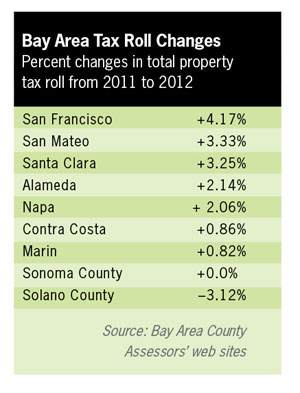
In 2012, most Bay Area counties announced increases in their property tax rolls.
The 2012 roll increases are due, at least in part, to increasing sales and leasing activity, which tend to be reflected in higher property tax values and assessments. However, these increases also reflect Proposition 13 value restorations described previously, and highlight those counties which merit increased consideration as far as whether to review and appeal property tax assessments.

Property tax appeal opportunities

The current situation presents several types of property tax appeal opportunities. First, for properties in San Francisco, San Mateo and Santa Clara counties, it is possible that assessors have been overly aggressive in restoring values to Proposition 13 levels. Taxpayers should request backup information supporting full or partial restoration of Proposition 13 levels and if the assumptions appear excessive, file an appeal.

This same advice goes for properties in secondary and tertiary markets, particularly where there have been Proposition 13 value restorations. Properties in these markets should also be reviewed, however, to determine whether they have participated in the economic recovery that San Francisco and the Silicon Valley have experienced. Economic recovery among Bay Area counties has been uneven, and hasn't benefited every city within a county consistently. In San Mateo County, for example, property values in Atherton have increased significantly, but values in East Palo Alto have continued to decline. Similarly, in Contra Costa County, values in five cities increased while in the county's remaining 14 cities values generally declined.

Finally, property owners should not assume that a "no change" assessment or that a lower assessment by the local assessor is correct. Values in some areas declined during 2011, which means that market values as of Jan. 1, 2012 may be lower than 2011 values, and should not reflect value increases that have occurred during the first nine months of 2012.

CONeall Cris K. O'Neall specializes in property and local tax matters as a partner in the law firm of Cahill, Davis & O'Neall LLP, the California member of American Property Tax Counsel, the national affiliation of property tax attorneys. He may be reached at cko@cahilldavis.com.

Continue reading
Oct
17

Contingent Fee Consultants Target Large Property Owners for Tax Increases

While the taxing jurisdictions' consultants maintain that they are not doing appraisal work or appraisal consulting work, a review of USPAP definitions suggests differently. The Uniform Standards define appraisal consulting as "the act or process of developing an analysis, recommendation, or opinion to solve a problem, where an opinion of value is a component of the analysis leading to the assignment results."

By John E. Garippa, Esq. & Brian A. Fowler, Esq., as published by National Real Estate Investor - Online, October 2012

As U.S. Supreme Court Chief Justice John Marshall observed two centuries ago, "the power to tax involves the power to destroy." That statement applies today in the Delaware Valley, where taxing jurisdictions are delegating the tax assessment function to outside consultants.

Incredibly, these consultants are compensated on a contingent fee basis for the additional tax revenue they can accumulate for the jurisdiction. In a typical contract, the fee has been 25 percent of the additional revenue received over a three-year period.

In practice, these consultants can pick and choose which properties to recommend for reassessment. It's not surprising that the most valuable commercial assets, which offer the largest potential for gain in a reassessment, attract the most attention from these bounty-hunting consultants.
Here's how the process typically works. Once consultants have determined which properties are under-assessed, the school districts file affirmative appeals to raise the assessments on the affected properties. Property owners who choose to defend their existing assessments must hire attorneys and independent appraisers at considerable cost.

This system of taxation grows less uniform with each reappraisal. And while it may seem absurd to hand over the reins of tax policy to an outside consultant, the practice is becoming routine under current Pennsylvania law.

Taxing questions

Experience has shown that at any given time there will always be disparities in tax assessments within a given jurisdiction. However, most taxpayers assume that the assessment function is being performed by tax assessors in an ethical and uniform manner, and that those assessors are not paid based on the increased revenue they find.

The increasingly prevalent use of tax assessment consultants raises serious issues that communities must address.
First, the Pennsylvania legislature has prohibited contingent fee agreements where it has deemed them to be contrary to public interest. Specifically, Pennsylvania law prohibits real estate appraisers from accepting an appraisal assignment where the fee is contingent on the valuation reached.
While consultants to taxing entities might argue that they are not appraisers, the fact that they are concluding to a value or value range arguably makes their work product an appraisal.

Second, Pennsylvania has adopted the Uniform Standards of Professional Appraisal Practice (USPAP), which can help to level the playing field for the property owner in appealing an assessment. Those rules include minimum standards for the retention of records, referred to as the "record-keeping rule." An appraiser or consultant must prepare a work file for each appraisal, appraisal review or appraisal consulting assignment.

A work file must exist prior to the issuance of any conclusion, and a written summary of any oral report must be added to the work file within a reasonable time after the issuance of the oral report. Any appraiser or consultant who willfully or knowingly fails to comply with the obligations of this record keeping rule is in violation of the state's ethics rule.

While the taxing jurisdictions' consultants maintain that they are not doing appraisal work or appraisal consulting work, a review of USPAP definitions suggests differently. The Uniform Standards define appraisal consulting as "the act or process of developing an analysis, recommendation, or opinion to solve a problem, where an opinion of value is a component of the analysis leading to the assignment results."

The Uniform Standards also indicate that an appraisal may be numerically expressed as a "range of numbers or as a relationship (e.g. not more than, nor less than) to a previous value opinion or numerical benchmark (e.g. assessed value, collateral value)." Clearly, concluding that certain properties are under-assessed requires a conclusion of value and a comparison to an existing assessment benchmark. The point is, if it looks like a duck, walks like a duck, and quacks like a duck, it is a duck--or in this case, an appraisal.

Allowing consultants to wander the tax lists on the basis of bounty hunting for under-assessed properties is essentially a free trip for the taxing authorities, which bear no burden of cost. When the targets are identified and appeals are filed to increase the assessments, the consultants are rewarded for their efforts by being paid a fee contingent on whatever additional revenue is raised.

If taxing authorities had to fund these efforts on an ongoing basis, rather than on a contingent fee basis, much of this bounty hunting would end. Moreover, if state licensing authorities would examine this conduct under existing appraisal law and the Uniform Standards, the inevitable conclusion would be that appraisal consulting services are taking place. Again, this would serve to restrain the current, unbridled practice of targeting large taxpayers.


Garippa155 John E. Garippa is senior partner and Brian A. Fowler is an associate in the law firm of Garippa, Lotz & Giannuario with offices in Montclair, N.J., the New Jersey member of the American Property Tax Counsel, the national affiliation of property tax attorneys.
FowlerPhoto90  
Continue reading
Sep
28

What Revaluation Means for Chicago

"In Chicago specifically, the most telling statistic may be the lack of property sales. From an average of 50,000 to 55,000 Cook County sales per year in the boom years, sales in the last three years have not exceeded 5,500 per year..."

By James P. Regan, Esq., as published by National Real Estate Investor - Online, September 2012

Cook County, Ill. systematically revalues all properties for taxation every three years, and 2012 is the reassessment year for Chicago. The last revaluation took place in 2009, shortly after the collapse of Lehman Brothers and the beginning of the Great Recession. The county has already sent reassessment notices to real estate owners in the northern sections of Chicago and will notify those in the rest of the city of the proposed assessed value of their properties over the next six months. The 2012 assessment will be used to determine each Chicagoan's real estate taxes through 2014.

Homeowners and business owners alike should pay close attention to this year's revaluation. Real estate has undergone a significant value loss since 2008, and that alone makes the 2012 revaluation a defining event for Chicago's property owners.

Assessment officials strive to make the process as transparent as possible, and the notices contain a wealth of information about the property and its assessment history. At neighborhood meetings throughout the city, officials stress that the proposed 2012 assessment contained in the notice is only the first step in a process, and that every taxpayer has the opportunity to provide evidence which shows that the proposed assessment inaccurately reflects the property's value. The assessor calculates values using mass appraisal techniques applied to data amassed on all segments of the city's real estate markets, but recognizes that each property is unique and that market data can be made more precise by information provided by the property owner.

Despite the efforts at transparency, the process of producing a final tax bill is not restricted solely to valuation. The budgets of local agencies funded by real estate taxes affect the bill as well.

The assessment process

Real estate taxes are an ad valorem tax, or dependent upon how much the property is worth. Illinois relates taxes to the fair cash value of the property. Simply said, the assessor must determine how much the property would have sold for as of Jan. 1, 2012. The primary purpose for assessment valuation is to determine the fair share of taxes and to assure that each property is uniformly taxed in accord with its value.

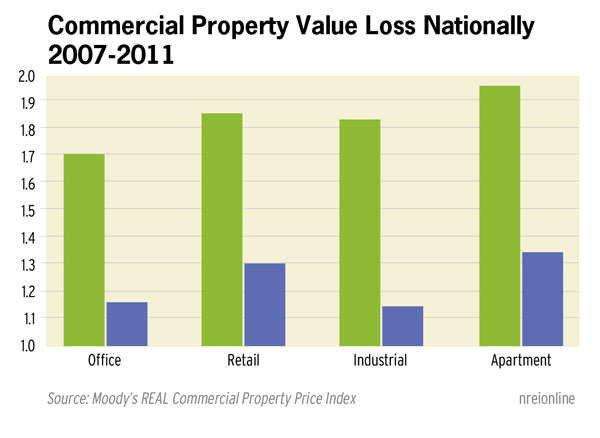
Value loss must be considered in that context. The real estate markets—residential and commercial—were at the heart of the boom of the last decade. In the last three years real estate has, in turn, felt the full force of the burst bubble. According to the Moody's REAL Commercial Property Price Index, as of the first quarter 2011, office, industrial, apartments and retail properties had all fallen back to 2003 value levels.

regan reevaluationChicago

In Chicago specifically, the most telling statistic may be the lack of property sales. From an average of 50,000 to 55,000 Cook County sales per year in the boom years, sales in the last three years have not exceeded 5,500 per year.

Office vacancy rates in the Central Business District have gone from 11.5 percent in 2008 to more than 20 percent as of the first quarter of 2012, according to MB Real Estate Services. Concessions and rent abatements continue for new tenants.

Retail rents declined from $18 per sq. ft. in 2009 to $16 per sq. ft. by 2011, according to Colliers International. And the S&P/Case-Shiller Home Prices Indices show that Chicago condominium prices in 2010 had fallen to 2002 levels, and that home prices closely followed the downturn in condos. Home prices were down 18.7 percent on an annual basis.

One could strongly argue that the decline in value, together with the paucity of sales, demands new methods to arrive at fair cash value. Income data is available to determine values more accurately determine, even for the residential and condo markets, and extraordinary times require extraordinary solutions.

The budget process

The other contributor to the real estate taxpayer's bill is the aggregate budget requirement of local schools, police, fire, county, city governmental, park districts and libraries, which determines the dollars that must be collected from real estate taxes. The assessment determines the proportion of that aggregate amount the individual taxpayer owes, based on property value.

Chicago's usage classifications further obfuscate the process: Residential properties are assessed at 10 percent of value while commercial properties are assessed at 25 percent. That triggers a state equalization factor, which is included in the computation of every taxpayer's bill. Experienced tax counsel can help taxpayers evaluate all these factors and determine whether to protest their assessment.

reganJames Regan is the managing partner of the Chicago law firm of Fisk Kart Katz and Regan, the Illinois member of the American Property Tax Counsel. He can be reached at jregan@proptax.com

Continue reading
Jun
14

Taxpayers Increasingly Use Appraisal Standards in Tax Appeals

One useful aid in arguing a property owner's appeal is often overlooked because it comes right out of the appraiser's tool box. The Uniform Standards of Professional Appraisal Practice (USPAP) can help to level the playing field for the property owner.

By John E. Garippa, as published in National Real Estate Investor Online, June 2012.

Property owners throughout New Jersey have observed that more tax appeals are headed to trial. More than ever, cases that would have been settled had they occurred a few years ago are now routinely in the litigation track.

What's behind this trend? The most significant reason is that government is under increasing pressure to preserve the municipal treasury. And as the drive for tax revenue brings more taxpayers to court, many of those property owners find an uneven playing field during litigation. The assessment is presumed to be correct until it is overcome by the preponderance of the evidence. The level of proof the taxpayer must provide to reach this standard has become increasingly more difficult to attain.

One useful aid in arguing a property owner's appeal is often overlooked because it comes right out of the appraiser's tool box. The Uniform Standards of Professional Appraisal Practice (USPAP) can help to level the playing field for the property owner. Taxpayers need to understand this set of regulations because it affords opportunities to attack the credibility of the taxing jurisdiction's presentation.

Any licensed appraiser in the state of New Jersey is subject to USPAP, which mandates that an "appraiser shall ensure that all appraisals shall, at a minimum, conform to the Uniform Standards of Professional Appraisal Practice." An appraiser's failure to comply with the provisions of USPAP may be construed to be professional misconduct in violation of New Jersey tax law.

For example, USPAP sets minimal standards for the retention of records, referred to as the "recordkeeping rule." An appraiser must prepare a work file for each appraisal, appraisal review or appraisal consulting assignment. A work file must exist prior to the issuance of any report, and a written summary of any oral report must be added to the work file within a reasonable time after the issuance of the oral report. Such a work file must include the report as well as the information used in creating the report.

The standards set time requirements as well. The work file must be retained for at least five years after preparation or at least two years after final disposition of any judicial proceeding in which the appraiser provided testimony related to the assignment, whichever period expires last. Any appraiser who willfully or knowingly fails to comply with the obligations of this recordkeeping rule is in violation of the state's ethics rule.

In further clarifying the recordkeeping rule, USPAP states that it applies to "appraisals and mass appraisal, performed for ad valorem taxation assignments."

USPAP is adopted by statute, so a violation of its standards may leave a violating appraiser susceptible to sanctions imposed by the governing professional association. In addition, New Jersey's tax statute provides explicitly that for engaging in an act of professional misconduct, the professional licensing board may penalize the offender by suspending or revoking any certificate, registration or license.

It is not unusual to find situations where appraisers are brought in to assist tax assessors in setting assessments. This is certainly understandable when complicated properties are being appraised. Now, however, as the appraiser advises the assessor as to value in setting an assessment, that advice and conclusion is now discoverable by the taxpayer. This presents a significant opportunity for taxpayers to discern the machinations behind the setting of an assessment.

Under USPAP, the appraiser must have a work file demonstrating all of the evidence relied upon to determine that value. It does not matter whether the advice given the assessor is written or oral; the work file must contain written evidence supporting the advice and conclusions given to the assessor. This now becomes a potential gold mine of information that can be used to damage the presumption of correctness of the assessment.

In another common scenario, taxing jurisdictions that rely on outside appraisers to assist the assessor in setting the assessment will typically retain those same appraisers to defend the assessments before the tax court. Because of the backlog of cases in the tax court, this means that an appraiser that originally assisted in setting an assessment could be testifying about value several years after the assessment was set.

This presents an opportunity for the taxpayer to probe the appraisal report prepared for trial and compare it to the work file prepared when the assessment was made. Was the value predetermined because of the early work in setting the assessment? Does the early work erode the conclusions of the later work?

These are all important considerations, and will significantly help to level the playing field against recalcitrant taxing jurisdictions. Appraisers who lend their licenses and credibility to taxing jurisdictions in setting assessments need to be aware that there could be a day of reckoning.

Garippa155 John E. Garippa is senior partner of the law firm of Garippa, Lotz & Giannuario with offices in Montclair, N.J. The firm is the New Jersey and Eastern Pennsylvania member of the American Property Tax Counsel. He can be reached at john@taxappeal.com

Continue reading
Mar
26

New York City's Relentless Reassessments Raise Revenue—and Eyebrows

"The New York City Charter grants property owners the right to protest their tentative assessments from Jan. 15 (or the first day following weekends and/or holidays) until March 1..."

By Joel R. Marcus, Esq., as published by National Real Estate Investor - Online, March 2012

In its 2012-2013 tax roll assessment, New York City has once again reported major increases in property values. Bucking the national trend toward flat or downward value changes, the city in January found that overall market value had grown to more than $876 billion, up by more than $31 billion from last year's record $845.4 billion.

Remarkably, the taxable assessment (approximately 45 percent of market value) is only the latest step in a relentless series of increases in the taxpayers' burden, dished out each and every year since 1995. Bar graphs of total assessed values for each year by property class reveal the linear, uninterrupted nature of the changes, with nary a hint of the variations that would be expected during the two most recent economic recessions. (See chart.)

jmarcusgraph

Last year's assessment increase provoked an angry backlash from both residential and commercial property owners. As a result of these widespread protests, the New York City Department of Finance agreed to voluntarily roll back assessments of cooperatives and condominiums (owned by voting taxpayers) that experienced assessment increases of 50 percent or more, choosing to instead limit increases on those properties to no more than 10 percent over the prior year. Properties that had received an assessment increase of 49 percent or less, however, went unchanged onto the 2011-2012 roll.

The Department of Finance had to correct 30,457 property assessments, and the Tax Commission handled 50,022 appeals covering 183,811 separately assessed tax lots. The Tax Commission's remedial actions yielded $560 million in tax relief to aggrieved taxpayers.

Repeat performance?

With the tentative assessment for the tax period running from July 1, 2012, through June 30, 2013, and showing dramatic value increases yet again for certain residential properties, there is a flurry of legislative activity promoting a new class of property for cooperatives and condominiums. As proposed, this class would have its tax increases capped at no more than 6 percent each year, the same treatment now accorded to one-, two- and three-family homes.

This legislation, if passed, still won't eliminate the precipitous disparity in taxes between apartments and homes. The cap on homes has been in effect since 1982, and now most homes are assessed at a very small fraction of their current market value.

Citywide, the taxable assessed values of one-, two- and three-family homes (Class 1) increased 3.11percent from last year's assessment. Rental apartments, co-ops and condos (Class 2) are up 5.15 percent, and office, hotel, retail and other commercial properties (Class 4) are experiencing an increase of 7.26 percent.

nyc-condo-400A red flag

A red flag

Before publication, the Department of Finance detected massive errors in the assessment roll and delayed its release. Officially, the Department of Finance cited the need "to correct an error in one of the computer systems it uses to calculate values." But insiders report that quality control issues were also a factor in the delay. On Jan. 19, 2012—two days late—the Department of Finance published the city's tentative assessment roll, covering more than 1 million separately assessed parcels of real estate.

The New York City Charter grants property owners the right to protest their tentative assessments from Jan. 15 (or the first day following weekends and/or holidays) until March 1. The law authorizes owners of one- to three-family houses the right to contest their tentative assessments until March 15. The protests must be filed during these time periods with the New York City Tax Commission, an independent city agency authorized to review and correct the Department of Finance's property tax assessments.

In announcing the delayed assessment release, Finance Commissioner David M. Frankel stated that "we will keep the roll open for an additional two days this year." The Tax Commission's legal authority to review protests filed after March 1 and March 15 is questionable, however. In the absence of remedial legislation expressly authorizing the Tax Commission to review protest applications filed after March 1 and March 15, applicants are better off assuming that the current statutory filing dates will continue to govern.

Commercial consternation

During the period after the publication of the tentative assessment and prior to the publication of the final assessment roll on May 25, the Department of Finance is permitted to increase assessed values of nonresidential properties. This authority may only be exercised until May 10, however, and only where the department has mailed written notice to the owner at least 10 days prior to May 10. The mailing of such notices after Feb. 1 extends the protest period for affected owners, who have 20 days after the notice was mailed to apply for a correction of their assessment.

In Frankel's announcement, he also mentioned that the Department of Finance is reviewing whether thousands of properties which have historically enjoyed not-for-profit exemptions remain eligible for such benefits. Previous exemptions for many properties which did not file timely renewal applications prior to Nov. 1, 2011, were removed on the tentative assessment roll, but Frankel advised that these properties can still regain their exemptions for the 2012-2013 tax year if they provide the required documentation by Feb. 13.

Joel MarcusJoel R. Marcus is a partner in the law firm of Marcus & Pollack LLP, the New York City member of American Property Tax Counsel.

Continue reading
Mar
05

Inaccurate Records Could Inflate Tax Assessments

Taxpayers should review their individual property tax records maintained by the county tax assessor to determine whether the specific facts of their property are accurate. Is the amount of acreage or square footage accurate and up to date, including any additions or demolitions that have occurred?

By Lisa Stuckey, Esq., as published by National Real Estate Investor - Online, March 2012

In this era of computer-generated recordkeeping, Georgia taxpayers should be aware of several areas in which accurate records are critical in the proper valuation of their properties for ad valorem tax purposes. While software and online filing save time, these tools also increase the opportunity for inaccuracy and unfairly high tax bills.

The importance of accurate written records begins with the initial purchase of the property. Georgia law requires property owners to report real estate sales on a PT-61 form, which is filed online with the clerk of the county superior court. This form is transmitted to the county tax assessor, who is required to consider sales in determining the fair market value of property.

Taxpayers should ask themselves if there has been a proper allocation between real and personal property. Examples of personal property include furniture, fixtures and equipment for the operation of hotels. Has there been a proper allocation of tangible vs. intangible property?

A new statute in the Georgia property tax code requires that tax assessors exclude the value of intangible assets such as patents, trademarks, trade names and customer and merchandising agreements. If the reported sale price of a real property contains these intangibles, then inflated tax valuations are likely to occur.

Sometimes there is no allocation in county records of the underlying business being acquired as part of a property transaction. For example, portfolio purchases of convenience stores or daycare centers may reflect only the aggregate purchase price and not a proper allocation of the individual components being acquired. Has there been a proper allocation of specific assets in a multi-property sale transaction? Inaccurate sale price allocation among properties purchased as a portfolio often results in improper tax valuations.

A purchaser with ownership and control of a property must make certain that internal recordkeeping is accurate, for both real and personal property. Inaccuracies can expand over time throughout the length of ownership and life of the property. For instance, owners of personal property may carry pieces of property on their books and ledgers that have been sold, disposed of, moved from the county to another facility owned by the taxpayer, or which are obsolete or no longer in use.

County tax assessors rely upon taxpayers to accurately report property held by the taxpayer in the county on Jan. 1 of each tax year by filing the business personal property tax return. If owners carry over historical purchase prices of personal property without analyzing the facts surrounding current ownership, location, and use of the individual pieces of property, the inaccuracies will result in improper tax valuations of personal property by the county tax assessor. Each passing tax year can compound problems if additional pieces of property are disposed of or moved but continue to be reported to the tax assessor as being held in the county by the taxpayer on Jan. 1.

Real property owners should periodically review and make sure their internal records are accurate. For instance, for office, apartment, retail and warehouse properties, does the software used by the taxpayer to maintain rental records accurately reflect both actual contract rents and the current market rent of the property? Dated and inaccurate market rental rates can be misleading to county tax assessors, who review taxpayer rent rolls to obtain market information used to value commercial properties.

Similarly, for hotel properties, is the actual and market room rate data accurate in all fields of the software, or have record-keepers merely carried over historical market rates that could mislead the tax assessor and cause improperly inflated valuations?

Another area of proper record-keeping involves the actual county tax records. The new Georgia statute requiring county tax assessors to issue annual tax assessment notices to every real property owner places an even greater burden on the tax assessor than in years past, which may result in more factual errors in the county property tax records.

Taxpayers should review their individual property tax records maintained by the county tax assessor to determine whether the specific facts of their property are accurate. Is the amount of acreage or square footage accurate and up to date, including any additions or demolitions that have occurred? Does the county have the correct age for the property, including all of the portions of the improvements, which may have been built at different times?

Along that line, does the county have the appropriate percentage breakdown for the various areas of use at the property, such as office vs. warehouse or rentable area vs. common area? Are the wall heights correct for all portions of the property? These are just a few examples of the type of data maintained by the county tax assessor which must be correct to assist in the accurate valuation of a taxpayer's property.

Electronic records offer many advantages. But savvy property owners invest some of the time they are saving through modern technology, and make sure that inaccurate records related to their property aren't contributing to an overstatement of their tax burden.

Stuckey Lisa Stuckey is a partner in the Atlanta, GA law firm of Ragsdale, Beal's, Seigler, Patterson & Gray, the Georgia member of American Property Tax Counsel, the national affiliation of property tax attorneys. She can be reached at lstuckey@rbspg.com.

Continue reading
Feb
12

Can the Property Tax Code Improve D.C.'s Public Schools?

It is well understood in economics that, outside of the margins, the more you tax something the less of it you get, and the less you tax something the more of it you get.

By Scott B. Cryder, Esq., as published by National Real Estate Investor - Online, February 2012

A city is unlikely to maximize its potential without attracting and retaining families with children. Yet attracting and retaining such families is perhaps the greatest obstacle the District of Columbia will face over the next several decades as it seeks to navigate the region's ongoing population boom. And while it may not seem obvious, the real estate tax code may be an effective tool to meet the challenge.

A good problem to have

According to the 2010 Census, the D.C. metropolitan area grew by 16 percent over the last decade. Among the 10 largest metropolitan areas, this was the largest percentage increase of any non-Sunbelt metropolitan area. Growth extended beyond the suburbs, as the District itself stemmed a 60-year population decline by adding nearly 30,000 new residents.

Buoyed by government spending, related contracting, a robust legal and professional field and growing technology and biomedical industries, the D.C. area is well positioned to maintain this growth over the coming decades. In fact, a recent study by the Center for Regional Analysis at George Mason University predicts that over the next two decades the population of the greater D.C. area will increase by 1.67 million people, a 30 percent increase over the current population of 5.58 million. Compared with the problems facing shrinking metropolitan areas such as Detroit and Chicago, the District is fortunate. Nonetheless, this projected growth presents significant challenges to state and local governments.

A city of hipsters and empty-nesters?

Though the District may be spared from some of the more implacable transportation issues facing its suburban neighbors, it faces its own unique set of challenges. The most glaring, long-term impediment to growth in the District is its dismal public education system. The dearth of quality public schools renders the District inhospitable to large numbers of families with school-age children. These families, who would otherwise prefer to live in the District, are forced either to decamp for the suburbs once their children are of school age or enroll them in private schools, an option that is beyond the reach of a large swath of the populace.

This lack of quality public education effectively restricts the District's appeal to a narrow demographic group of new residents—a fact that has not been lost on the multifamily developers who increasingly dominate D.C. residential development. Reacting to market conditions, these developers are focusing on delivering smaller, more affordable units in amenity-laden buildings. These units are, however, largely impractical for families with school-age children.

DC-family-600

Attracting these families presents a Catch-22 conundrum, however: The quality of public schools will improve if more diverse families move into the District, yet these families are hesitant to move into the District because of the lack of quality public schools. Solving this challenge requires innovative thinking by the District government. Policies must be enacted that simultaneously incentivize individual families to move to the District and incentivize residential developers to provide the necessary housing stock, especially in the multifamily segment. This is where a simple tinkering with the real estate tax code could pay big dividends.

It is well understood in economics that, outside of the margins, the more you tax something the less of it you get, and the less you tax something the more of it you get. This same basic principal should be applied to attracting and retaining families with school-age children. Specifically, the District should implement a child property tax credit of $1,000 for each child enrolled in D.C. public or charter schools. This credit could be claimed by either owner-occupants or landlords where the child lives.

By making this credit available to both owners and landlords, the District would not only directly motivate families to move to the District and enroll their children in D.C. schools, but it would also incentivize developers to provide the new housing necessary to support these families. This simple, easily administered tax credit would address two difficult issues simultaneously, in an efficient manner with little regulatory overhang. If the District wishes to reach its potential, it will need to enact precisely these types of policies.

Scott B. Cryder is an associate in the law firm Wilkes Artis Chartered, the District of Columbia's member of American Property Tax Counsel.

Continue reading
Jan
15

Inflated Taxes Threaten Phoenix Property Owners

The "new normal" for Phoenix is likely a prolonged era of deleveraging as the market absorbs these distressed assets. For Arizona property owners, the decline in real estate values has not always translated into a commensurate drop in taxes, however. This has occurred for three reasons..."

By Douglas S. John, Esq., as published by National Real Estate Investor Online, January 2012

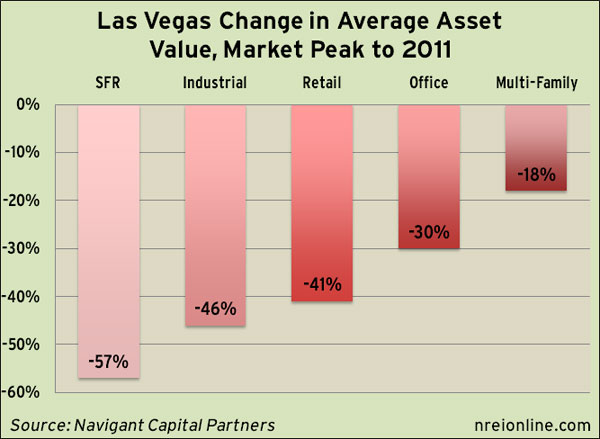
As 2012 begins, the real estate collapse ravaging Phoenix continues. Phoenix real estate prices have fallen from their height in early 2008 by 28 percent for retail, 52 percent for industrial and 71 percent for office, according to Navigant Capital Advisors, a Chicago-based investment bank. Phoenix ranks No. 7 on Real Capital Markets' list of the most distressed U.S. markets for commercial real estate.

The city's delinquency rate for commercial mortgage-backed securities (CMBS) loans is the third-highest in the nation, accounting for 3.6 percent of total U.S. CMBS delinquencies. And Phoenix's delinquency count is expected to increase next year.

The "new normal" for Phoenix is likely a prolonged era of deleveraging as the market absorbs these distressed assets. For Arizona property owners, the decline in real estate values has not always translated into a commensurate drop in taxes, however. This has occurred for three reasons.

First, the general decline in assessed property values has not kept pace with the actual decline in asset prices. Second, even though taxable property values have dropped, Maricopa County, where Phoenix is located, has increased its property tax rates: for fiscal 2011, tax rates increased by 18 percent from the previous year.

The third and final reason stems from Arizona's unique system of calculating property tax liability from two statutory values — a full cash value and a limited property value. A property's full cash value can decline while its limited property value, determined statutorily, increases, causing an escalation in tax liability.

Taxpayers must be diligent to ensure they are paying no more than their fair share of taxes. Consider the following points before deciding whether an appeal may be beneficial.

Start early

Arizona's property tax system is complex, difficult to navigate, and requires perseverance. Tax year 2013 property tax notices will be mailed in February 2012. The system entails multiple forms and filing deadlines which, if missed, will result in a taxpayer losing appeal rights.

The process will conclude in October 2012 with State Board of Equalization hearings. Owners should start planning now to challenge their 2013 tax assessments. To do so, they should pay close attention to how their properties are assessed.

Mass appraisal?

To determine if a property has been overvalued, it is important to understand that assessors use computer-based statistical models to derive value. These models have several limitations that can result in a property being over-valued.

phoenix graph2First, the assessor's valuation of an individual property is only as accurate as the data and assumptions used in the statistical model to generate a value for a given submarket. The value created by a mass appraisal system may not account for the specific characteristics of a property, which may make it less valuable than predicted by the mass appraisal model.

Second, the mass appraisal system is dependent on correct, complete, and current property data. Oftentimes, the data that assessors use is not only incorrect but outdated by as much as six to eight months, which can inflate assessments. Part of the reason for outdated data is the existence of statutory cut-off dates for collecting data.

Valuation approach

While appraisers use three generally accepted approaches to value - the cost approach, the sales comparison approach, and the income capitalization approach - the appropriate valuation method depends on the property type. In Maricopa County, assessors value 70 percent of commercial properties using the cost approach, which measures the current replacement cost of the improvements minus depreciation, plus the value of the site. But the application of the cost approach in real estate transactions is limited and is rarely used by investors to determine market value.


In a depressed real estate market, the use of the cost approach typically results in an assessment that exceeds market value unless all forms of depreciation, especially obsolescence, are deducted.

Market value vs. property tax value

Even if an owner believes the assessor's valuation is reasonable based on his/her understanding of market value in the business world, the property may still be overvalued. Market value as commonly understood differs from property tax value in two key respects. First, Arizona law requires assessors to determine full cash value based on a property's current use, rather than its highest and best use. In many instances these two value concepts produce radically different values.

Second, market value for property tax purposes is limited to the value of the real estate. Arizona law prohibits the inclusion of personal and intangible property in the assessor's valuation.

Limiting assessments to real property is crucial to lowering the taxes of businesses such as hotels, assisted living facilities, and shopping centers and malls, which derive significant income from personal property and intangibles.

Because of the many deadlines, procedures, and valuation methods used, owners should begin reviewing their property tax values now to maximize their chances for success.

dough johnsmall Douglas S. John is an attorney in the Tucson, Ariz. law firm of Bancroft & John, P.C., the Arizona and Nevada member of American Property Tax Counsel, the national affiliation of property tax attorneys. He can be reached at djohn@bancroftlaw.com.

Continue reading
Nov
20

Why Las Vegas Property Owners Should Challenge Their Tax Assessments

"Business leaders' confidence in the Las Vegas economy has turned pessimistic and continued its downward slide throughout 2011. The Southern Nevada Business Confidence Index, which measures companies' outlook, fell to 99.91 for the fourth quarter, down from 99.96 in the third quarter..."

By Douglas S. John, Esq., as published by National Real Estate Investor Online, November 2011

While the tourism, gaming and hospitality industries are stabilizing, the near-term outlook for the Las Vegas economy remains bleak. Economic factors that affect real estate value, such as demographics, employment, income and housing, portend minimal growth in the next 12 to 24 months.

Business leaders' confidence in the Las Vegas economy has turned pessimistic and continued its downward slide throughout 2011. The Southern Nevada Business Confidence Index, which measures companies' outlook, fell to 99.91 for the fourth quarter, down from 99.96 in the third quarter. Adding to commercial property owners' woes, real estate values for all asset classes are at historic lows. Property owners want to know if the steep decline in market values since the peak in 2008 will be reflected in the 2012-13 property tax assessments.

Taxpayers will soon find out: Clark County's issuance of property tax assessments takes place in early December. When assessments arrive, property owners will need to evaluate the benefit of filing a property tax appeal.

Tragically, few owners will file an appeal, even though, on average, property taxes account for 33 percent of real estate operating expenses. They will simply pay their tax bills based on the belief that their assessment is reasonable and that challenging an assessment is too expensive, complicated and time-consuming.

However, rather than taking an immediate pass on contesting an assessment, Las Vegas property owners should consider the following points and then decide whether an appeal may be beneficial.

Long-term Benefits

For savvy taxpayers, the next few years represent a unique opportunity to reduce long-term tax liability. Because of Nevada's partial abatement law or tax cap, a successful appeal this year will yield tax savings now and in the future. When property values begin to appreciate, the tax cap will limit the annual increase in tax liability to no more than 8 percent over the prior year.

Recapture Tax

Taxpayers must be careful to sidestep Nevada's recapture tax. Even if a property's taxable value declined last year, Nevada's recapture provision applies if a property's taxable value decreased by more than 15 percent between tax years 2010-11 and 2011-12, but increases by 15 percent or more in the upcoming 2012-13 tax year. If the recapture applies, the amount of tax that would have been collected without the tax cap will be levied on the property.

The Law on Value

It is important to understand how assessors value property in Nevada to evaluate if a property is overvalued. Owners may believe the taxable value appears reasonable based on their understanding of market value in the business world. But market value in the business world is different from market value for property tax purposes. Nevada law requires assessors to determine taxable value based on value in use rather than highest and best use. In many key instances, these two value concepts produce radically different values.

DJohn_NREINov2011

The Cost Approach

Nevada law requires assessors to determine the initial value of all property using the cost approach, which measures the current replacement cost of the improvements minus depreciation, plus the value of the site. The cost approach is limited in its application and is rarely used by investors to determine market value. In a depressed real estate market, the cost approach generally yields a result that exceeds market value unless all forms of accrued depreciation are deducted.

Value the Sticks and Bricks

Market value for property tax purposes is restricted to the valuation of the real estate alone, or the "sticks and bricks." Nevada law prohibits the inclusion of personal property or intangible property in the assessor's valuation. This applies particularly to businesses such as hotels and motels, assisted living and nursing facilities, and shopping centers and malls, which derive significant income from personal property and intangibles such as trade names, expertise and business skills.

Deadlines and Procedures

Owners should start planning an appeal before tax notices are mailed. The property tax appeal timeline is highly compressed in Nevada. Tax notices are mailed in early December, and this year taxpayers have until Jan. 17 to file an appeal. This leaves taxpayers with only about 30 days after receiving the tax notice to determine whether an appeal is warranted.

Where to Begin

Owners unfamiliar with the deadlines, procedures, and valuation methods used to arrive at their assessment can easily miss an opportunity to reduce their tax bill. To maximize the chances for success, an owner should consult with a tax professional or property tax lawyer with a sound knowledge of Nevada property tax law, valuation theory and tax assessment practices to identify potential avenues for reducing tax liability.

dough_johnsmall Douglas S. John is an attorney in the Tucson, Ariz. law firm of Bancroft, Susa & Galloway, the Nevada and Arizona member of American Property Tax Counsel, the national affiliation of property tax attorneys. He can be reached at djohn@bancroftlaw.com.

Continue reading
Nov
08

Bay Area Governments Expand the Use of Transfer Taxes to Boost Collections

"Lately, cities and counties have been seeking ways to collect transfer tax from these legal entity transfers. For guidance, they have looked to California's property tax regime, which generally reassesses property when legal entity transfers occur..."

By Cris O'Neall, as published by National Real Estate Investor, November 2011

Property owners in and around San Francisco face an increasing tax burden as local governments attempt to bolster their struggling budgets by expanding the scope of transfer tax laws. In recent years, the cities of San Francisco and Oakland as well as Santa Clara County have gone beyond just collecting transfer tax when a deed is recorded, and now collect the tax for real property ownership changes that occur when one company buys or takes over another. The new laws may be working, as transfer tax revenues in all three jurisdictions have recently risen. From the time of its first implementation in the 1960s until recently, local governments only levied documentary or real property transfer taxes when a deed or other legal instrument was recorded based upon a transfer of "realty sold." The amount usually ranged from $0.55 cents to $3 for each increment in the reported price paid for the property.

However, the advent of new types of legal entities which are readily bought and sold has altered the way properties transfer now. As a result, the traditional system for collecting transfer tax via recorded deeds cannot always keep up with today's transactions.

For example, owners frequently transfer single-member limited liability companies and limited partnership interests to other owners. When these legal entities own real property, tracking real estate transfers can be difficult: While a deed is recorded when Company A sells real estate to Company B, no deed recording occurs when Company A buys a controlling interest in Company B, which owns real estate and continues to operate. Because the change in control of a legal entity that owns real property does not require a deed to be recorded, transfer tax is not collected when such legal entity transfers occur. Until now, that is.

New Implementation

Lately, cities and counties have been seeking ways to collect transfer tax from these legal entity transfers. For guidance, they have looked to California's property tax regime, which generally reassesses property when legal entity transfers occur. Amending their transfer tax laws to follow California's property tax system, jurisdictions have adopted ordinances that expand the scope of the transfer tax to include legal entity transfers. Santa Clara County was the first Bay Area jurisdiction to enact a transfer tax on legal entity transfers. The county's law imposes transfer tax whenever a legal entity that holds real property experiences a change in control, either directly or indirectly.

CONeall NREINNov2011

San Francisco adopted an easier approach. It simply redefined the term "realty sold" in the 1960s transfer tax statute to mean a change in ownership control for a legal entity that holds real property. Oakland followed suit, amending its law to include language similar to that in San Francisco's ordinance.

The amendments to these three Bay Area jurisdictions' laws were intended, at least in part, to close a perceived loophole in the transfer tax and thereby increase the amount of tax collected. For instance, when Oakland amended its transfer tax law, it expected to increase transfer tax revenues by $550,000 each year.

Amounts rising

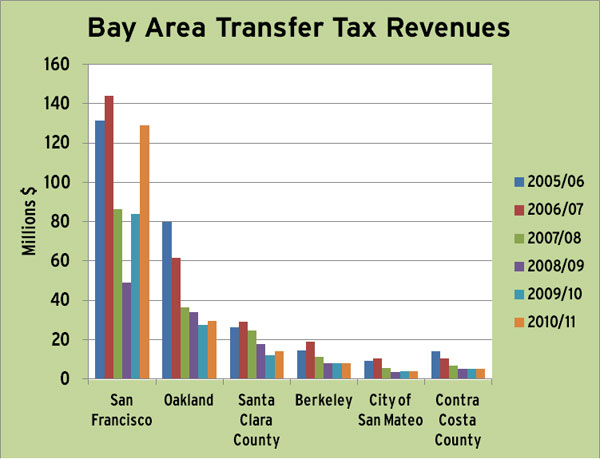
The strategy may be working. In the past one to two years, the amount of transfer tax collected by San Francisco, Oakland and Santa Clara County has been on the rise. By far, the largest rise was in San Francisco where collections have shot up by more than 160 percent over the past two years, while Oakland and Santa Clara County experienced modest gains in transfer tax revenues.

The reason for the increase is less clear. Obviously, a higher number of transactions due to the recovery of the Bay Area real estate market drove some of the surge. And in San Francisco, transfer tax revenues also rose because the city raised tax rates to 2 percent for transactions valued at more than $5 million and to 2.5 percent for transactions million or more, up from 1.5 percent previously.

For comparison, the amounts of transfer tax collected by Berkeley, the City of San Mateo and Contra Costa County—none of which collect transfer tax on legal entity transfers—have been flat in recent years. The experience of these other jurisdictions may be an indication that the expansion of transfer tax laws by San Francisco, Oakland and Santa Clara County to capture legal entity transfers is indeed having the intended effect.

To combat transfer taxes, property buyers should structure transactions to fall under one of the exceptions in California's transfer tax law. If an exception is not available, buyers should timely advise tax authorities of their transaction to avoid costly non-reporting penalties.

CONeallCris K. O'Neall specializes in property and local tax matters as a partner in the Los Angeles law firm of Cahill, Davis & O'Neall LLP. His firm is the California member of American Property Tax Counsel, the national affiliation of property tax attorneys. He can be reached at cko@cahilldavis.com

Continue reading

American Property Tax Counsel

Recent Published Property Tax Articles

The Commercial Property Tax Rebellion

The property tax system in the United States, which traces its roots to colonial America, has long been the life blood of local government finance. Used to fund schools, infrastructure and vital municipal services, it is also a system fraught with controversy and mounting calls for reform.

Over the past...

Read more

How to Achieve Fair Valuation of Renewable Energy Facilities

As renewable energy assets become more prevalent in commercial real estate portfolios – especially among industrial and data center users – property owners face a critical challenge: ensuring that intangible assets are not mistakenly included in the taxable value of real and personal property.

Wind farms, solar installations, battery energy storage...

Read more

Taxing Real Estate On Redevelopment Prospects

When a property's current use isn't highest and best, New Jersey jurisdictions can assess and tax based on hypothetical redevelopment.

It's hard to imagine a more dystopian world than one in which governments base real estate tax upon a hypothetical use other than a property's current and actual use. Unfortunately, taxing...

Read more

Member Spotlight

Members

Forgot your password? / Forgot your username?