Menu

Property Tax Resources

Nov
08

Recipes to Reduce Property Taxes Can Ease the Pain of Challenging Economic Times

"Rental rates and asset values have fallen to staggering lows, while snowballing vacancy has sapped income from commercial projects across property types and markets. And with local governments determined to maximize revenue from shrinking tax bases, it is more important than ever that property owners know the best recipes to minimize tax bills..."

By Stewart L. Mandell as published by National Real Estate Investor Online, November 2011

In his 1948 book, "How to Stop Worrying and Start Living," Dale Carnegie titled one chapter, If You Have a Lemon, Make A Lemonade. That advice has been passed down through the years to anyone facing a tough situation. How do you take something that's bad and turn it into a positive? The metaphor is apt for commercial real estate owners today, many of whom are stuck with piles of lemons.

Rental rates and asset values have fallen to staggering lows, while snowballing vacancy has sapped income from commercial projects across property types and markets. And with local governments determined to maximize revenue from shrinking tax bases, it is more important than ever that property owners know the best recipes to minimize tax bills. Imagine an intersection with four 150,000-sq.-ft. office buildings, one on each corner. The four buildings are physically identical, but have economic incongruities that could result in significantly different property taxation. These differences include vacancy rates, current rents, lengths of leases, creditworthiness of tenants and recent financing transactions.

Building A's rents average $25 per sq. ft., which is $5 more than the market average of $20 per sq. ft. But its leases with above-market rents will be ending sooner than the average lease in the other buildings at the intersection. Building A is 90 percent occupied, versus the market average of 80 percent.

If a tax assessor values the property using the actual contract rents, current occupancy and a capitalization rate obtained from a national survey, the property owner might well suffer excessive taxation. Arguing for a few adjustments to that calculation might substantially reduce Building A's taxes. The law of the jurisdiction might authorize a valuation that uses market rent, rather than above-market contract rents. Furthermore, leases that will be ending soon could justify a capitalization rate that is much higher than that reported in a national survey; rates from national surveys often are derived from fully leased, stabilized properties and not ones that soon could have significant vacancy.

If Building A's value is assessed according to its superior attributes and taxed at 2.5 percent of market value, its taxes would be more than $520,000 (see chart). If, however, its valuation is similar to a building with market attributes, its taxes would be around $360,000, almost 30 percent less.

Building B has the market's average vacancy rate of 80 percent and the same, above-market rents as Building A. The property recently sold in a sale-leaseback transaction that priced the building above its assessment.

SMandell_NREINov2011

As with Building A, the applicable law might provide for using market rents in the assessment. Additionally, the sale-leaseback transaction price doesn't preclude a lower assessed value. Some state supreme courts have recognized that sale-leasebacks are simply financing transactions and should not be used to value properties for taxation.

Buildings C and D both have below-market average rents of id="mce_marker"5 per sq. ft. Building C has accepted tenants with greater credit risk to achieve 90 percent occupancy. Building D is in the worst shape, with below-market rents and a below-market 70 percent occupancy rate.

Certainly any tax appeal for Building D would rely on the property's below-market rents and occupancy. Additionally, the taxpayer may be able to show that these problems warrant a higher capitalization rate, which also would reduce the property's indicated value and taxes.

To the extent that Building C, like Building D, has below-market rents, the same holds true. With the above-market occupancy, the owner of Building C will need to determine whether the jurisdiction would accept a valuation that uses market vacancy, and if not, seek an adjustment based on the greater likelihood of defaults.

Dale Carnegie also wrote, "We all have possibilities we don't know about." Well-advised property owners, too, may learn of possibilities for property tax reductions they didn't know about.

MandellPhoto90Stewart L. Mandell is a partner in the law firm of Honigman Miller Schwartz and Cohn LLP, the Michigan member of American Property Tax Counsel (APTC). He can be reached at slmandell@honigman.com.

Continue reading
Sep
29

Combatting the Road Less Traveled

When an altered traffic route handicaps your retail center, it's time for an assessment appeal.

"Owners should appeal their property tax assessment immediately after a public announcement of a highway or road change that will divert traffic away from their property..."

By Jerome Wallach, Esq., as published by National Real Estate Investor, September 2011

Once motorists lose sight of the property or can no longer access it conveniently, customers stop coming. At the very least, an owner facing such a loss is entitled to a fair property tax bill that reflects the asset's diminished commercial value.

Owners should appeal their property tax assessment immediately after a public announcement of a highway or road change that will divert traffic away from their property. Don't wait for evidence of changing traffic counts. The damage to property value occurs when the public announcement of the traffic diversion is made.

Effect on value

Assessed values are based upon market value, and market value in turn is predicated on a willing buyer and a willing seller. A public announcement that traffic will be rerouted for a period of time is an external event that appraisers refer to as external obsolescence, or something beyond the perimeter of the property that has an impact upon the property's value. Altered traffic routes are something a prudent buyer would consider in determining what to pay for an asset.

The announcement of an impending traffic shift will affect properties in varying time sequences and severity. For instance, the economic lifespan of a highway commercial property such as a convenience store will be limited to the opening date of the new roadway. A prudent buyer will base the purchase price upon the net operating income for that economic life.

There could very well be some residual value after the opening of the new road, but certainly not for convenience-store purposes. The carcasses of functionally obsolete convenience stores can be viewed from any recently moved.

JWallach-graph

Calculating the loss

Determining the property value after a road realignment plan is announced requires the stabilization of the declining income over the predictable remaining life of the property.

Consider, for example, a strip retail center. After the announcement but before construction, there may be no observable effect on retail sales at the center. From the time that the yellow barrels go up and the construction starts, and through the opening of the new road, however, sales and tenancy will decline.

Assuming the center is functioning at 95% of its gross potential at the time of the announcement, there may be a slight drop-off in the first and second year. But assuming a three-year building period for the roadway, leases that expire are not likely to be renewed. Leases in place also are in danger because patronage is expected to decline subsequent to the road opening.

The tenant will lack the ability to make the rental payments and may walk away. As spaces within the center go Notesdark, the property will lose its synergy of crossover customers. At the end of a 10-year period after the announcement, the center will be either dark or attract only an inferior class of tenant, and will at best be a marginal performer.

The property owner must analyze this declining income stream to determine a stabilized income over the remaining economic life of the property. The capitalization rate is then applied to the stabilized income over the property's remaining life as opposed to using the historic data, which becomes meaningless in the face of the changing traffic pattern.

It is critical to remember that the property owner's loss of value occurs at the time the road relocation project is made public, not at some future date. Thus, delaying a tax assessment appeal will only add to the property owner's losses.

Wallach90Jerome Wallach is a partner in the law firm of The Wallach Law Firm, the Missouri member of American Property Tax Counsel, the national affiliation of property tax attorneys. He can be reached at jwallach@wallachlawfirm.com.

Continue reading
Sep
25

How Eden Prairie Mall Challenged the Minnesota Tax Court

"It is now clear that the Minnesota Tax Court doesn't need to merely pick one of the taxable property values presented at trial and can find a taxable value outside the range of values introduced at trial..."

By John Gendler, Esq., as published by NREIonline, September 2011

In several cases over the past few years, the Minnesota Tax Court has found a taxable property value higher than the amounts presented in witness testimony from either side of a tax argument.

Because the Tax Court has the power to increase values as well as decrease them, this trend has raised concerns when considering whether a case should be taken to trial. However, a Minnesota Supreme Court opinion issued this year suggests that the Tax Court's decisions in the future are more likely to reflect facts presented in testimony.

Legal showdown

The pivotal decision stems from Eden Prairie Mall, LLC vs. County of Hennepin in which the Minnesota Supreme Court rejected the Tax Court's value increase for a recently renovated mall from $90 million to id="mce_marker"22 million.

The Supreme Court has said the Minnesota Tax Court cannot simply copy a county attorney's memorandum — including arithmetic mistakes — when deciding to find a value for a property that is higher than that testified to by either appraiser.

Both the taxpayer and government presented appraisals prepared by independent appraisers who had earned the MAI designation from the Appraisal Institute. (The professional accreditation refers to "Member, Appraisal Institute.")

The diverse appraisal testimony included value opinions for Jan. 2, 2005, and for Jan. 2, 2006, as a separate value must be found for each year in Minnesota.

The taxpayer's appraiser relied exclusively on an income approach, citing the lack of comparable sales, and testified to a value of $68.75 million in 2005 and a value of $60.55 million in 2006.

The original assessments being appealed put the mall's market value at $90 million in 2005, increasing to id="mce_marker"00 million in 2006. The government's appraiser gave most weight to the income approach, testifying to a value of id="mce_marker"10 million in 2005 and id="mce_marker"15 million in 2006. Neither appraiser prepared a discounted cash flow analysis.

The judge based her decision on a direct-capitalization income approach, finding that the government's cost and sales approaches were not meaningful given the recent major renovation of the mall. The Tax Court found the value of the mall to be id="mce_marker"22.9 million the first year and a slightly lower id="mce_marker"20.1 million for the later assessment.

In the decision, the Tax Court adopted an argument made by the government's attorney, which resulted in the indicated value being higher than that found by the government's appraiser. Like the government's attorney, the court stated that the government's appraiser had made a mistake in his calculations.

JGendler_eden_chart

Independent judgment

The Supreme Court said that the Tax Court did have the authority to make a value determination that is higher or lower than the testimony of the experts because the judges bring their "own expertise and judgment in valuation matters."

The Supreme Court noted, however, that "market value determinations involve the exercise of complex and sophisticated judgments of market conditions, anticipated future income, and investor expectations ...." In other words, the Tax Court can set taxable values based on its own analysis supported by the factual record. But did that analysis occur?

The Supreme Court pointed out that the Tax Court rejected both appraisers' opinions of market value and adopted, verbatim, a calculation presented by the government's attorney in a post-trial brief, "including several arithmetic errors."

The Supreme Court said "adopting verbatim the recalculated assumptions and nearly verbatim the value determinations ... presented in a post-trial brief raises doubts over whether the Tax Court exercised its own skill and independent judgment."

Although the Supreme Court affirmed other portions of the case, including the increase in value of a separate anchor store, this part of the case was returned to the Tax Court for additional explanation, including its use of income higher than that used by either appraiser.

Furthermore, the Supreme Court explicitly stated the Tax Court could reopen the record and admit additional evidence. It is not clear whether the Tax Court must admit additional evidence, but presumably the taxpayer will seek to do so when the Tax Court reconsiders its decision. At this writing, the Tax Court has not issued a new decision.

It is now clear that the Minnesota Tax Court doesn't need to merely pick one of the taxable property values presented at trial and can find a taxable value outside the range of values introduced at trial.

Importantly, however, it is also clear that the Minnesota Supreme Court will scrutinize those findings, demanding that the Tax Court explain in detail why it is rejecting the testimony and substituting its own opinions and data.

This precedent-setting case could encourage the Tax Court to stay within the range of testimony from the various appraisers, absent a compelling explanation for doing otherwise.

jgendler

John Gendler is a partner in the Minneapolis law firm of Smith, Gendler, Shiell, Sheff, Ford & Maher, P.A., the Minnesota member of American Property Tax Counsel, the national affiliation of property tax attorneys. He can be reached at jgendler@smithgendler.com.

Continue reading
Aug
29

Pittsburgh Exemplifies Pennsylvania's Property Tax Discord

"Pennsylvania has no mandatory requirement for periodic revaluation, meaning that, as a practical matter, no county spends the time and political currency to reassess properties unless a lawsuit is filed forcing it to do so..."

By Sharon DiPaolo, Esq., as published by National Real Estate Investor Online - City Reviews, August 2011

Imagine you are a property owner trying to budget now for 2012 real estate taxes on your high-rise downtown office building, and no one can tell you what assessment your taxes will be based upon.

What number do you budget? What will you bill your tenants?

That property management nightmare is reality in Pittsburgh. The state Supreme Court ordered Pittsburgh and the rest of Allegheny County to reassess properties in 2012, the county's fourth reassessment in 12 years. But with the third quarter drawing to a close, the county hasn't released even tentative assessments, and has no plan to do so before the 2012 real estate bills go into the mail.

Pittsburgh's debacle is but one chapter in an ongoing tragedy, as Pennsylvania's broken property tax system plays out against the day-to-day practicalities of managing real estate. In recent years, the state's system for assessing real property has been under attack — in the courts, in the legislature, in the media and around kitchen tables.

Decentralized property tax system

Pennsylvania is one of only nine states that decentralize the property tax assessment process to the local government level. Its property assessment system operates under six separate statutes which are implemented and funded at the county level.

Pennsylvania has no mandatory requirement for periodic revaluation, meaning that, as a practical matter, no county spends the time and political currency to reassess properties unless a lawsuit is filed forcing it to do so.

As a result, assessments on aging properties grow stagnant while new construction is assigned higher assessments. New assessments occur on a property-by-property basis, either when taxpayers file individual appeals or when taxing districts cherry pick properties to appeal, usually based on recent sales.

For example, two identical office buildings built at the same time by the same builder might originally be assessed at the same id="mce_marker"0 million. But if one of the buildings sells at id="mce_marker"5 million, the taxing district will appeal the assessment of that property, resulting in two identical properties with dramatically different assessments.

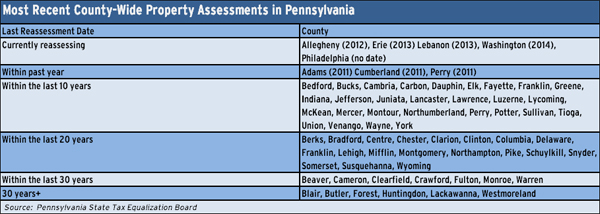
Seven Pennsylvania counties have not reassessed in more than 30 years, and Blair County's last reassessment was in 1958. The reason Allegheny County is undergoing yet another reassessment is that multiple lawsuits have forced it to do so.

Currently, Allegheny County is under order from the Pennsylvania Supreme Court to revalue every property within its borders, with new assessed values to take effect for the 2012 tax year. Erie and Lebanon counties are preparing for reassessments to take effect in 2013.

Washington County is in on-again, off-again litigation and currently preparing for a reassessment for 2014. Lancaster County has cancelled its reassessment for 2013 and now will not reassess until 2017.

Call for statewide solution

When the Pennsylvania Supreme Court ordered Allegheny County to reassess, it stopped short of directing the state's other 66 counties to do the same but called on the legislature to study the system. Motivated by imminent reassessment projects with price tags upwards of id="mce_marker"0 million, both Allegheny and Washington counties asked the legislature to issue a moratorium on reassessments until a state-wide solution could be found.

Two years ago, legislation mandating a moratorium died in committee. Then in late June, 2011, the legislature passed a moratorium on just Washington County's revaluation project in a measure tacked onto Pennsylvania's budget.

On July 8, Gov. Corbett vetoed the bill, so Washington County's reassessment was back on but is now delayed until at least 2014. Currently some legislators are putting together yet another task force to study the issue. If history is any predictor, no statewide solution is on the horizon.

Delay in Allegheny County

Allegheny County's revaluation project has been repeatedly delayed. The county is behind on its preparations for the reassessment project and, in particular, behind on its valuation of commercial properties.

At the latest court conference before Judge Stanton Wettick, who is overseeing the reassessment project, the county admitted that it is behind in valuing commercial properties. At the judge's request, the county produced two alternate plans — neither of which will provide taxpayers with tentative 2012 values until next year.

Under the county's preferred plan, in which it would issue all notices at the same time, preliminary notices would be mailed out Jan. 31, 2012 with final values to be certified by early April 2012.

Under the alternate plan, notices would go out first to property owners in Pittsburgh, in December 2012, with certified values following in February 2012. Property owners in the rest of the county would be forced to wait until March for their preliminary notices and May for certified values.

Further, Allegheny County's plans call for an informal review process to analyze preliminary values. But as the reassessment project and preliminary notices have been delayed while the project drags on, the county has shortened the time for informal reviews from five months to five weeks.

tax_chart_pennsylvania

Complicating the matter for taxpayers and taxing districts alike, Pennsylvania law requires municipalities to set the 2012 tax rates in January, before the 2012 assessment is final. And in Pittsburgh, the school district will issue its 2012 tax bills before the assessment deadline.

Progress?

Last week, Judge Wettick heard a dozen representatives of school districts and municipalities describe how the delay in the reassessment project is affecting their budget process, hiring decisions and tax rates while it increases administrative costs and overhead. The City of Pittsburgh School District reported that it would have to take out a $66 million tax anticipation loan just to make payroll, costing the school district almost id="mce_marker".5 million.

Judge Wettick is expected to select one or the other timetable at a hearing on Sept. 15. Taxpayers and taxing districts alike are keeping a close watch on the outcome.

Gov. William Penn announced Pennsylvania's first property tax in 1683; within two weeks of the tax's enactment, a property owner filed the first complaint challenging an assessment. More than 300 years later, Pennsylvanians still struggle to find the right solution to meet Pennsylvania's constitutional requirement of uniformity in taxation.

dipaolo_webSharon F. DiPaolo is a partner in the law firm of Siegel Siegel Johnson & Jennings, the Ohio and Western Pennsylvania member of American Property Tax Counsel, the national affiliation of property tax attorneys. She can be reached at sdipaolo@siegeltax.com.

Continue reading
Aug
16

Property Taxation Runs Amok in the District of Columbia

"This pumping up of assessments allowed politicians the luxury of claiming that they did not raise the tax rate during the entire period. If taxes went up, even dramatically, well then that's just the marketplace talking."

By Stanley Fineman, Esq., as published by National Real Estate Investor Online - City Reviews, August 2011

Real estate taxes, which are based on assessor opinions, are the only subjectively determined taxes on the planet. And unlike other building expenses, which are largely controllable, property taxes are volatile, chaotic and often quixotic. Above all else, in the District of Columbia, they are high.

So, how high are your property taxes? Presumably all owners can answer that question on a cost-per-square-foot basis. But there are other perspectives to consider. How much have those taxes changed in the past five years? What percentage of the property's overall operating expenses do property taxes represent, and has that ratio altered over the years?

SFineman_graph

Here in D.C., we keep track of such things — and the results are startling. Office building taxes ballooned from $4.97 per sq. ft. in 2004 to $8.81 per sq. ft. in 2009, an increase of 77%. That's more than double the rate of increase in office contract rents, which averaged $45.31 per sq. ft. in 2009, up 35% from $33.46 in 2004.

None of the tax increases in those five years resulted from changes in the millage rate, or tax per id="mce_marker",000 of valuation, which remained essentially constant for the entire period. The increase was the product of assessment legerdemain, and would have been much higher had property owners failed to wage relentless and successful administrative and judicial tax appeals.

This pumping up of assessments allowed politicians the luxury of claiming that they did not raise the tax rate during the entire period. If taxes went up, even dramatically, well then that's just the marketplace talking.

Never mind that the tax rate might have been significantly reduced, softening the blow of the assessment spikes, but it was not. After all, there were pet projects that needed feeding.

Economic toll

We can examine the impact of mushrooming assessed values on the bottom line. Non-tax building expenses including fixed costs, maintenance, utilities, administration and services rose modestly from 2004 through 2009, by perhaps 20%.

With tax bills growing at a faster rate, however, the tax burden as a percentage of total building costs increased dramatically over that same period.

By 2009, property taxes climbed to an astounding 42.25% of all operating expenses, up from 33.24% five years earlier. In the early 1990s, taxes were as low as 24% of all operating expenses.

The overall effect on property cash flow was to significantly blunt the profitability one might have expected from the general rise in property values over the period.

Let's examine that further. Average rental rates increased 35% over a five-year period. If property taxes had increased at the same rate, taxes on the average office building would be $6.71 per sq. ft.

But because property taxes actually climbed 77% over that five years, the average office taxes is $8.81 per sq. ft. That's $2.10 per sq. ft. lost from the bottom line.

In a 250,000 sq. ft. office building, not uncommon in D.C., that equates to a loss of $525,000, annually.

Let's now look at it from the perspective of the taxing authority. There are approximately 1,000 privately owned office buildings in D.C. If the average size were, say, 175,000 sq. ft., D.C. arguably would be gaining excess tax revenues approaching $400 million annually.

That is a staggering sum, a massive shift of the tax burden heaped quietly onto the shoulders of commercial owners.

The D.C. government, always a minority partner in real estate enterprises, has been biting off heftier chunks of the commercial pie through taxation as the years roll by.

This has allowed it to subsidize homeowners (i.e. voters) through reduced tax rates and capped increases. And everybody's happy. Oh, except commercial owners and their tenants, the geese that lay the golden eggs. And we all remember what happened to them.

A proposal

Over the years, commercial owners have raised many salient arguments in an attempt to hold down their taxes. For example, commercial taxes in D.C. are considerably higher than in the adjacent jurisdictions, suburban Maryland and Virginia, resulting in a competitive disadvantage for D.C. property owners.

Arguing this point has brought some success in lowering the D.C. tax rate, but a large disparity remains.

Most recently, recalcitrant D.C. assessors were slow to recognize the downturn in the economy that afflicted property values in all jurisdictions. When the economy improves, aggressive assessors will tend to be overzealous in pursuing and overstating the market.

Simply put, property taxes shouldn't increase at a faster rate than rents. In practice, such a rule would require first establishing a base line of rents and taxes, and then utilizing reliable data to establish increases.

There might be lag time involved in acquiring and utilizing the data, but that challenge is a hill, not a mountain, to climb. And most importantly, it would be reasonable and fair.

sfinemanStanley J. Fineman is a shareholder in the law firm of Wilkes Artis Chartered, the District of Columbia member of American Property Tax Counsel. He can be reached at sfineman@wilkesartis.com

Continue reading
Jul
27

Oklahoma Courts Rule Low-Income Housing Tax Credits Shouldn't Be Treated As Property Income

"A developer who commits to operate a property as a low-income housing complex can apply for Low Income Housing Tax Credits under Section 42 of the Internal Revenue Code. The developer then sells the credits to investors to generate equity to construct the project..."

By William K. Elias, Esq., as published by National Real Estate Investor - Online Edition, July 2011

The impact of low-income housing tax credits (LIHTC) on the taxable value of real property has been a subject of controversy in Oklahoma for many years. A recent court ruling lays down the law, however, by definitively excluding the credits from calculations of taxable value.

WKElias_graph

Under the Tax Reform Act of 1986, Congress established the low-income housing tax credit program to encourage private development of affordable housing for people with low incomes.

A developer who commits to operate a property as a low-income housing complex can apply for Low Income Housing Tax Credits under Section 42 of the Internal Revenue Code. The developer then sells the credits to investors to generate equity to construct the project.

The recent case of Stillwater Housing Associates v. Jacquie Rose, Payne County Assessor, et al. (Oklahoma Supreme Court No. 108,682) could result in lower tax assessments for many low-income housing properties in Oklahoma.

In the Stillwater Housing decision, the Oklahoma Court of Civil Appeals issued several conclusions to clarify how low-income housing tax credits issued under Section 42 of the Internal Revenue Code affect taxable value.

Case in point

The Stillwater Housing case arose in Payne County, Okla., where limited partnership Stillwater Housing Associates applied to the Oklahoma Housing Finance Agency for low-income housing tax credits to develop a low-income housing complex. The agency granted credits to be allocated over 10 years in the amount of $455,235 per year.

To generate private equity to complete construction, Stillwater sold its low-income housing tax credits to investors, who became limited partners, and the credits flowed through Stillwater directly to those limited partners. Stillwater received no monetary benefit or cash flow from the tax credits.

Stillwater was obligated under a regulatory agreement to rent the units to low-income residents at restricted rents for 40 years. The tax credits were subject to recapture if Stillwater breached the terms of the regulatory agreement during the first 15 years.

Under Oklahoma law, real property is assessed annually as of Jan. 1 at its fair cash value. That's the estimated price the property would bring in a voluntary sale for the highest and best use for which it is actually used, or classified for use, during the previous calendar year.

Assessors can use the cost, income or sales-comparison method to estimate fair cash value. Neither the Oklahoma statutes nor the Oklahoma Tax Commission rules prescribe a methodology for valuing low-income housing tax credit properties.

In 2007, Stillwater protested the assessor's value of the property and asserted a fair cash value of $3.975 million, based upon actual rents. The assessor denied the protest and the developer appealed to the County Board of Equalization. The board instructed the assessor to add $235,347 of tax credits as income under the income approach. As a result, the value increased to more than $8.6 million.

Stillwater appealed the board's value to district court and both sides filed motions for partial summary judgment on the issue of whether low-income housing tax credits should be treated as property income. The district court ruled in favor of Stillwater and the assessor appealed.

The Oklahoma Court of Appeals affirmed the district court, however, and held that low-income housing tax credits are not income and do not replace income to the real property.

The court also held that the credits are tax benefits belonging to the investor, not a right or privilege belonging to the land, meaning the credits are not within the statutory definition of real property. Finally, the court held that the tax credits are intangibles exempt from taxation under Article X, Section 6A of the Oklahoma Constitution.

The assessor asked the Oklahoma Supreme Court to review the appeals court decision, but that petition was denied on March 28, 2011. When published, the appellate court's Stillwater Housing decision will constitute persuasive authority in all Oklahoma courts.

What does Stillwater Housing mean for owners of low-income housing tax credit properties? First, because the tax credits are not income and do not replace income to the property, the credits must be excluded from income-based assessments.

Second, because the credits are tax benefits belonging to the investor and not a right or privilege belonging to the land, then credits do not fall within Oklahoma's statutory definition of real property.

Essentially, regardless of their value to investors, low-income housing tax credits are intangibles exempt from taxation. The Stillwater Housing decision could result in lower tax assessments for many LIHTC properties in Oklahoma.

EliasPhoto_web

William K. Elias is a partner in the Oklahoma City law firm of Elias, Books, Brown and Nelson, P.C., the Oklahoma member of American Property Tax Counsel (APTC). He can be reached at wkelias@eliasbooks.com.

Continue reading
May
18

Tax Grab: Are New York Assessors Inflating Values for the Wrong Reasons?

"The real estate tax is based on the tax rate and a property's assessed value. In the face of all the troubles and distress seen in real estate over the last three years, the City of New York has made some outsized increases in its estimates of market values, which it uses to assess properties for taxation..."

By Joel R. Marcus, Esq., as published by National Real Estate Investor, April 2011

The New York City real estate community has been through the wringer since 2007. It has endured a dearth of major property transactions, suffered through the meltdown of the financial services industry and watched available debt financing evaporate. Lenders and special servicers are more in control of the real estate market than ever before.

In the real world of property ownership and development, many taxpayers are experiencing a drop in occupancy for office, hotels and rental apartment buildings. Condo sales have slowed to a trickle and construction of new office, hotels and apartment buildings has come to a virtual standstill.

In this environment of dropping office rents, condominium fire sales and increasing costs of operations, real estate taxes — the largest component of a building's expenses — have skyrocketed. Why is this happening?

New York City satisfies its budget needs through a variety of taxes, and of all of them, the real estate tax is the most important and durable. The city now finds itself facing a cutback in state and federal aid and has big budget deficits. This is happening at a time when corporate and personal income taxes and sales taxes have declined, and other taxes such as transfer and mortgage-recording taxes have all but disappeared.

The city's revenue options are few. People and businesses can move to New Jersey or other areas to escape New York City's income taxes or sales taxes, and this puts a practical limit on what New York City can extract. Real estate, however, is stuck in New York City and can't escape the city's tax grip.

Excessive taxes erode equity.

The real estate tax is based on the tax rate and a property's assessed value. In the face of all the troubles and distress seen in real estate over the last three years, the City of New York has made some outsized increases in its estimates of market values, which it uses to assess properties for taxation.

A snapshot provided by the City of New York Department of Finance highlights some of these amazing hikes in estimated market value. In Queens, for instance, assessors raised the market values for cooperatives 32.37% (on average12.05% citywide) from last year and Queens luxury hotels experienced a 27.97% increase as well. Manhattan luxury hotels underwent a 14.82% raise in values, while values climbed 9.65% for cooperatives and 15.91% for condominiums.

Many in the commercial real estate industry believe that the jump in assessed real estate market values is related to the city's budget woes, rather than to actual changes in the market place. The city vociferously denies this notion, but as Shakespeare's Hamlet said, "The lady doth protest too much, methinks."

How much tax is too much?

An analysis of the city's system for assessing properties shows that in office and other commercial properties the property tax bite consumes almost 34% of a property's pre-tax net income. Let's examine with this hypothetical example the formulas used by assessors.

An office building charges $45 rent per sq. ft. Its operating expenses are $12 per sq. ft., and its amortized leasing and tenant expenses are another $4.50 per sq. ft. Therefore the pre-tax net income is $28.50 per sq. ft.

The city divides that income by 13.64%, which is derived by adding a 9% capitalization rate to 4.64%, or 45% of the 10.312% tax rate. That yields a fair market value of $209 per sq. ft.

Assessed at 45% of fair market value, the result is a tax assessment of $94 per sq. ft. and a tax bill of $9.70 per sq. ft., based on the 10.312% tax rate. Therefore the city is a partner in 34% of the net operating income without any equity investment at all! This is before debt service, depreciation and capital improvements are accounted for — expenses that only the owner has to pay but for which the owner gets no credit from the city. Not bad if you can get away with it.

For apartment buildings, the pattern is even more egregious. If rents are $45 per sq. ft. and expenses are $12 per sq. ft. as in the office example, the assessor takes 45% of the 13.353% Class-2 tax rate (which is 6.009%) and adds a 7.5% cap rate to get a loaded cap rate of 13.509%. Divide the cap rate into the net operating income of $33, and the fair market value is $244.28 per sq. ft.

The assessment, therefore, is $110 per sq. ft., and this applies to the tax rate results in annual taxes of $14.69 per sq. ft. That's 44.5% of the property's pre-tax net income. Boy, what a deal the city has! If major capital repairs are needed for such expenses as the facade or elevator modernization, a roof or an apartment makeover, they are borne solely by the owner. None of these expenses are factored into the city's formula.

Property owners can always appeal their assessments, but many believe that it's the city's policy on taxes instead, that needs a reassessment.

MarcusPhoto290Joel R. Marcus is a partner in the law firm of Marcus & Pollack LLP, the New York City member of American Property Tax Counsel, the national affiliation of property tax attorneys. He can be reached at jmarcus@marcuspollack.com.

Continue reading
Apr
18

Taxes Target Green Pastures

"Property owners must stay vigilant to maintain agricultural-use status on farmland and avoid financial penalties..."

By Douglas S. John, Esq., as published by National Real Estate Investor, April 2011

Local governments are under the greatest financial stress since the Great Depression, and assessing authorities are aggressively pursuing revenue to combat these financial woes. One target in assessors' crosshairs is the preferential tax treatment of land with agricultural status.

Developers who are considering the purchase of agricultural land or holding acreage for eventual development need to be aware of the potential tax consequences. Depending on the way assessors categorize the land, the owner could face an unexpected rise in tax costs.

All states offer some tax relief for qualified agricultural property, but each jurisdiction has specific and often complex legal requirements for agricultural status. Investors in land held for future development must know the laws governing agricultural status if they hope to maintain this preferred tax position.

Most real estate is assessed at market value, which typically reflects the most probable price a buyer would pay in a competitive market. The most common benefit of an agricultural designation is that the land is assessed at use value instead of market value. Use value reflects how the property is currently used, i.e., for agriculture, rather than its highest and best use, which may be for residential or commercial development.

Eligibility for agricultural status varies by jurisdiction. The following are the major eligibility requirements.

  • Use: Typically, states require that land be actively engaged in agricultural use and used exclusively or primarily for commercial agriculture. That can include growing crops, dairying, raising and breeding livestock, or horticulture.
  • Acreage: A majority of states impose an acreage requirement to qualify for agricultural use, meaning a minimum number of acres. Qualifying acreage is typically low relative to average farm size. Some states have no minimum acreage requirement, while others allow local authorities to establish size criteria.
  • Productivity: Most states impose minimum productivity requirements. These laws vary by jurisdiction, but most require property to generate a minimum amount of annual income from farming or raising livestock. Some states average the measure of income over a period of years. Other states require that a minimum percentage of the owner's or lessee's annual income is earned from agricultural activity on the land.
  • Prior Usage: About half the states require property to be used for agricultural purposes for a period of years before it qualifies for preferential tax treatment. These laws are meant to discourage owners from changing a tract's use to take advantage of the tax benefits. Two or three years immediately preceding approval is typical.

Check for penalties

Many states impose a penalty when farmland is converted to non-agricultural use. In some states the penalty takes the form of a recapture or rollback tax, which is the difference between the taxes that would have been paid and the taxes actually paid while the land qualified as agricultural. This recapture period varies between three and 10 years.

In other states, if farmland is converted from agricultural use within a certain period after qualifying for preferential treatment, penalties are calculated based on the property's fair market value when its use changes or it is sold.

Most states require owners to periodically submit extensive information to demonstrate that the land continues to be used agriculturally. This may include IRS Form 1040F, leases, invoices and receipts, among other documents.

Each state's eligibility requirements, application process and potential penalties play a part in determining whether properties qualify for agricultural status. But a property's agricultural status can translate into significant tax savings. Local counsel may be required to navigate the complexity of obtaining or maintaining the agricultural status.

Douglas S. John is with the Tucson, Arziona law firm of Bancroft Susa & Galloway, the Nevada and Arizona member of American Property Tax Counsel. He can be reached at djohn@bancroftlaw.com.

Continue reading
Jan
07

Tax Data Reveals Plunge in Atlanta Commercial Property Values

"As of November 2010, 99.1% of appeals from the 2008 tax year had been resolved. For the 2009 tax year, 79.1% of appeals had reached a resolution; while only 16.4% of the cases from the 2010 tax year had been resolved...."

By Lisa Stuckey, Esq., as published by National Real Estate Investor-Online/City Reviews, January 2011

As in many U.S. markets, most property owners in Atlanta believe that commercial real estate values in the local market have been declining, and that the declining trend will continue. What is less clear to taxpayers and taxing entities is the severity of value losses and whether property taxes have come down to a corresponding degree.

An analysis of Atlanta-area commercial property valuations and property tax appeals in years past was conducted to determine if, indeed, the perceived drop in property values has occurred, and if so, what effect that drop had on property taxes. Possible new trends can also be extrapolated from the data.

LStuckey_graph

Measuring loss: Which yardstick?
A review of commercial property sales tracked by CoStar Group confirms that asset values have declined since 2008. Yet the degree of decline varies depending on whether the data are broken down by the number of properties or by square foot.

On a per-unit basis, sale prices for multifamily, retail, office, industrial, healthcare, flex, hospitality and specialty properties in Atlanta-area zip codes fell 25% from the beginning of 2008 through the start of 2010. Looking at those same property types on a per square foot basis, it appears that values fell 15%. Taking those results together, we can say that commercial values have decreased by 15% to 25%, or about 20% on average, from Jan. 1, 2008 to Jan. 1, 2010.

The pool of commercial tax parcels in the city of Atlanta has remained fairly constant over the past three years. The number of commercial parcels in the city was 16,347 for tax year 2008, 16,280 for tax year 2009, and 16,184 for tax year 2010.

Appeals fluctuate
In 2008, 5,069 property owners in Atlanta filed tax appeals, representing approximately 31% of all commercial properties. For tax year 2009, the number of appeals filed by taxpayers fell to 2,087, or approximately 13% of all commercial properties; the number of appeals increased to 3,467 for tax year 2010, representing approximately 21% of the commercial properties.

One possible and likely explanation for the marked decrease in the number of appeals filed from tax year 2008 to tax year 2009 is that Fulton County mailed assessment notices for the revaluation of all commercial properties for tax year 2008. That gave city of Atlanta taxpayers the opportunity to file appeals from the notices. However, for tax year 2009, the County did not issue widespread assessment notices. Only taxpayers who received notices were informed enough to file returns of their opinion of value with the tax assessors and, thereby, were assured of receiving assessment notices from which to appeal.

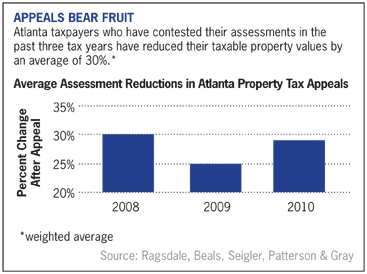
As of November 2010, 99.1% of appeals from the 2008 tax year had been resolved. For the 2009 tax year, 79.1% of appeals had reached a resolution; while only 16.4% of the cases from the 2010 tax year had been resolved.

In cases from the 2008 tax year, resulting valuations averaged 30% less value than the original assessments. In the 2009 appeals, the average reduction in value was 25%. The few cases resolved from the 2010 tax year brought down the original assessments by an average of 29%.

Clearly then, Atlanta property values as well as Atlanta property taxes have dropped. On a weighted average basis across the three years, assessments reflect a reduction of approximately 30%.

In spite of the inherent limitations of analysis with many appeals still waiting for resolution, the available data from concluded appeals shows a clear trend: A significant number of commercial property owners in the Atlanta area have achieved substantial valuation reductions in the past three years.

New rules kick in
Under a change to state law effective in tax year 2011, which began on January 1, county taxing authorities will send notices of assessed property values to all Georgia taxpayers for each tax year. With this change to the law, property owners will no longer be required to file a return of their opinion of their property value with the county tax assessor in order to receive an assessment notice from which to appeal.

Based on an examination of the past years' data, it appears that approximately 16,000 assessment notices will be mailed to commercial property owners in Atlanta. Judging from recent trends, anywhere from 15% to 30% of those assessments will be appealed.

If the current trend of reductions in property values continues, then it is also to be expected that the filed appeals will result in valuation decreases for tax year 2011 as well.

LStuckey_web90Lisa Stuckey is a partner in the Atlanta, GA law firm of Ragsdale, Beals, Seigler, Patterson & Gray, the Georgia member of American Property Tax Counsel, the national affiliation of property tax attorneys. She can be reached at lstuckey@rbspg.com.

Continue reading
Nov
20

Why Las Vegas Property Tax Assessments Will Exceed Market Value

"Some analysts suggest the volume of troubled commercial loans could create a wave of foreclosures similar to those that swept through the residential market..."

By Paul D. Bancroft, Esq., National Real Estate Investor, November 2010

The odds are stacked against property owners in Las Vegas, where the commercial real estate market continues to suffer from a severe downturn. With nearly $17.2 billion in distressed assets across all commercial property types, Las Vegas ranks No. 1 among U.S. metros by proportion of distress to total inventory in the local market, according to New York-based Real Capital Analytics.

Some analysts suggest the volume of troubled commercial loans could create a wave of foreclosures similar to those that swept through the residential market, a specter that is eroding confidence in commercial real estate. Meanwhile, the pool of available buyers has shrunk and the return on investment they require has increased, depressing sale prices.

Why_LasVegas_graph2

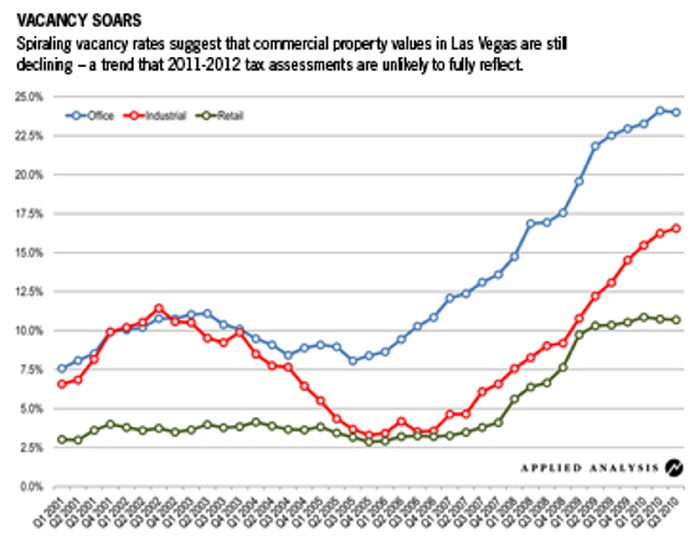
Vacancy rates are another metric that illustrates the severity of the downturn. The vacancy rate for all classes of office space in Las Vegas has slowed its rate of increase, but is projected to top out at a staggering 24.8% by the end of this year, according to Encino, Calif.-based real estate services firm Marcus & Millichap. By contrast, the firm estimates that the current, national vacancy rate for all classes of office is 17.7%.

Applied Analysis, a research consulting firm based in Las Vegas, reports that vacancy rates have risen for the past four years in every subsector of commercial real estate, from retail to industrial to office. The average price per acre of developable commercial land in Clark County has fallen from a peak of $939,000 at the end of 2007 to $155,000 today, a drop of more than 83%, according to Applied Analysis.

Brian Gordon, a principal at the research company, draws a direct correlation between the weak demand for space and the depressed value of commercial properties.

The cumulative effect of these trends is clear: The market value of commercial property has dramatically declined. The question that remains for property owners is whether the taxable values assessors assign to Las Vegas real estate will reflect the decline in market value. Unfortunately for taxpayers, the short answer is no.

Data lag skews values

During any period of changing real estate values, Nevada's taxable property assessments tend to fall out of step with the current market. The tendency to reflect outdated property values doesn't mean the staff of the assessor's office isn't keeping up with the latest newspaper headlines. Rather, it's because assessors are required to follow a methodology that doesn't reflect recent shifts in market value.

In Nevada, the assessor is required to adhere to a valuation methodology that, in the current market, is biased toward a value that will exceed market value. To begin with, the sales data assessors use to establish pricing is simply outdated.

Nevada tax law requires assessors to value the land and improvement components of an improved parcel separately. The land component is valued by comparing it to the sale of vacant land. The comparable transactions are drawn from sales that occurred six months to three years prior to the valuation date, a point in time when real estate was selling for higher prices than is the case today.

In a market in which values are rising, the reliance on "old" sales data would tend to result in a taxable value that is below market value. In a declining market, however, the reliance on old sales will tend to result in a taxable land value that exceeds market value.

A different problem derives from assessors' methodology for valuing the improvement component of a property. In Nevada, improvements are valued according to replacement cost, or what it would cost to build a duplicate asset today, less depreciation.

Replacement cost is established from cost manuals published by Los Angeles-based Marshall & Swift, which monitors materials pricing for the commercial and residential real estate industries.

Reliance on replacement cost may be relevant in a market that is not overbuilt. But in a market with excess inventory, the replacement cost of a building will not reflect economic obsolescence that makes the space less marketable to tenants, and therefore less valuable.

The appraisers in the Clark County Assessor's office currently are valuing properties for the tax year that begins on July 1, 2011 and runs to June 30, 2012. More likely than not, the methodology they are required to follow will result in taxable values that exceed market value.

If that occurs, the assessor is required to reduce taxable value to market value. As a practical matter, however, it is unlikely the reduction to market value will be made because the assessor's office simply does not have the time or property-specific information on vacancy, rent and expenses to determine the market value of all commercial properties. That limitation puts the onus on the property owner. Taxpayers will receive a notice of the taxable value assigned to their property for tax year 2011-2012 in early December. Even if that taxable value is less than the value it was assigned in the preceding tax year, the bias in the methodology employed by the assessor is likely to have resulted in a taxable value that still exceeds market value.

Owners must ask themselves what a snapshot of their property's market value would be on Jan. 1, 2011. If the market trends previously described continue, any reasonable level of analysis is likely to support a market value for most commercial properties that is less than the taxable value determined by the assessor.

Consequently, owners of most commercial properties in Las Vegas will have good reason to appeal to the county board of equalization for an adjustment this year. The deadline for filing an appeal is Jan. 18, 2011.

PBancroft150Paul Bancroft is a managing partner in the Tucson, AZ law firm of Bancroft, Susa & Galloway, the Nevada and Arizona member of American Property Tax Counsel, the national affiliation of property tax attorneys. He can be reached at pbancroft@bancroftlaw.com.

Continue reading

American Property Tax Counsel

Recent Published Property Tax Articles

The Commercial Property Tax Rebellion

The property tax system in the United States, which traces its roots to colonial America, has long been the life blood of local government finance. Used to fund schools, infrastructure and vital municipal services, it is also a system fraught with controversy and mounting calls for reform.

Over the past...

Read more

How to Achieve Fair Valuation of Renewable Energy Facilities

As renewable energy assets become more prevalent in commercial real estate portfolios – especially among industrial and data center users – property owners face a critical challenge: ensuring that intangible assets are not mistakenly included in the taxable value of real and personal property.

Wind farms, solar installations, battery energy storage...

Read more

Taxing Real Estate On Redevelopment Prospects

When a property's current use isn't highest and best, New Jersey jurisdictions can assess and tax based on hypothetical redevelopment.

It's hard to imagine a more dystopian world than one in which governments base real estate tax upon a hypothetical use other than a property's current and actual use. Unfortunately, taxing...

Read more

Member Spotlight

Members

Forgot your password? / Forgot your username?