Menu

Property Tax Resources

Jan
30

Attorney: Owners Need to Investigate Whether Possible Tax Increases from New Tax Law can be Abated

''While Republicans and Democrats remain divided on the overhaul's benefits, there is a single undeniable fact: The sharp reduction of the corporate tax rates from 35 percent to 21 percent will be a boon for most businesses"

President Trump's Tax Cuts and Jobs Act is the first sweeping reform of the tax code in more than 30 years. Signed into law on Dec. 22, 2017, the plan drops top individual rates to 37 percent and doubles the child tax credit; it cuts income taxes, doubles the standard deduction, lessens the alternative minimum tax for individuals, and eliminates many personal exemptions, such as the state and local tax deduction, colloquially known as SALT.

While Republicans and Democrats remain divided on the overhaul's benefits, there is a single undeniable fact: The sharp reduction of the corporate tax rates from 35 percent to 21 percent will be a boon for most businesses. At the same time, employees seem to be benefiting too, with AT&T handing out $1,000 bonuses to some 200,000 workers, Fifth Third Bancorp awarding $1,000 bonuses to 75 percent of its workers, Wells Fargo raising its minimum wage by 11 percent and other companies sharing some of the increased profits with employees. Companies are showing understandable exuberance at the prospect of lower tax liability, but investments many firms are making in response to the changes may trigger increases in their property tax bills.

Some companies already are reinvesting in their own infrastructure by improving and upgrading inefficient machinery or renovating aging structures. Renovations to address functional or economic obsolescence can help to attract new tenants and, most significantly,command higher rental rates for the same space.

The real property tax systems in place for most states are based on an ad valorem (latin for "according to value") taxation method. Thus, the real estate taxes are based upon the market value of the underlying real estate. Since the amounts on tax bills are based on a property's market value, changes or additions to the real estate can affect the taxes collected by the municipality.

Generally speaking, most renovations such as new facades, windows, heating or air conditioning will not change the value or assessment on a property. The general rule is that improvements that do not change the property's footprint or use, such as a shift from industrial to retail, shouldn't affect the property tax assessment. However, an expans1on or construction that alters the layout of a property can -and usually does -result in an increased property assessment. Since realestate taxes are computed by multiplying the subject assessment by the tax rate, these changes or renovations can significantly increase the tax burden.

Tax Exemptions Available for Property Improvements

Recognizing that this dynamic could chill business expansions, many states offer a mechanism to phase-in or exempt any assessment increases. This can ease the sticker shock of a markedly higher property tax bill once construction is complete.

New York offers recourse in the form of the Business Investment Exemption described in Section 485-b of the Real Property Tax Law. If the cost of the business improvements exceeds $10,000 and the construction is complete with a certificate of occupancy issued, the Section 485-b exemption will phase-in any increase in assessment over a 10-year period. The taxpayer will see a 50 percent exemption on the increase in the first year, followed by 5 percent less of the exemption in each year thereafter. Thus, in year two there will be a 45 percent exemption, 40 percent in year three and so on.

Most other states have similar programs to encourage busmess investments and new commercialconstruction or renovations. The State of Texas has established state and local economic development programs that provide incentives for companies to invest and expand in local communities.For example, the Tax Abatement Act, codified in Chapter 312 of the tax code, exempts from realproperty taxation all or part of an increase in value due to recent construction, not to exceed 10 years. The act's stated purpose is to help cities, counties and special­ purpose districts to attract new industries, encourage the development and improvement of existing businesses and promote capital investment by easing the increased property tax burden on certain projects for a fixed period.

Not long ago, the City of Philadelphia enacted a 10-year tax abatement from realestate taxes resulting from new construction or improvements to commercial properties. Similarly,the State of Oregon offers numerous property tax abatement programs, with titles such as the Strategic Investment Program and Enterprise Zones.

Minnesota goes a step further and automatically applies some exemptions to real property via the Plat Law. The Plat Law phases-in assessment increases of bare land when it is platted for development. As long as the land is not transferred and not yet improved with a permanent structure, any increase in assessment will be exempt. Platted vacant land is subject to different phase-in provisions depending on whether it is in a metropolitan or non-metropolitan county.

Clearly, no matter where commercial real estate is located, it is prudent for a property owner to investigate whether any recent improvements, construction or renovations can qualify for property tax relief.


Jason M. Penighetti is an attorney at the Mineola, N.Y., law firm of Koeppel Martone & Leistman LLP, the New York State member of AmericanProperty Tax Counsel, the national affiliation of property tax attorneys. Contact him at JPenighetti@taxcert. com.
Continue reading
Jun
20

Taxation of New York City Real Property

Introduction

This article provides an overview of real estate taxation in New York City (the “City”) including (i) the process by which the City assesses real property, (ii) how property owners challenge the City’s assessments, (iii) benefit programs available to reduce property owners’ real estate tax burdens, and (iv) the importance of understanding real estate taxes in lease negotiations. In New York City, real estate taxes have become an increasingly greater expense for property owners and landlords in recent years. As such, they are an ever-growing factor that any potential purchaser or tenant must account for in its business decisions. Counsel on either side of any real estate transaction should possess at least a basic knowledge of the real estate taxation process to be able to appropriately account for such taxes in negotiations. The process is complex, involves interaction with many government agencies, and is often counter-intuitive. Therefore, a working knowledge of the process is also important in order to understand that, for more complex transactions, specialized real estate tax representation might be necessary and appropriate.

New York City’s Department of Finance (DOF) is the agency charged with assessing all real property in New York City. DOF reassesses all real estate (over one million parcels) each year. Income generated from real estate taxes is the top source of revenue for the City, currently comprising over 40% of the City’s revenue. As a result, real estate taxes are a major factor to account for in the sale / purchase, and leasing of real estate. Furthermore, the City offers numerous real estate tax benefit programs that builders, developers, purchasers, landlords, and tenants need to be aware of in considering any transaction.

Procedures for assessing real property, challenging real estate tax assessments, and qualifying for the various tax benefit programs are governed by the New York State Real Property Tax Law (RPTL) and the New York City Charter, Administrative Code, and Rules.

Arriving at a Tax Assessment

Unlike most jurisdictions around the country, New York City reassesses every property on an annual basis and adheres to a strict and consistent calendar for publication of its assessment roll. Below is a summary of the key dates in the assessment process.

  • Taxable Status Date. DOF assesses real property as of its status and condition each January 5, also known as the taxable status date. This date is particularly important when assessing properties that are experiencing large vacancies as of January 5 or are in various stages of construction and/or demolition. Since the status and condition of these types of properties are likely to change dramatically over the course of the year, their assessments the following year may experience similarly dramatic changes.
  • Tentative vs. Final Assessment Dates. Each parcel of real property subject to assessment is identified on the New York City Tax Maps by a specific block and lot number. An individual tax lot may range from multiple buildings to just one residential or commercial unit in a condominium. On January 15, the City publishes tentative assessments for each tax lot. Between January 15 and May 24 the City has the authority to increase or decrease any assessment for any reason. This is called the change by notice period. During this time period taxpayers can also request a review of assessments if they feel such assessments were made due to usage of erroneous factors (i.e., incorrect square footage). Any changes to the tentative assessment made during this time must be sent to the taxpayer, in writing. The assessment roll closes on May 25 of each year, at which time the final assessment roll is published. This final assessment is the one upon which a taxpayer’s property tax bill is based and the one from which any challenge to the assessment will arise.

It is important for counsel to note that the tentative assessment published on January 15 is not the final word on a property’s tax burden. This assessment should be reviewed for potential errors that should be brought to the City’s attention in advance of the final roll’s publication on May 25. While the City sometimes adjusts errors on its own, there is an opportunity to alert them to potential issues. It is also important to note that this change by notice period exists separately and apart from the administrative and legal challenges to an assessment that take place later and have different deadlines associated with them. That process is discussed in greater detail below.

The Property Tax Bill

When the tentative assessment roll is released each January, DOF provides taxpayers with a notice of value. The notice of value includes many numbers and terms which may cause confusion, but which are important to understand for purposes of what a taxpayer’s real estate tax obligation will ultimately be based upon. Below is a summary of the key terms to understand in the notice of value.

Equalization Rate: In assessing properties, DOF first derives a parcel’s market value which is the City’s determination as to what the property is worth. The City, other than the few exceptions discussed below, assesses properties at 45% of their market value. This is the City’s equalization rate.

Actual Assessment: The City applies the 45% equalization rate to a property’s market value to arrive at its actual assessment.

Transitional Assessment: To shield taxpayers from sudden and drastic annual fluctuations in assessed value, the City provides for a five-year “phase-in” of every property’s actual assessment. Other than an important exception discussed below, this number is generally an arithmetic average of the five most recent years’ actual assessments and is known as the transitional assessment for a property. A property’s real estate tax liability is based on the lower of the actual vs. transitional assessment. As a result, if a property’s actual assessed value increased by $1 million over the previous year’s assessment, the transitional assessment would really only be incorporating 20% of that increase into this year’s transitional assessment. The taxpayer will not bear the full brunt of that large increase immediately.

As an example, take a hypothetical apartment building in Manhattan with the following values and assessments:

Tax Year

Market Value

Actual Assessment

Transitional Assessment

17/18

$8,100,000

$3,645,000

$2,587,500

16/17

$6,400,000

$2,880,000

$2,173,500

15/16

$5,500,000

$2,475,000


14/15

$4,750,000

$2,137,500


13/14

$4,000,000

$1,800,000


12/13

$3,500,000

$1,575,000


As you can see, the actual assessment increased by almost $1 million from $2.88 million in tax year 16/17 to $3.645 million in tax year 17/18. However, because the transitional assessment incorporates the five most recent actual assessments, the transitional assessment only increased by about $400,000. The real estate taxes for the property will therefore be based on this lower ($2,587,500) amount. Note that tax years 12/13 – 15/16 would also have transitional assessments based on actual assessment of years not listed. For purposes of illustration only, the focus of this chart is on the two most recent tax years (15/16 and 16/17).

An important exception to note regarding transitional assessment phase-ins comes up when there is construction or demolition being done on a property. In those instances the City adds or subtracts what is called a “physical increase” or “physical decrease” to the property based on the value added or subtracted for the construction or demolition taking place. This physical increase or decrease is not subject to a five-year transitional phase-in and is taxable in the year in which it took place.

Tax Rate: After determining the appropriate billable assessment, a tax rate is applied to the billable assessed value to come up with the real estate tax liability for a particular property. The tax rates vary depending on the class of property being assessed (see below). The rates are set annually by the New York City Council and are not subject to challenge.

Assessment of Different Classes of Property

Real property in New York City is divided into four classes, each with distinct assessment rules as detailed below:

  • Class 1. Properties in tax class 1 consist of primarily residential properties with three or fewer residential units. Essentially these are one, two, and three family homes. Properties in class 1 enjoy highly favorable treatment from a real estate tax perspective. As discussed above, while the City assesses the vast majority of properties at 45% of their city-determined market values, properties in class 1 are assessed at only 6% of their market values. This generally makes their assessed value (and as a result, their real estate tax bill) much lower as compared to the other classes of property. Furthermore, state law places caps on the amount the assessed value for class 1 properties is permitted to increase each year. Specifically, properties in tax class 1 cannot see their assessment increase by more than 6% year over year and by more than 20% over any five year period. As with all other properties, any physical changes to the property are not subject to these statutory limitations on increases and can result in increases that are larger than 6%.
  • Class 2. Properties in class 2 are primarily residential properties with more than three units. Class 2 includes residential apartment buildings as well as cooperatives and condominiums. Within class 2 is a subset of properties (class 2a, 2b, and 2c) that enjoy limitations on assessment increases similar to those that properties in tax class 1 enjoy. Specifically, primarily residential properties in class 2 with fewer than 11 units cannot see their assessments increase by more than 8% per year and by more than 30% over any five year period. These properties include rental properties as well as cooperatives and condominiums. Class 2a properties contain 4-6 residential units; class 2b properties contain 7-10 residential units; class 2c properties are cooperative or condominium properties with 3-10 units. While they are still assessed at 45% of market value (as opposed to the 6% equalization rate for class 1), the statutory caps still provide a benefit to these smaller residential properties. Transitional assessments do not apply to this subclass.

Many of these smaller residential properties that may qualify for favorable tax treatment by being within class 2a, 2b, or 2c also contain a commercial component. Since commercial properties fall within tax class 4 (see below) and do not enjoy any statutory limitations on increase, it is important for an owner hoping to qualify for these statutory caps to make sure the property is considered primarily residential. There is no explicit definition of primarily residential and, over the years, the City has had various policies in determining whether something should be considered primarily residential or commercial. Previously, the City looked at which component generated greater rental income for the building and considered that to be its “primary” function. More recently, greater weight seems to be given to overall commercial vs. residential square footage as well as to the total number of commercial versus residential units within the building in determining whether it would be considered primarily residential for purposes of receiving class 2a, 2b or 2c status.

On April 25, 2017 a coalition seeking tax reform called Tax Equity Now filed suit against New York City and New York State in New York State Supreme Court seeking a declaratory judgment that the entire New York City real property tax system is unconstitutional on various grounds. Specifically, the lawsuit targets the inequity and alleged constitutional infirmities created by the beneficial treatment of class 1 properties and smaller class 2 properties (described above) at the expense of other real estate tax payers among the other tax classes. Furthermore, the suit goes on to claim that this unequal treatment among the tax classes has a disparate impact on minorities. Tax Equity Now claims that since minorities in the City are predominantly tenants in larger class 2 rental apartment buildings which are not subject to any favorable tax treatment, minorities pay a disproportionate share of the City’s tax burden. As a result, wealthier, predominantly non-minority homeowners pay a disproportionately lower real estate tax burden. While this lawsuit will likely take years to be resolved and is not of immediate concern to the accuracy of the information in this practice note, it something to be mindful of as it works its way through the courts.

  • Class 3. Properties in tax class 3 consist primarily of utility properties (i.e., power plants). These are also assessed at 45% of market value.
  • Class 4. Class 4 is all properties that do not fall within tax class 1, 2, or 3. These are essentially all commercial properties, including office buildings, retail spaces, hotels, parking garages, etc. Under New York State law, certain utility related equipment is also considered real property for the purposes of assessment and falls into tax class 4. This property is known as Real Estate Utility Company (REUC) property and is separately assessed by the City of New York. The most common type of property that is assessed as REUC property is emergency backup generators. The assessment of these generators has become increasingly important in the wake of Super Storm Sandy as the sheer number of generators in the City has increased exponentially. From an assessment policy perspective, the City actually differentiates between tenant-owned and building-owned generators. Specifically, generators that are owned by the building are not separately assessed, as they are considered part of the building and, therefore, their presence is deemed to have already been incorporated into the building’s assessment. Conversely, tenant-owned generators are separately assessed and given their own unique REUC Identification Number, which is basically the equivalent of an individual tax lot for assessment purposes. These generators are considered more portable, are more likely to travel with the tenant, and are, therefore, not reflected in the overall assessment of a building.

Particularly with respect to REUC properties, counsel should understand and be aware of the intentions of both sides with respect to backup generator equipment. Do tenants plan to install their own backup generating systems? Will they use some other backup system already in place in the building? These backup generators are not traditionally the type of item one would consider “real estate,” however, New York State Law defines them as such. Furthermore, City policies treat these generators differently based on their ownership status. As a result, they may be subject to additional real estate taxes not initially contemplated in any deal.

Three Methods of Real Property Valuation

Set forth below are the three methods of valuation typically used in assessing real property.

  1. Income Capitalization Approach. The City assesses the vast majority of properties using the income capitalization approach. By law, most owners of income-producing properties are required to provide annual real property income and expense statements to the City (referred to as RPIE). In the simplest cases, the City reviews and adjusts these numbers to arrive at a net operating income for the property. It then applies a capitalization rate to the property to arrive at a market value for the property. As discussed above, the City then generally takes 45% of that market value to arrive at an assessment. However, strictly and blindly applying RPIE numbers to arrive at an assessment becomes difficult when issues of vacancies, construction, and other factors result in the RPIE numbers not necessarily being a reflection of a property’s true value. In these cases, DOF will generally make various adjustments to a property’s net operating income based on annual guidelines and parameters DOF establishes for the various types of properties it is responsible for assessing.

Obviously residential co-ops and condos do not report rental income. Therefore, in order to arrive at a net operating income (and ultimate assessment) for these properties, New York State law requires that co-ops and condos are to be valued and assessed as if they were rental properties. This results in City assessors looking to the rental income market of what they deem to be comparable buildings and applying those rents to the co-ops and condos to arrive at their assessments. A successful challenge to the assessment of a residential co-op or condo would require finding other comparable rentals that more closely reflect and mirror the situations at the subject property being assessed. Since commercial condominium units typically do pay rent, the City assesses them as they would any other individual block and lot. The one caveat is that, since an individual commercial condominium unit is usually part of a larger building containing many condominium units, DOF will generally assess a specific unit based on its percent interest in the common elements of the building as a whole. This percentage figure is listed in the condominium’s declaration. As a result of this methodology, the percent interest of a particular condominium unit is an important factor in the unit’s ultimate tax bill and the ultimate allocation should be considered carefully when drafting and reviewing the condominium offering plan.

  1. Cost Approach. City assessors primarily use the cost approach in valuing specialty properties or equipment (power plants, generators, etc.). They arrive at the assessment by determining what the current cost would be to build a new identical specialty property and then deduct from such cost for depreciation.
  2. Sales Approach. The City has a policy to not reassess properties based on sales prices. Property sales may be used as evidence of value when challenging a property’s assessment; however, they are not the basis of an assessment. The City does review sales when valuing class 1 properties (1, 2, and 3-family homes) and to arrive at market values for those properties. However, as discussed above, since the permissible annual assessment increases for class 1 properties are capped, the market value the City applies based on comparable sales generally has no bearing on the assessment.

How to Challenge an Assessment

As discussed above, DOF publishes tentative assessments for all properties on January 15 of each year. A property owner (or other party with standing) who wishes to challenge that assessment must do so by filing an application with the New York City Tax Commission (the Tax Commission) by March 1 (note that for class 1 the deadline is March 15). Most properties also require the filing of an income and expense statement, which must be filed by March 24. Failure to timely meet these deadlines is a jurisdictional defect which precludes an owner from challenging that year’s assessment.

In order to challenge an assessment, a party must have standing to do so. Generally, any party claiming to be aggrieved by an assessment has the right to challenge that assessment. This has been defined as anyone whose pecuniary interest may be affected by an assessment. As a result, not just property owners, but tenants, partial tenants, and other parties responsible for the payment of real estate taxes may have standing to challenge the assessment upon which those taxes are based.

The Tax Commission is the administrative agency charged with reviewing the assessments issued by DOF. It schedules hearings to review the assessments of all properties that file timely challenges each year. These hearings are held from late spring to early fall each year. At the hearings, the Tax Commission generally reviews the two most recent years’ assessments. However, legally, the agency has jurisdiction to review any two of the five most recent assessments. The Tax Commission may decide to offer a reduction in an assessment or confirm DOF’s assessment. The Tax Commission is prohibited from raising a property tax assessment as a result of a hearing.

DOF publishes its final assessment roll on May 25 of each year.

By June 1 of each year property owners are required to file income and expense statements with DOF, reporting their numbers from the prior calendar year. This is the RPIE filing (discussed above), which must be completed online through DOF’s website.

If an owner is unable to resolve its assessment challenge with the Tax Commission in a particular year, the owner must file a petition in New York State Supreme Court by October 24 of each year in order to preserve its right to litigate over the assessment.

Grounds for Court Challenges/Trials

If an assessment challenge proceeds to trial there are four grounds under which that assessment may be challenged. The assessment must be alleged to be: (i) excessive, (ii) illegal, (iii) unequal, or (iv) misclassified. The vast majority of trials involve a claim of overvaluation.

Trials over an assessment are generally bench trials. The City agency responsible for handling assessment-related litigation is the New York City Law Department. At trial, generally, each side submits an expert appraisal report with conclusions of value and the expert real estate appraiser who prepared the report testifies at the trial. Testimony is usually limited to the four corners of the report.

City assessments are deemed presumptively valid so the burden is on the petitioner to show the assessment was incorrect. Much as in the case of administrative review of the assessment at the Tax Commission, a court is prohibited from raising an assessment as the result of a trial. The City’s assessment can only be confirmed or reduced at trial.

Recently, DOF has provided an additional administrative avenue to challenge an assessment on the grounds that it was based on a clerical error or error of description. New York State law has had a longstanding procedure by which to challenge assessments based on clerical error, however, those sections of the RPTL were inapplicable to New York City. As a result, the City recently amended its rules to codify and apply similar procedures. The types of errors DOF considers under these rules include, but are not limited to, errors in assessments due to: computation errors, incorrect square footage, incorrect number of units, incorrect building class, as well as all other clerical errors specified in Article 5 of the RPTL. DOF will specifically not consider clerical error challenges if the challenges have to do with valuation methodology, incorrect comparables and other valuation-related challenges that are more appropriately challenged in the standard ways described above. Much like New York State law, the new City rules allow DOF to look back up to six years prior to the time a clerical error challenge was filed when considering changing an assessment on these grounds.

Benefit, Abatement, and Exemption Programs

The City offers a wide variety of real estate tax exemption/abatement programs to encourage development of new buildings and renovation of existing buildings, among other things. Below is a summary of the most commonly utilized programs.

  • Industrial Commercial Abatement Program (ICAP). ICAP provides tax abatements for renovating commercial buildings and, in some parts of the City, for building brand new industrial/commercial buildings. In some instances even renovated or newly built retail space can qualify for ICAP benefits. Abatements can last as long as 25 years in some cases and protect a developer from the large increases in value (and consequently, real estate tax assessments) that normally results from these large development projects. There are complex filing procedures and requirements to be met and maintained during the duration of the project in order to qualify for the benefit, including minimum required expenditure amounts and requirements for soliciting Minority and Women-Owned Businesses (MWBE) for the work being done.
  • 420 Benefits. This program provides various tax abatements/exemptions for properties owned by charitable and not-for-profit entities. There are initial requirements that must be met and substantiated in order to qualify as well as certification of continuing charitable or non-profit use in order to ensure the benefits remain in place each year.
  • J-51Program. This program provides a property tax exemption and abatement for renovating and upgrading residential apartment buildings. The benefit varies depending on the building’s location and the type of improvements.
  • 421-a Program. In April, 2017 legislation was signed amending and replacing the previous 421-a program to create the new Affordable New York Housing Program. This program applies to new construction of multi¬family residential buildings and eligible conversions and provides eligible projects with substantial tax savings, in some cases up to 35 years of real estate tax abatements (in addition to a three year abatement during construction).       To benefit from the tax savings, some significant requirements must be met - for example, all projects must be comprised of at least 25% affordable units. For projects located in specific areas and comprised of more than 300 units, certain wage requirements for construction workers also apply. The program applies to both rental and condominium/co-op projects though the eligibility for condo/co-op projects has more restrictions. (3) This new version of the 421-a program applies to eligible projects that commence between January 1, 2016 and June 15, 2022. As of May, 2017, the law is brand new and there are nuances that will likely need to be resolved by the City in its rule making process, however, the key point is that this benefit for new residential projects will once again be available to developers.
  • Exemptions for Individual Homeowners. Many individual home and apartment unit owners may qualify for certain property tax reductions pursuant to programs such as the cooperative/condominium abatement, School Tax Relief Program (STAR), Senior Citizen Exemption, Disabled Homeowners Exemption, Veterans Exemption, and Clergy Exemption. Applications for benefits must be made annually as changes in circumstances (i.e., transfers) each year may take a unit out of eligibility for the various programs.
  • Progress Assessments. While not part of any formal exemption or abatement program, New York City law does allow for some tax relief for the construction of new commercial and residential buildings. It is a general rule of assessment in the City that a building in the course of construction, commenced since the preceding fifth day of January and not ready for occupancy on the fifth day of January following, shall not be assessed unless it shall be ready for occupancy or a part thereof shall be occupied prior to the fifteenth day of April. All newly constructed commercial and residential buildings are entitled to at least one year of this so-called “progress assessment” whereby any building assessment placed on the property would be removed. With the exception of hotels, new commercial buildings can actually get up three years of progress assessments while in the course of construction if the building is not ready for occupancy each April 15. This essentially allows for up to three years of no building assessments while in the course of construction.

The programs noted above are important for counsel to be aware of. When representing an owner, any discussion regarding major construction projects and changes to a building should be considered in the context of potential availability of some of these benefit programs. They can play a huge role in reducing an owner’s tax burden and making contemplated projects more economically feasible. Similarly, counsel representing a purchaser should be aware of any plans the purchaser may have as far as construction and/or converting the nature of the building (i.e., from commercial to residential) as these types of changes have substantial property tax ramifications as well as potentially substantial benefit programs that may help mitigate potential increased liability.

Tax Certiorari Lease Provisions/Exemption Lease ICAP Provisions

Real estate taxes in New York City are becoming an increasingly large portion of landlords’ and tenants’ investment calculations and it is vital to account for real estate tax issues in commercial leasing. Determining whether a landlord or a tenant is responsible for payment of the taxes and who has the right to challenge the taxes is just one issue. Tax escalation clauses and how payments are spread among the tenant and the landlord, as well as choosing an appropriate base year from which said real estate tax escalations begin, are essential components to any commercial leasing negotiation and often make or break deals.

Knowledge of assessment procedures and DOF calendars for when rental figures will be used in assessments is vital in determining base year real estate tax payments and how increases in tax payments are to be determined on a going-forward basis. These issues must also be accounted for in commercial leases. Finally, provisions regarding which party benefits from any abatement programs (if applicable) need to be negotiated in any lease.

This will certainly affect overall rental and tax payments. Many negotiated real estate transactions hinge on real estate tax projections going forward. Projecting future real estate taxes is fraught with uncertainty. However, with comprehensive knowledge of how the system works, one can make reasonable estimates. It is these estimates and projections that are frequently the basis for lease negotiations. Specialized real estate tax counsel may be retained to assist in these projections and to review drafts of leasing documents.

Conclusion

At the very least, when entering into a real estate transaction involving property in New York City, counsel should be aware of New York City’s complex real property tax process and how the issues surrounding that process may affect his or her clients. The process of challenging property taxes involves a complicated assessment procedure system on the part of the City as well as multiple required filings throughout the course of the year, which must be complied with in order to even have the opportunity to challenge one’s assessment.

An understanding of the assessment process, how real estate taxes are calculated, and the benefit programs the City makes available to property owners will allow counsel to better negotiate on behalf of clients. Failure to accurately and meticulously account for the increasingly important role that real estate taxes play will put counsel at a major disadvantage.

Tishco image

Steven Tishco is an associate at Marcus & Pollack, LLP. Mr. Tishco concentrates his practice on real estate tax assessment and exemption matters (tax certiorari). He handles all types of real estate tax disputes and appears regularly before the Courts of the State of New York and various New York City agencies. His experience includes litigation and trial work involving the valuation of residential and commercial properties.  The law firm of Marcus & Pollack LLP, is the New York City member of American Property Tax Counsel (APTC), the national affiliation of property tax attorneys. He can be reached at stishco@marcuspollack.com

Continue reading
May
05

Property Tax Assessments Spiral Out Of Control In New York

Massive assessment hikes in New York City confirm that Mayor Bill de Blasio intends to extract as much revenue as possible from real estate, one of the city’s most important industries. This will kill the golden goose underlying the city’s economic recovery.

The city released its tentative assessment roll for the 2015-2016 tax year on Jan. 15, 2015, revealing painful and substantial increases in market value for both residential and commercial properties. The city pumped up the value of residential properties by almost 11 percent, while driving up commercial assessments by 12 percent over the prior tax year.

These increases are nearly double the rate of increase effected by last year’s final assessment roll, where residential market values increased by 6.6 percent and commercial market values increased by 7 percent over the 2013­-2014 roll.

The compound effect of year-after-year increases is a crushing burden to owners and tenants, but the higher end of the commercial property spectrum was particularly hard hit in the latest assessment roll. Owners of trophy office buildings saw their market values spike by more than 31 percent over the prior year’s values.

Even worse, owners saw the market value of luxury hotels soar almost 65 percent over the previous year’s values for assessment purposes. The city is rough-handling these properties with mounting harshness on both sides of the income and expense equation.

As a result of the new citywide assessments, real estate taxes in the city continue to substantially erode owners’ and developers’ bottom lines. Based on an analysis of the most re­cent assessment roll, the percentage of income now dedicated to paying real estate taxes is so high that the city has essentially become a silent partner in these properties — without the inher­ent risks of ownership, of course.

Consider the example of a non-exempt Manhattan residential property, with annual net operating income of $1 million before real estate taxes. Factoring in the current municipal residential tax rate and the prevailing capitalization rates used by the City Department of Finance, our hypothetical property yields a taxable assessed value of approximately $3.6 million and a property tax bill of about $463,000.

That burden means the property owner in this example is paying 46 percent of his or her net income in real estate taxes alone. Even analyzing the numbers based on a gross income of $1.4 million (based on the Department of Finance’s most recent expense guidelines), city property taxes account for more than one-third of the property’s overall expenses.

The situation is similarly oppressive for commercial properties, although they currently enjoy a lower property tax rate and higher capitalization rates than their residential counterparts — at least according to the most recent New York City Department of Finance Assessment Guidelines. Utilizing a similar analysis to the residential example above, the owner of a midtown Manhattan office building with a net operating income of $1 million would be paying just under 40 percent of its net operating income and almost 30 percent of its gross income in real estate taxes.

Based on the de Blasio administration’s ever-increasing crusade for revenue, owners and developers can expect this trend to continue. However, there are a number of avenues for them to pursue in order to ameliorate the effects of this rapid and seemingly endless rise.

While the release of the 2015-2016 assessment roll may have upset many taxpayers, it also marks an opportunity. That’s because the roll’s release begins the process under which owners and developers can initiate challenges to their property tax assessments. Based on the situation described above, it is likely that most of them will be doing exactly that.

Owners must challenge their assessments by filing applications and supporting documentation to the New York City Tax Commission. The owner’s representative must prepare a detailed analysis of conditions at the property, an analysis of leasing and vacancy, and a carefully prepared set of comparable properties to support the relief sought.

The Tax Commission is the administrative agency charged with annually hearing owners’ real estate tax challenges. The agency has the power to offer a reduction in the challenged assessment. Owners who are dissatisfied with the results of this Tax Commission review are entitled to challenge their assessments in New York State Supreme Court.

JoelMarcusJoel R. Marcus is a partner in the New York City law firm of Marcus & Pollack LLP, the New York City member of American Property Tax Counsel (APTC), the national affiliation of property tax attorneys. He can be reached at jmarcus@marcuspollack.com.

Continue reading
Oct
29

New York Tax Uncertainty

The future of New York City's 421-a tax exemption is highly uncertain, particularly in light of the election of Mayor Bill de Blasio, whose initiatives appear to call for sweeping changes to the program.

The 421-a program, which is scheduled to expire on June 14, 2015, provides substantial real estate tax exemption benefits for the developers of new multifamily buildings. Currently, the city determines the level of exemption provided to an eligible building under 421-a; that determination is based on a geographical and functional basis.

That could change under de Blasio's proposed "Five-Borough, 10-Year Plan." The proposal, relating to the creation or preservation of 200,000 units of affordable housing, frequently references the 421-a program, alluding to its future presence in the real estate market.

The city created the 421-a program in 1971 to encourage multifamily construction by granting a partial tax exemption for the property owner. In 2008, changes to the program had a prospective effect on 421-a projects. These modifications included a dramatic expansion of the Geographical Exclusion Areas (GEA), in which properties must meet additional requirements to qualify for an exemption. The amended laws eliminated as-of-right, or automatic, benefits for new multifamily construction throughout Manhattan. In addition, significant sections of the outer boroughs became part of the GEA, effective for buildings that commenced construction after June 30, 2008.

The law created exceptions for projects within the GEA to obtain a tax exemption. To qualify, at least 20 percent of the units must be affordable to families whose income at initial occupancy does not exceed 6o percent of the area median income adjusted for family size. In addition, projects located in a GEA could qualify for benefits via the purchase of negotiable certificates. Under the negotiable certificates program, affordable housing developers can sell negotiable certificates to market-rate developers, who use the certificates to access tax abatements.

Hints of Change

Based on Mayor de Blasio's proposal, the percentage of affordable housing required per project may increase to provide for more affordable units.

The proposal highlights the establishment of a new, mandatory Inclusionary Housing Program, which will serve a broader range of New Yorkers with varying income levels. The Inclusionary Housing Program offers an optional floor area bonus to developers of new residential buildings, in exchange for the creation or preservation of affordable housing.

The new residential housing can be onsite or offsite, so long as it is within the same community board jurisdiction or within a half-mile radius of the site receiving the floor area compensation. The program seeks to promote economic integration in areas of the city undergoing significant new residential development. In order to qualify under the current Inclusionary Housing Program, the affordable units must be affordable to households at or below 80 percent of the area median income.

In contrast to the current Inclusionary Housing Program, some observers speculate that the mayor's proposed program would require all developers to put aside at least 20 percent of their units for low-income families. These units would then remain permanently affordable.

Currently, developers are able to layer 421-a benefits on top of inclusionary housing benefits, therefore allowing developers to take advantage of both programs. By allowing this double-dipping of benefits, the city creates a greater incentive for developers to provide onsite affordable housing.

However, de Blasio's plan may change the way developers use multiple subsidy programs together. The proposal states that in situations where a developer pursues multiple subsidies, the city will increase the percentage of affordable units required for eligibility and/or require that the developer provide deeper affordability.

No automatic exemptions?

Some observers have speculated that the mayor's plan may expand the GEAs of the city and reduce, if not completely eliminate, any as-of-right areas for 421-a construction. As Manhattan is already a GEA, this proposal would affect those areas in the outer boroughs that were not classified as GEAs in 2008. Moreover, developers in the expanded GEAs would be required to provide a higher percentage of affordable units (some proposals call for as much as 50 percent affordability) and offer apartments to families at 40 percent to 50 percent of area median income.

Proposed changes to the program also include eliminating some of the strict requirements that developers must meet in order to receive a 421-a Certificate of Eligibility. For example, under the current program, a qualifying property must meet one of the following three conditions:

  • All affordable units must have a comparable number of bedrooms to the market rate units, and a unit mix proportional to the market rate units. Or
  • At least go percent of the affordable units must have two or more bedrooms, and no more than go percent of the remaining units can be smaller than one bedroom. Or
  • The floor area of affordable units is no less than 20 percent of the total floor area of all dwelling units.

Mayor de Blasio's proposal seeks to modify or eliminate what the administration terms inefficient regulations," since existing requirements may force developers to build larger units than the market dictates.

Overall, the filing process to receive a Certificate of Eligibility is time consuming, due to regulations such as the unit distribution requirement. Mayor de Blasio's proposal states that it seeks to "streamline the 421-a program, improving its usefulness to developers and its ability to promote affordability, by eliminating outdated and unnecessary programmatic, eligibility, and oversight requirements."

JoelMarcusJoel R. Marcus is a partner in the New York City law firm of Marcus & Pollack LLP, the New York City member of American Property Tax Counsel (APTC), the national affiliation of property tax attorneys. He can be reached at jmarcus@marcuspollack.com.

Continue reading
Oct
31

The Price of Air - New York Ponders Fair Value for Right to Develop Taller Buildings

In order to fund proposed transit improvements in the vicinity of Grand Central Terminal, New York City is considering an air-rights zoning change to allow construction of perhaps a dozen buildings, primarily office towers, that would stand taller than is currently permitted. Developers would be asked to pay the city about $250 per square foot to acquire these new air rights, and the city would use the monies to carry out its proposed public improvements.

The pricing of new air rights under the proposal stands to pit the city against some New York property owners, who could see the value of their own air rights slashed as a result. A question with implications for commercial property owners is, how did the city determine the square-foot charge of $250? An article by Laura Kusisto in the Aug. 13 edition of the Wall Street Journal explores the brewing controversy.

The Landauer Valuation & Advisory organization calculated an estimate of value for the city. Landauer is a division of Newmark Grubb Knight Frank, a well-known real estate advisory firm.

Landauer first determined the value of office land in the Grand Central area, then applied a 35 percent discount. According to Robert Von Ancken, its chairman, residential or hotel uses were not considered in valuing the proposed air rights. Landauer relied on current market data and a methodology used in the past by market participants.

Argent Ventures, which already has a dog in this argument because it owns the air rights above Grand Central, has termed $400 a more accurate unit value. Argent's president has asserted that air rights should not be discounted off underlying land values and might even be worth more than land with the same development potential.

Argent bases this on work performed for it by Jerome Haims Realty Inc. and backed by another appraisal firm. However, as Kusisto notes in her Wall Street Journal article, "Argent has an interest in putting a higher price tag on the air rights because it will have to compete with the city to sell air rights to developers if the rezoning passes."

This controversy obviously sets an existing stakeholder against a municipality that needs to encourage growth in a particular submarket. The value of Argent's Grand Central air rights will be sharply influenced by the city's offerings. The city probably cares as much about creating tax flows from the buildings that would float on the newly created air rights as it does about the selling price, although the Wall Street Journal article does not mention this point.

From a valuation perspective, it would be interesting to review the Landauer and Haims studies, if only to learn in detail how these firms valued the right to create what apparently will be millions of square feet of new office product. Issues such as absorption, the impact of the transportation improvements proposed by the city on market values and the data relied upon to upport the appraisers' conclusions could offer a textbook tudy of a very complicated topic.

Ultimately, the New York City Council must vote on the creation and price of the new air rights.

Pollack_Headshot150pxElliott B. Pollack is a member of Pullman & Comley in Hartford, Connecticut and chair of the firm's Valuation Department. The firm is the Connecticut member of American Property Tax Counsel. He can be reached at ebpollack@pullcom.com.


Continue reading
May
10

New York City Assessors Elevate Forms over Substance

"New York City has launched an all-out effort to deprive taxpayers of hard fought tax exemptions and find new ways to impose high penalties for late and defective filing. The measures are all calculated to bring in additional revenue..."

By Joel R. Marcus, Esq., as published by National Real Estate Investor - online, May 10th, 2013

The New York City Department of Finance has generated millions of dollars in additional revenue for the city coffers by directing new and greater efforts to serve penalties and remove tax exemptions from property owners who fail to make complete and timely filings of routine information statements. In the process, however, the city has deprived many property owners of valuable tax exemptions that they were entitled to, or charged stiff penalties for what amount to minor infractions and late or incomplete returns.

Late last year, property owners received notices to file a certificate of continuing use for commercial tax exemptions like the Industrial and Commercial Incentive Program and the Industrial and Commercial Abatement Program. The notices warned that even though a property owner may qualify for continued benefits on these multi-year, legislative as-of-right incentive programs, failure to timely file the renewal form would result in the exemption's cancellation.

This form only asked a few routine questions, requiring the property owner to list the square footage of commercial or industrial space, the number of permanent employees at the building, and report the number of employees who were New York City residents. In fact, the city had discontinued the form for the past 10 years.

Many owners were either unfamiliar with the form or failed to receive notices that were mailed to the wrong address, in many cases because the city failed to note a change in ownership that occurred during the past decade. To complicate matters, only a form specifically generated by the Department of Finance for each property could be used, requiring those who did not receive it to request a duplicate. So where a property owner had multiple parcels and lacked the correct form for one or more of its properties, the city refused to accept a standard form that did not carry its barcode.

The city allowed no margins for error. If the property owner left even one question blank, as in the number of permanent city residents that worked in a shopping center or office building, this was grounds to declare the form incomplete and invalid.

Not-for-profits received a similar request to renew Educational, Charitable and Religious exemptions by returning a different renewal form on a timely basis. Many houses of worship and schools that failed to receive the notice or were negligent in completely filling out and returning the form on time saw their exemptions removed.

Many not-for-profit organizations had enjoyed an exemption for decades, if not longer, and considered the exemptions to be granted by the State Constitution and state legislation. Some of those organizations were unfamiliar with this new policy and ill-equipped to delineate details of tax exempt uses and purposes. After all, this information previously was only required on the initial exemption application, filed long ago by people long since departed.

In the process, a great many of these venerable institutions lost an exemption for which they were absolutely qualified. In many instances they were forced to engage counsel and file appeals at the tax commission, which found that the removals were unjustified.

The most severe of the form-failure penalties fell on Real Property Income and Expense (RPIE) filers. The RPIE is a mandatory report of income and expenses, but some properties fall into one of several filing exemptions, such as those with new owners. Although exempt from filling out the entire form, new owners had to check a box on the form affirming that they were exempt from filing. Therefore a failure to report back to the city that they weren't required to file the form became a reason to charge a penalty for failing to file a form on time. Here the penalties, rarely if ever experienced before, became commonplace.

Last year the city collected fines of $100,000 or more for minor infractions of the filing deadlines. To make matters worse, the city imposed many penalties a year or more after the alleged infractions, with the unfortunate result of saddling new owners with penalties because the previous owners failed to file two years earlier. Filing errors not being of record, title companies are unable to insure against such losses.

Notwithstanding that for more than 20 years RPIE compliance has been greater than 99 percent and only three examples of fraud are on record, the Department of Finance now is proposing legislation to tighten the screws again. The department refuses to trust taxpayers to file these returns themselves, and has asked the City Council to move the annual due date up from Sept. 1 to June 1, with a new requirement that the form be completed and certified by a certified public accountant (CPA).

Property owners who submitted RPIE statements digitally on the Department of Finance website each September previously will now have to file using a CPA ertificate by June 1 each year. That means owners will incur certification fees for all commercial properties with an assessed valuation of $1 million or more (a CPA fee is usually $10,000 or more depending on the property). This burden never existed before.

Since the Department of Finance online entry system doesn't adhere to generally accepted accounting principles, and because it excludes large categories of income and expense, it may prove impossible for many CPA's to comply. Also, by excluding these categories, the report doesn't mirror the owner's actual operating information, making it impossible for anyone to sign or attest to it.

These policies elevate "form over substance" to an entirely new — and sinister — level.


JoelMarcusJoel R. Marcus is a partner in the New York City law firm Marcus & Pollack, LLP, the New York City member of American Property Tax Counsel(APTC), the national affiliation of property tax attorneys. He may be reached at jmarcus@marcuspollack.com.

Continue reading
Mar
26

New York City's Relentless Reassessments Raise Revenue—and Eyebrows

"The New York City Charter grants property owners the right to protest their tentative assessments from Jan. 15 (or the first day following weekends and/or holidays) until March 1..."

By Joel R. Marcus, Esq., as published by National Real Estate Investor - Online, March 2012

In its 2012-2013 tax roll assessment, New York City has once again reported major increases in property values. Bucking the national trend toward flat or downward value changes, the city in January found that overall market value had grown to more than $876 billion, up by more than $31 billion from last year's record $845.4 billion.

Remarkably, the taxable assessment (approximately 45 percent of market value) is only the latest step in a relentless series of increases in the taxpayers' burden, dished out each and every year since 1995. Bar graphs of total assessed values for each year by property class reveal the linear, uninterrupted nature of the changes, with nary a hint of the variations that would be expected during the two most recent economic recessions. (See chart.)

jmarcusgraph

Last year's assessment increase provoked an angry backlash from both residential and commercial property owners. As a result of these widespread protests, the New York City Department of Finance agreed to voluntarily roll back assessments of cooperatives and condominiums (owned by voting taxpayers) that experienced assessment increases of 50 percent or more, choosing to instead limit increases on those properties to no more than 10 percent over the prior year. Properties that had received an assessment increase of 49 percent or less, however, went unchanged onto the 2011-2012 roll.

The Department of Finance had to correct 30,457 property assessments, and the Tax Commission handled 50,022 appeals covering 183,811 separately assessed tax lots. The Tax Commission's remedial actions yielded $560 million in tax relief to aggrieved taxpayers.

Repeat performance?

With the tentative assessment for the tax period running from July 1, 2012, through June 30, 2013, and showing dramatic value increases yet again for certain residential properties, there is a flurry of legislative activity promoting a new class of property for cooperatives and condominiums. As proposed, this class would have its tax increases capped at no more than 6 percent each year, the same treatment now accorded to one-, two- and three-family homes.

This legislation, if passed, still won't eliminate the precipitous disparity in taxes between apartments and homes. The cap on homes has been in effect since 1982, and now most homes are assessed at a very small fraction of their current market value.

Citywide, the taxable assessed values of one-, two- and three-family homes (Class 1) increased 3.11percent from last year's assessment. Rental apartments, co-ops and condos (Class 2) are up 5.15 percent, and office, hotel, retail and other commercial properties (Class 4) are experiencing an increase of 7.26 percent.

nyc-condo-400A red flag

A red flag

Before publication, the Department of Finance detected massive errors in the assessment roll and delayed its release. Officially, the Department of Finance cited the need "to correct an error in one of the computer systems it uses to calculate values." But insiders report that quality control issues were also a factor in the delay. On Jan. 19, 2012—two days late—the Department of Finance published the city's tentative assessment roll, covering more than 1 million separately assessed parcels of real estate.

The New York City Charter grants property owners the right to protest their tentative assessments from Jan. 15 (or the first day following weekends and/or holidays) until March 1. The law authorizes owners of one- to three-family houses the right to contest their tentative assessments until March 15. The protests must be filed during these time periods with the New York City Tax Commission, an independent city agency authorized to review and correct the Department of Finance's property tax assessments.

In announcing the delayed assessment release, Finance Commissioner David M. Frankel stated that "we will keep the roll open for an additional two days this year." The Tax Commission's legal authority to review protests filed after March 1 and March 15 is questionable, however. In the absence of remedial legislation expressly authorizing the Tax Commission to review protest applications filed after March 1 and March 15, applicants are better off assuming that the current statutory filing dates will continue to govern.

Commercial consternation

During the period after the publication of the tentative assessment and prior to the publication of the final assessment roll on May 25, the Department of Finance is permitted to increase assessed values of nonresidential properties. This authority may only be exercised until May 10, however, and only where the department has mailed written notice to the owner at least 10 days prior to May 10. The mailing of such notices after Feb. 1 extends the protest period for affected owners, who have 20 days after the notice was mailed to apply for a correction of their assessment.

In Frankel's announcement, he also mentioned that the Department of Finance is reviewing whether thousands of properties which have historically enjoyed not-for-profit exemptions remain eligible for such benefits. Previous exemptions for many properties which did not file timely renewal applications prior to Nov. 1, 2011, were removed on the tentative assessment roll, but Frankel advised that these properties can still regain their exemptions for the 2012-2013 tax year if they provide the required documentation by Feb. 13.

Joel MarcusJoel R. Marcus is a partner in the law firm of Marcus & Pollack LLP, the New York City member of American Property Tax Counsel.

Continue reading
May
18

Tax Grab: Are New York Assessors Inflating Values for the Wrong Reasons?

"The real estate tax is based on the tax rate and a property's assessed value. In the face of all the troubles and distress seen in real estate over the last three years, the City of New York has made some outsized increases in its estimates of market values, which it uses to assess properties for taxation..."

By Joel R. Marcus, Esq., as published by National Real Estate Investor, April 2011

The New York City real estate community has been through the wringer since 2007. It has endured a dearth of major property transactions, suffered through the meltdown of the financial services industry and watched available debt financing evaporate. Lenders and special servicers are more in control of the real estate market than ever before.

In the real world of property ownership and development, many taxpayers are experiencing a drop in occupancy for office, hotels and rental apartment buildings. Condo sales have slowed to a trickle and construction of new office, hotels and apartment buildings has come to a virtual standstill.

In this environment of dropping office rents, condominium fire sales and increasing costs of operations, real estate taxes — the largest component of a building's expenses — have skyrocketed. Why is this happening?

New York City satisfies its budget needs through a variety of taxes, and of all of them, the real estate tax is the most important and durable. The city now finds itself facing a cutback in state and federal aid and has big budget deficits. This is happening at a time when corporate and personal income taxes and sales taxes have declined, and other taxes such as transfer and mortgage-recording taxes have all but disappeared.

The city's revenue options are few. People and businesses can move to New Jersey or other areas to escape New York City's income taxes or sales taxes, and this puts a practical limit on what New York City can extract. Real estate, however, is stuck in New York City and can't escape the city's tax grip.

Excessive taxes erode equity.

The real estate tax is based on the tax rate and a property's assessed value. In the face of all the troubles and distress seen in real estate over the last three years, the City of New York has made some outsized increases in its estimates of market values, which it uses to assess properties for taxation.

A snapshot provided by the City of New York Department of Finance highlights some of these amazing hikes in estimated market value. In Queens, for instance, assessors raised the market values for cooperatives 32.37% (on average12.05% citywide) from last year and Queens luxury hotels experienced a 27.97% increase as well. Manhattan luxury hotels underwent a 14.82% raise in values, while values climbed 9.65% for cooperatives and 15.91% for condominiums.

Many in the commercial real estate industry believe that the jump in assessed real estate market values is related to the city's budget woes, rather than to actual changes in the market place. The city vociferously denies this notion, but as Shakespeare's Hamlet said, "The lady doth protest too much, methinks."

How much tax is too much?

An analysis of the city's system for assessing properties shows that in office and other commercial properties the property tax bite consumes almost 34% of a property's pre-tax net income. Let's examine with this hypothetical example the formulas used by assessors.

An office building charges $45 rent per sq. ft. Its operating expenses are $12 per sq. ft., and its amortized leasing and tenant expenses are another $4.50 per sq. ft. Therefore the pre-tax net income is $28.50 per sq. ft.

The city divides that income by 13.64%, which is derived by adding a 9% capitalization rate to 4.64%, or 45% of the 10.312% tax rate. That yields a fair market value of $209 per sq. ft.

Assessed at 45% of fair market value, the result is a tax assessment of $94 per sq. ft. and a tax bill of $9.70 per sq. ft., based on the 10.312% tax rate. Therefore the city is a partner in 34% of the net operating income without any equity investment at all! This is before debt service, depreciation and capital improvements are accounted for — expenses that only the owner has to pay but for which the owner gets no credit from the city. Not bad if you can get away with it.

For apartment buildings, the pattern is even more egregious. If rents are $45 per sq. ft. and expenses are $12 per sq. ft. as in the office example, the assessor takes 45% of the 13.353% Class-2 tax rate (which is 6.009%) and adds a 7.5% cap rate to get a loaded cap rate of 13.509%. Divide the cap rate into the net operating income of $33, and the fair market value is $244.28 per sq. ft.

The assessment, therefore, is $110 per sq. ft., and this applies to the tax rate results in annual taxes of $14.69 per sq. ft. That's 44.5% of the property's pre-tax net income. Boy, what a deal the city has! If major capital repairs are needed for such expenses as the facade or elevator modernization, a roof or an apartment makeover, they are borne solely by the owner. None of these expenses are factored into the city's formula.

Property owners can always appeal their assessments, but many believe that it's the city's policy on taxes instead, that needs a reassessment.

MarcusPhoto290Joel R. Marcus is a partner in the law firm of Marcus & Pollack LLP, the New York City member of American Property Tax Counsel, the national affiliation of property tax attorneys. He can be reached at jmarcus@marcuspollack.com.

Continue reading
Apr
18

Real Estate and the Yankees

Why Hotels and Nursing Homes Prove Especially Vulnerable to Inaccurate Taxation

"The most valuable asset the team would acquire through that contract would be a continued association with the Derek Jeter name, a brand in which the team has invested a great deal. The Yankees' challenge in reaching a new contract with Jeter, recently accomplished, indeed echoes the difficulty faced by many municipal assessors in valuing properties that are as much business as they are parcels of real estate."

By Elliott B. Pollack, Esq., as published by Commercial Property Executive, April 2011

Tax laws across the United States typically prohibit assessors from including intangible assets such as good will, franchise value or business value in a property tax assessment. Only tangible real and personal property may be placed on assessment rolls. But taxpayers and assessors alike sometimes have difficulty differentiating between tangibles and intangibles.

That's understandable on the part of taxpayers who may need to include intangibles in their calculations when buying or selling a hotel, nursing home or assisted-care property. For purposes other than property taxes, intangibles often are part of a property's overall value. Indeed, rivers of ink in appraisal and valuation literature—not to mention judicial rulings— have been devoted to the issue of intangibles.

Unfortunately, many assessors don't fully understand how to exclude these non-taxable elements from their calculations, either. For the unwary property owner, the resulting overassessment can result in an equally overstated tax bill. One way to gain a clearer perspective on the degree to which intangible assets can affect value is to turn our lenses on another field entirely—a baseball field, in fact. On Nov. 10, 2010, sports columnist Richard Sandomir presented an illuminating look at the talents of the New York Yankees' redoubtable shortstop, Derek Jeter, in an article for the New York Times. "The Yankees would not quite be the Yankees if (Derek Jeter) suited up with another team," Sandomir noted. The writer contended that Jeter adds substantially to the Yankees' overall value, much in the same way, it can be argued, that a respected brand boosts the worth of a hotel. Without Jeter's headline-grabbing performances, the team would be less valuable, just as an unflagged hotel is likely to be less valuable than its branded competitor. Sandomir quoted a business consultant who observed that Jeter's playing, were he less celebrated, might be worth $10 million a year. But as an iconic draw for ticket sales, Jeter's value to the team is closer to $20 million each year. The Yankee captain's "value as a brand builder," the expert noted, not merely as a hitter or infielder, is what drives his intangible worth differential, again, very much like the business value inherent in a well-managed hotel or convalescent facility.

With Jeter's lengthy contract concluded, it would be foolish for the Yankees not to sign him up again as he enters free agency, even though his baseball skills have eroded, the expert opined. The most valuable asset the team would acquire through that contract would be a continued association with the Derek Jeter name, a brand in which the team has invested a great deal. The Yankees' challenge in reaching a new contract with Jeter, recently accomplished, indeed echoes the difficulty faced by many municipal assessors in valuing properties that are as much business as they are parcels of real estate.

After years of resistance from taxpayers and their attorneys, it seems taxing authorities in the United States are getting the message about intangible assets. It now appears that the majority of assessors recognize that the net operating income generated by a hotel, as an example, does not result exclusively from its real estate value. In fact, the management expertise—which drives revenues from non-occupancy hospitality services such as food service, special events and recreation revenues—is an asset independent of and severable from the real estate itself.

Similarly, the intensive services furnished to the patients of long-term-care convalescent facilities are distinct from the property in which those services operate. Indeed, nursing and medical care, meals and rehabilitation produce revenues that have little to do with the real property and should not be capitalized when the health-care facility is valued using an income methodology.

There is case law to provide examples of the correct way to value commercial real estate without inflating taxable value by rolling intangible assets into the equation. Taxpayers interested in doing a little research will find one court's approach toward the separation of intangibles and the valuation of health-care real property in the case of Avon Realty L.L.C. v. Town of Avon, decided in 2006 by the Superior Court of Connecticut, Judicial District of New Britain. In that case, the owner of the Avon Convalescent Home, a 120-bed skilled nursing facility, appealed an assessed value in excess of $5 million on the grounds that the assessor hadn't deducted sufficient value attributable to intangible assets from the business's overall value. Upon review, the court deemed the value to be a little more than $4 million, supporting the taxpayer's appeal.

A thorough understanding of the issues and methodologies involved in properly differentiating and valuing tangibles and intangibles marks the difference between fair and excessive property tax assessments for hotels, nursing homes and assisted-care facilities.


Pollack_Headshot150pxElliott B. Pollack is chair of the property valuation department of the Connecticut law firm Pullman & Comley L.L.C. He cautions that he is an avid Boston Red Sox fan. The firm is the Connecticut member of the American Property Tax Counsel, the national affiliation of property tax attorneys. He can be reached at ebpollack@pullcom.com.

Continue reading
Sep
23

Golf Course Owners Teed Off Over Taxes

"Taxpayers are left to rely on the courts to compel assessors to value golf courses by present use and condition only..."

By Michael Martone, Esq., and Michael P. Guerriero, Esq., National Real Estate Investor, September 2010

A battle is raging in New York and across the country between assessors and taxpayers at odds over the market value of golf courses and their associated membership clubs.

The front lines in this conflict are clearly demonstrated in Nassau County, N.Y., home to 400 overlapping tax districts and a population suffering the highest taxation burden in the state. The recession and nationwide decline in property values for golf courses have pushed many clubs into severe financial straits as thinning rosters force them to lower dues or scrap fees.

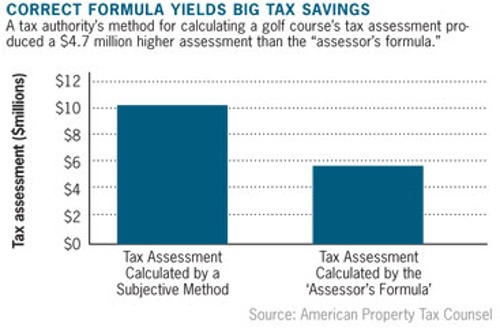
Golf_Courses_graph2One prominent Long Island club recently sold to a developer. Another declared bankruptcy, and surviving golf courses are fighting to avoid similar fates. Closures outpace new openings as demand for golf declines and revenue growth remains flat in the face of rising costs especially property taxes.

Exacerbating the tax problem are assessors who turn a blind eye to the economic forces threatening the survival of private clubs, and who instead pay undue attention to alternative land uses. Taxpayers are left to rely on the courts to compel assessors to value golf courses by present use and condition only.

In most all cases a golf course sells for a price that includes its business operation and personal property, but only the value of the real estate may be considered in setting the property tax assessment.

Development factor

Many courses are bought and sold for their development potential, grossly inflating values. Where developable land is at a premium, reliance on comparable sales could tax private golf courses from existence. The cost approach, too, is generally reserved for specialty property.

For these reasons, courts require the assessor to value the private golf course based on its value in use when employing the income capitalization approach. With this approach, a not-for-profit private club is valued as if it were a privately operated, for-profit, daily fee operation.

The courts tend to determine a golf course's income stream by capitalizing the amount a golf operator would pay a property owner as rent for the course. They use this methodology because golf course operators typically pay a percentage of gross revenues as rent. That amount can be capitalized to arrive at a value. The capitalization of golf rent to value is a hotly litigated issue and influences the percentage rent to be used.


Conflicting formula

Rents for golf course leases are influenced by differences in tax burdens from one location to the next. Similar golf courses operating under a similar operating basis, yet in differing locations with disparate tax burdens, must be equalized to arrive at a fair and uniform tax value. In a recent case, the court sought how best to keep the influence of high tax burdens from unfairly distorting value.

In that case, the assessor preached the application of an ad-hoc, subjective adjustment to the percentage rent to reflect a greater or lesser tax burden. This approach assumes the rental amounts would be triple-net. In a triple-net lease the tenant pays the real estate taxes, and the percentage rent is adjusted to reflect local taxes on a case-by-case basis.

The taxpayer offered another, more reliable method, the "assessor's formula". This formula lets the assessor follow the law, which calls for like-kind properties to be equally and uniformly assessed. The formula takes into account the income stream, the cap rate and the tax rate.

For example, consider two identical properties a city block apart, but in separate tax districts. One district has high tax rates, and the other a low tax rate. Because the assessor's formula weighs all three elements used to arrive at market value, it produces fair tax assessments as opposed to a subjective adjustment that is not computed on a scientific basis.

The accompanying chart shows the difference in assessments when the assessor's formula is used instead of an ad hoc, subjective tax adjustment. The assessor's formula provides a superior method that both assessor and taxpayer can rely on.

MMartone_ColorMichael Martone is the managing partner of law firm Koeppel Martone & Leistman LLP in Mineola, N.Y. Michael Guerriero is an associate at the firm, the New York member of American Property Tax Counsel (APTC), the national affiliation of property tax attorneys. They can be reached at mmartone@taxcert.com and mguerriero@taxcert.com.

Continue reading

American Property Tax Counsel

Recent Published Property Tax Articles

The Commercial Property Tax Rebellion

The property tax system in the United States, which traces its roots to colonial America, has long been the life blood of local government finance. Used to fund schools, infrastructure and vital municipal services, it is also a system fraught with controversy and mounting calls for reform.

Over the past...

Read more

How to Achieve Fair Valuation of Renewable Energy Facilities

As renewable energy assets become more prevalent in commercial real estate portfolios – especially among industrial and data center users – property owners face a critical challenge: ensuring that intangible assets are not mistakenly included in the taxable value of real and personal property.

Wind farms, solar installations, battery energy storage...

Read more

Taxing Real Estate On Redevelopment Prospects

When a property's current use isn't highest and best, New Jersey jurisdictions can assess and tax based on hypothetical redevelopment.

It's hard to imagine a more dystopian world than one in which governments base real estate tax upon a hypothetical use other than a property's current and actual use. Unfortunately, taxing...

Read more

Member Spotlight

Members

Forgot your password? / Forgot your username?