Menu

Property Tax Resources

Oct
08

Caught in 'The Twilight Zone'

"Property owners haunted by flawed approach to tax assessments..."

By Stewart L. Mandell, Esq., as published by National Real Estate Investor, October 2010

Flawed cost-based assessments are a common cause of unlawfully high property taxation. Year after year, inflated valuations by government assessors can impose excessive tax bills on a property, notwithstanding annual taxpayer efforts to correct them.

For property owners, persistently unfair assessments are like Talky Tina, the infamous talking doll in the television series The Twilight Zone. The evil toy ultimately prevails against homeowner Erich Streator, notwithstanding his repeated efforts to remove the doll from the Streator family home. The bad news for taxpayers is that assessors will continue to impose excessive, flawed assessments because they often employ error-prone appraisal methods in the interest of expediency. The following demonstrates a common route to a cost-based assessment.

Software can help assessors quickly calculate the cost of reproducing property improvements, an amount I'll call "cost to build today." To account for physical deterioration of improvements, assessors can use an age-life method.

Twilight_Zone_graph2

For example, let's say a five-year old structure's estimated life is 50 years and its cost to build today is $10 million. The assessor deducts 10% for physical deterioration and adds the resulting $9 million value to the land value for a quick — and often inflated — assessment. The good news for taxpayers is that, unlike the Twilight Zone's Streator family, they have the means to seek and obtain justice.

A compelling case

A recently litigated tax appeal regarding a big-box retail building offers a persuasive example. The taxpayer-submitted appraisal included not only income- and sales-comparison based valuations, but also a proper cost approach.

The cost-based analysis differed in several ways from the tax assessor's hasty valuation. First, the appraisal explained that in addition to physical deterioration, depreciation must reflect functional obsolescence or drawbacks to the property itself, as well as external obsolescence. The latter refers to factors outside the property, such as reduced demand for space due to a recession.

The taxpayer proved that the original assessment was flawed because only physical deterioration had been subtracted from the cost to build today. Additionally, the property owner's appraiser presented comparable sales of other big-box locations where a taxpayer had purchased a site, developed a building and sold the property within a few years. These comparable sales were properties in which the owners had a fee simple interest.

For each comparable sale, the appraiser established the total depreciation of the improvements by first subtracting the original land purchase amount from the recent sale price to arrive at a current depreciated value for the building. Then the appraiser compared that building value to the cost to build today, which showed how much the building had depreciated over time.

The total depreciation at these similar properties supported the case for a lower assessment. In the most extreme example from several comparable sales, the value of the building and improvements was 56% less than the cost to build today. Total depreciation of the improvements in the comparable examples ranged from 42% to 56%. Applying this analysis, even after adding back the property's $700,000 land cost, the property assessment should have been about $3 million instead of more than $5 million.

In this case, the appraiser had comparable sales data on similar properties where land acquisition, construction and a sale had taken place in a relatively short time. In cases where the available comparable sales are of older properties, land sales may be used to establish the land value, rather than using the actual original price. As the accompanying chart shows, the taxpayer demonstrated that the government's assessment was unlawfully inflated by over 40%. Clearly, comparable sales can help taxpayers fight the kind of excessive taxation that should only exist in the fictitious world of The Twilight Zone.

MandellPhoto90Stewart L. Mandell is a partner in the law firm of Honigman Miller Schwartz and Cohn LLP, the Michigan member of American Property Tax Counsel (APTC). He can be reached at slmandell@honigman.com.

Continue reading
Sep
23

Golf Course Owners Teed Off Over Taxes

"Taxpayers are left to rely on the courts to compel assessors to value golf courses by present use and condition only..."

By Michael Martone, Esq., and Michael P. Guerriero, Esq., National Real Estate Investor, September 2010

A battle is raging in New York and across the country between assessors and taxpayers at odds over the market value of golf courses and their associated membership clubs.

The front lines in this conflict are clearly demonstrated in Nassau County, N.Y., home to 400 overlapping tax districts and a population suffering the highest taxation burden in the state. The recession and nationwide decline in property values for golf courses have pushed many clubs into severe financial straits as thinning rosters force them to lower dues or scrap fees.

Golf_Courses_graph2One prominent Long Island club recently sold to a developer. Another declared bankruptcy, and surviving golf courses are fighting to avoid similar fates. Closures outpace new openings as demand for golf declines and revenue growth remains flat in the face of rising costs especially property taxes.


Exacerbating the tax problem are assessors who turn a blind eye to the economic forces threatening the survival of private clubs, and who instead pay undue attention to alternative land uses. Taxpayers are left to rely on the courts to compel assessors to value golf courses by present use and condition only.

In most all cases a golf course sells for a price that includes its business operation and personal property, but only the value of the real estate may be considered in setting the property tax assessment.

Development factor

Many courses are bought and sold for their development potential, grossly inflating values. Where developable land is at a premium, reliance on comparable sales could tax private golf courses from existence. The cost approach, too, is generally reserved for specialty property.

For these reasons, courts require the assessor to value the private golf course based on its value in use when employing the income capitalization approach. With this approach, a not-for-profit private club is valued as if it were a privately operated, for-profit, daily fee operation.

The courts tend to determine a golf course's income stream by capitalizing the amount a golf operator would pay a property owner as rent for the course. They use this methodology because golf course operators typically pay a percentage of gross revenues as rent. That amount can be capitalized to arrive at a value. The capitalization of golf rent to value is a hotly litigated issue and influences the percentage rent to be used.


Conflicting formula

Rents for golf course leases are influenced by differences in tax burdens from one location to the next. Similar golf courses operating under a similar operating basis, yet in differing locations with disparate tax burdens, must be equalized to arrive at a fair and uniform tax value. In a recent case, the court sought how best to keep the influence of high tax burdens from unfairly distorting value.

In that case, the assessor preached the application of an ad-hoc, subjective adjustment to the percentage rent to reflect a greater or lesser tax burden. This approach assumes the rental amounts would be triple-net. In a triple-net lease the tenant pays the real estate taxes, and the percentage rent is adjusted to reflect local taxes on a case-by-case basis.

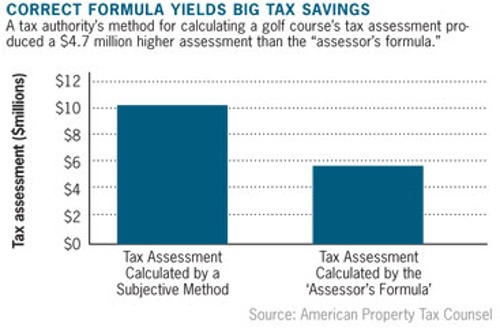
The taxpayer offered another, more reliable method, the "assessor's formula". This formula lets the assessor follow the law, which calls for like-kind properties to be equally and uniformly assessed. The formula takes into account the income stream, the cap rate and the tax rate.

For example, consider two identical properties a city block apart, but in separate tax districts. One district has high tax rates, and the other a low tax rate. Because the assessor's formula weighs all three elements used to arrive at market value, it produces fair tax assessments as opposed to a subjective adjustment that is not computed on a scientific basis.

The accompanying chart shows the difference in assessments when the assessor's formula is used instead of an ad hoc, subjective tax adjustment. The assessor's formula provides a superior method that both assessor and taxpayer can rely on.

MMartone_ColorMichael Martone is the managing partner of law firm Koeppel Martone & Leistman LLP in Mineola, N.Y. Michael Guerriero is an associate at the firm, the New York member of American Property Tax Counsel (APTC), the national affiliation of property tax attorneys. They can be reached at mmartone@taxcert.com and mguerriero@taxcert.com.

Continue reading
Aug
23

Controversy Emerges Over Michigan Business Tax Credits for Industrial Owners

"The tax credits threaten to reduce tax revenue to the state. To minimize lost revenue, taxing entities are attempting to limit use of the tax credits for industrial personal property by seeking to reclassify many of those assets as commercial..."

By Michael Shapiro, Esq., as published by National Real Estate Investor - online, August 2010

Detroit, along with the rest of Michigan is wrestling with two major tax issues that frequently involve litigation and have costly implications for owners of commercial and industrial properties. The first issue relates to the fact that the applicable tax statute in Michigan treats industrial properties differently than office, retail, hotel and other commercial properties.

tax-char 08-20

Starting with the 2008 tax year, the Michigan legislature granted Michigan Business Tax credits to owners of industrial personal property. These credits are intended to offset property taxes and reduce the tax rate levied on industrial personal property.

As the accompanying chart indicates, for the 2009 tax year, Detroit's rate for commercial personal property was $70.92 per $1,000 taxable value (generally 50% of market value). Meanwhile, the personal industrial property rate was $59.14 per $1,000, effectively reduced to $38.44 per $1,000 by the Michigan Business Tax credits.

The tax credits threaten to reduce tax revenue to the state. To minimize lost revenue, taxing entities are attempting to limit use of the tax credits for industrial personal property by seeking to reclassify many of those assets as commercial.

The Michigan Department of Treasury recently announced that it filed almost 10,000 property tax classification cases affecting 2009 property taxes. In addition, state officials have encouraged local communities to file classification appeals in the State Tax Commission for 2010, all with the intent of changing property classifications from industrial personal property to commercial personal property.

Raw deal for industrial owners

Many of the actions have been initiated by the state or local jurisdiction based solely on the name of the owner, and without regard to the actual use of the property or the property's legal classification. If a company's name is Joe's Manufacturing, it will not have a classification action brought against it, whereas Joe's Warehouse will be the subject of such an action.

Because the law involved is relatively new, most taxpayers receiving notice of these appeals have little to no idea what the action involves.

At the heart of the issue is the definition of industrial personal property, and the statute is reasonably clear that personal property located on industrial real property is industrial personal property.

Notwithstanding the statute, the state and State Tax Commission claim that the use of personal property governs its classification and that personal property has to be used for manufacturing or processing in order to be deemed industrial. There is nothing in the applicable statute to support that position, however.

The classification appeals recently filed make it apparent that the state and State Tax Commission recognize their claims may not prevail. As a result, in more recent filings they are seeking to change the classification of the underlying real estate from industrial to commercial.

It appears that most actions by the State Tax Commission and the State have been taken without any property specifics other than the name of the owner. If those reclassifications succeed, then the personal property at the site would also be redefined as commercial and not industrial personal property.

Taxpayers affected by such actions should consult with competent property tax counsel for advice on whether to defend such claims and, if so, how to proceed. In some instances, the government may have missed a critical deadline, which will give taxpayers an additional basis for prevailing.

Backlog of appeals

The second source of property tax litigation in Detroit and other Michigan communities is shared by thousands of property owners across the country. Nearly everywhere in the United States, property values are depressed by as much as 40% or more from where they were before the onset of the recession in December 2007.

And just like local governments in other states, Michigan's taxing entities are strapped for cash and reluctant to voluntarily lower valuations to reflect current market conditions. It's no surprise that thousands of property owners have appealed assessments in hopes of lowering their property tax bills.

What may be surprising to property owners who haven't already filed an appeal is that an unprecedented deluge of valuation protests has slowed down the panel that reviews them. As of July 31, there were approximately 2,600 non-small-claims cases pending before the Michigan Tax Tribunal for the 2008 tax year, and another 5,600 cases for 2009. Approximately 3,900 such new cases have been filed in 2010.

The tax tribunal recently adopted new procedures and is laboring to reduce this backlog and expedite the time it takes cases to move from filing to resolution. Most property tax practitioners applaud the tribunal's recent efforts in this regard. Even so, for anyone considering an appeal, it makes sense to start the process sooner rather than later and get in line to have the case heard.

SHAPIRO_Michael2008Michael Shapiro chairs the tax appeals practice group at Michigan law firm Honigman Miller Schwartz and Cohn LLP. The firm is the Michigan member of American Property Tax Counsel, the national affiliation of property tax attorneys. HE can be reached at mshapiro@honigman.com.

Continue reading
Feb
25

How To Contest Clawbacks Provisions

"Companies out of compliance on tax abatement agreements can still make a compelling case for relief."

By Stephen Paul, Esq. & Fenton Strickland, Esq. - as published by National Real Estate Investor, January/February 2010

The race among states and cities to lure new companies and retain existing businesses has been furious, featuring aggressive offerings of significant tax allowances in exchange for promises of jobs and capital investment.

But taxpayers must be cautious. When the government lends a bigger hand that hand can claw back realized tax savings.

Deals involving property tax abatement usually include a promise by a business to invest certain sums of money in its properties and create and/or retain a certain number of jobs.

In return, the local taxing authority exempts all or a portion of the property taxes a business otherwise would have to pay on the new development over some specific period of time.

Governments often insist that abatement contracts permit them to recoup tax savings if a company falls short of its investment and/or hiring aims. Generally referred to as "clawbacks," these provisions in tax abatement agreements are becoming more commonplace and governments are keen on enforcing them.

Many current beneficiaries of tax abatements operate under agreements that originated prior to the recession that began in December 2007, when business expansion appeared more attainable.

However, new economic challenges have frustrated expansion objectives. And with governments mired in search of additional revenue, the potential for clawback appears greater.

Recognizing that clawback is a risk commensurate with the tax benefit, tax abatement recipients facing the prospect of clawback still have the possibility of avoiding the risk.

Escaping clawbacks

When a company enters into an abatement agreement with a municipality, it should be fully aware of the ramifications if the investment and/or hiring fall short of promised levels.

Agreements often allow taxing authorities to cancel abatements when companies fall out of compliance and may also require reimbursement of past tax savings in proportion to investment or employment shortfalls.

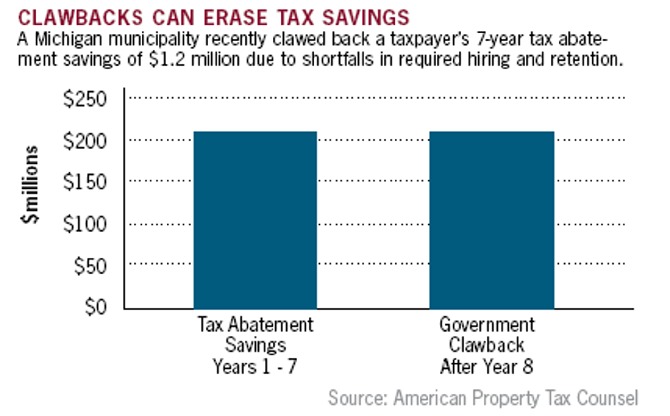
In other cases, noncompliance could mean recoupment by the tax collector of all tax abatement savings to date. Total recoupment of tax savings is illustrated in the chart above, where the recipient of a long-term abatement complied with job requirements for seven years but fell out of compliance in year eight, violating the abatement agreement.

When a clawback provision exists, the owner should examine the language to see if it applies to the circumstances of his property. Some clawback language might excuse shortcomings because of factors beyond the property owner's control.

This amorphous test often is tied to an unforeseeable reduction in demand for the company's product or services, or something similar. Because of the recent economic downturn, much litigation can be expected regarding these issues.

Contest_Clawbacks_graph_bigIn some situations, a taxpayer should consider renegotiating the abatement agreement. A business can be in a surprisingly strong negotiating position, especially in instances where it can boast contributions to the local economy.


Confronted with the possibility of losing such a business to another municipality, local officials might be willing to work out a deal.

Where negotiation fails, a business can consider fighting the government's clawback.

Special attention should be paid to the applicable statutes. The local government's clawback effort might run afoul of statutory abatement cancellation and reimbursement schemes to such a degree that the provision should be nullified.

When a business has complied with abatement terms before the shortfall, a court might hesitate to award the government a windfall recoupment of all tax abatement savings.

Every case is unique, but the value of the abatement makes fighting the clawback worthwhile.


PaulPhoto90

Stephen Paul is a partner in the Indianapolis law firm of Baker & Daniels, the Indiana member of American Property Tax Counsel. He can be reached at stephen.paul@bakerd.com.

stricklandf

Fenton Strickland can be reached at fenton.strickland@bakerd.com.

Continue reading
Dec
31

Thinking Outside the Box

"Smart shopping center owners follow Hoteliers' approach to reducing property taxes."

By Cris K. O'Neall, Esq., as published by National Real Estate Investor, November/December 2009

Why do taxing authorities recognize intangibles for hospitality properties, but not shopping center properties? The answer may be the way mall intangibles have been chara­acterized for tax purposes.

Intangibles include such items as business franchises, licenses and pera­mits, operating manuals and procedures, trained workforce, commercial agreea­ments and intellectual property.

Owners of hospitality properties know that branding their properties with well-recognized franchises or flags, such as Marriott, increases revenues. Because branding usually delivers access to resera­vations and management systems, traina­ing programs and other value-added benefits, it attracts clientele willing to pay premiums for hospitality stays and related amenities.

While hospitality properties benefit from their property tax exemption for franchises and other intangibles, shopa­ping mall properties haven't garnered the same benefits.

A recent unfavorable decision by the Minnesota Tax Court in an appeal filed by Eden Prairie Center in suburban Minneapolis typifies the difficulty shopa­ping center owners face in obtaining exemptions for intangibles. Mall owners who could use a respite from high propa­erty taxes are understandably frustrated.

Identifying intangibles

Hotel owners have succeeded in claiming the intangibles tax exemption by identia­fying specific types of intangibles, such as franchises and employee workforce, and assigning values to those tax-exempt items. This approach is particularly suca­cessful in states like California where statutes and court decisions support deductions for intangibles.

In contrast, shopping center owners typically urge tax assessors to reduce assessments based on residual "business enterprise value" (BEV). These owna­ers ascribe to BEV the higher in-line store rents produced by the presence of high-end anchor tenants or a particularly advantageous tenant mix.

Taxing authorities are reluctant to accept taxpayers' requests for BEV assessa­ment reductions. Court decisions involva­ing shopping center properties usually point to difficulties in proving BEV and the problem of separating intangibles from real estate.

Mall owners should focus on intana­gible assets and rights specific to their properties, as hospitality owners have done, rather than rely on the more neba­ulous BEV. They should identify and determine the value of intangibles such as anchor tenant and/or mall trade names, management agreements, and advertising arrangements. Creativity in identifying and valuing intangibles can bring significant assessment reductions, but success depends on owners' efforts. For example, proving to taxing authorities the benefits of having upscale anchor tenants likely requires an appraiser's analysis and may also depend upon data for competing properties.

Making the case

After intangibles are identified, an appraiser who specializes in intangible valuation should be retained to appraise the identified assets and rights. Then the total value of the tax-exempt intangibles is deducted from the entire property's value to arrive at the value of the taxable real property.

If the value of all intangibles is suba­stantial, this should be presented to the assessor. Ideally, informal negotiations with the taxing authority result in lower assessments. Even with the best efforts, however, it's still possible that the assessor won't reduce a shopping center's value by removing tax-exempt intangibles. In that event, a tax appeal should be filed.

CONeallCris K. O'Neall is a partner with Cahill, Davis & O'Neall LLP, the California member of American Property Tax Counsel. He can be reached at cko@cahilldavis.com.

Continue reading
Aug
01

New Method to Reduce REIT Property Taxes

Stock price offers a reliable indicator for assessed value.

"Prediction of a property's ability to generate income is precisely what the income approach to value in property assessment attempts to accomplish."

By Stephen Paul, Esq., as published in National Real Estate Investor July/August 2009

Assessing the value of REIT assets for property tax purposes has historically been an ordeal for assessors, as well as for owners challenging their work. Published data indicates that property values have dropped over the past two years, but the lack of sales leaves relatively little to prove the declines.

Without an active market of REITs buying and selling property, the sales comparison approach to value loses its usefulness. Even if taxpayers and assessors agree that properties in most REIT sectors are best valued under the income approach, decisions about estimates of future income streams, capitalization rates, and other factors required under the income approach often breed intense discord.

These difficulties are amplified in today's market due to lower predictability of occupancies, lease terms, and percentage rents. Thus, REIT owners need new ways to substantiate for the tax authorities the decline in their property values.

Stock prices are telling

In many REIT sectors, declining stock values actually have the potential to provide suitable proof of decreasing property values. Since the trend in a REIT's stock price represents the market's prediction of the direction in which the capitalized funds from operations of the REIT likely will move, readily available stock market data could be used to show an assessor that assessed values should be reduced.

This methodology is particularly appropriate for REIT properties. The stock price for any ordinary non-REIT company, in effect, states how the market values the company's assets, but any indication of the value oPrediction of a property's ability to generate income is precisely what the income approach to value in property assessment attempts to accomplish.f the real property itself is unclear.

REITs are different. By definition, REIT assets comprise investments in real property. To qualify as a REIT, at least 75% of income must come from real estate sources, and at least 95% of income must be derived from interest, dividends, and the property itself. The trend in the value of a REIT stock thus reveals how the market values the income-producing capability of the REIT's real property.

Paul_NewMethod_NREI09Prediction of a property's ability to generate income is precisely what the income approach to value in property assessment attempts to accomplish. The income approach estimates future benefits from ownership of the property. But this estimate requires extensive market research to evaluate risk factors in order to accurately predict income streams and expenses.


Examples of these risk factors include whether tenants and locations are favorable, whether acquisitions were prudent, the likelihood that locations will go dark, and the extent to which rent collections might be in jeopardy. Evaluating such risks is problematic during a deep recession like that experienced currently.

In setting the stock price, however, the market already has evaluated the risk factors associated with the properties of a particular REIT. The market has performed the research that is so troublesome in a difficult economic climate.

Because the trend in a REIT's stock price represents a statement by the market in direct relation to the real property itself, the trend in value of the stock price can provide valuable support for reduced assessments and input for analysis under the income approach.

Understanding that REITs generally own many properties, often in multiple states or even worldwide, it should be acknowledged that stock price cannot determine with precision assessed values of individual properties. But the correlation between a REIT's stock price and its property value can be employed to demonstrate the necessity for some assessment reduction on individual properties.

Here's how

A simple linear regression analysis provides an ideal tool to prove the correlation between a REIT's stock price and the value of its properties. To illustrate the point, let's use data from an actual REIT property in the Midwest.

Assume the REIT appeals the 2008 assessment of one of its properties. That property is assessed for 2008 at $5.6 million when the REIT's stock is trading at $11.50 per share. Assume further that the assessed values and stock quotes have been as follows over the last six years

Year Stock Quote Assessed
Value
(in millions)
2002

$9.95

$3.75

2003

$11.99

$4.07

2004 $14.51 $4.42
2005 $15.3 $4.96
2006 $18.00 $5.26
2007

$22.16

$5.40

Plotting the stock quotes on the x-axis and assessed values on the y-axis of a graph produces a scatter diagram as shown in the accompanying chart. Using a simple linear regression formula, a trend line can be drawn through the data.

Because the trend line so closely matches the assessments across the six year period, it clearly illustrates that the stock price correlates very closely to the assessed values. Thus, stock price is a reliable predictor of assessed value.

This demonstrated correlation is not exhibited, however, by the 2008 assessment on which the REIT has filed an appeal. During the period illustrated in the chart, the increase in stock price from $9.95 in 2002 to $22.16 in 2007 had been matched by increases in assessed value from about $3.7 to $5.4 million.

But a further increase in assessed value to $5.6 million for 2008 is inconsistent with the stock losing nearly 50% of its value and falling to $11.50 per share.

Therefore, the REIT owner should urge the assessor to reduce the property's 2008 assessment.

In the current market, demonstrating that assessed values should be reduced demands resourcefulness. Absent comparable sales and easily identified factors under the income approach, analysis of the correlation between stock performance and assessed value can help demonstrate a necessary reduction in assessed value.

PaulPhoto90Stephen Paul is a partner in the Indianapolis law firm of Baker & Daniels, the Indiana member of the American Property Tax Counsel. He can be reached at stephen.paul@bakerd.com.

Continue reading
Jun
01

Shouldering a Costly Burden

States cut homeowners a property tax break, leaving commercial owners to fill the gap

The conventional wisdom is that lower valuations result in lower taxes. Many commercial owners and tax practitioners expect property values to decline this year due to a depressed economy.

By Linda Terrill, Esq., as published by National Real Estate Investor, June 2009

Will Rogers once said: "The only difference between death and taxes is that death doesn't get worse every time Congress meets." Commercial property owners could say the same thing of state legislatures when it comes to property taxation.

In the beginning, most states provided a "uniform and equal" rate of assessment and taxation for all classes of property. Today, the vast majority of states still have the basic "uniform and equal" framework, but all have tinkered with it to shift the weight of taxation to commercial property.

Once the local tax base and budget are determined, a mill levy is set. Some states apply the mill levy against the 100% value of the property. The math is: 100% value a— mill levy = tax due.

Other states have an intermediary level, generally referred to as the assessed value, which is a percentage of the 100% value. In those cases, the mill levy is applied to the assessed value and the computation is as follows: 100% value a— assessment rate a— mill levy = tax due.

Terrill_CostlyBurden_GRAPH

Altering the equation?

Several states have adopted "classification legislation" that provides for differential assessment rates for commercial real estate versus residential. In most cases, the commercial taxpayer carries the larger load.

This disparity grows wider if the residential owner also qualifies for other preferential treatment that some states may provide to seniors, veterans or low-income property owners. Here are examples of the tax system in practice:

In Colorado, all property is assessed at 29%, except residential, which is assessed at 7.96%. In terms of tax dollars, this disparity means that for every $1 paid by the residential owner, a commercial property owner will pay $3.64.

To further illustrate, assume a mill levy of .075 and a commercial and residential property each valued at $200,000. In Colorado, the property taxes for the homeowner are calculated as follows: $200,000 a— 7.96% = $15,920 a— .075 = $1,194. The commercial owner, however, pays 3.6 times as much: $200,000 a— 29% = $58,000 a— .075 = $4,350.

Arizona legislates commercial assessment rates at 22% and residential rates at 10% (see chart). Thus, for every $1 paid by the residential property owner, a commercial property owner will pay $2.20.

Tennessee commercial property owners fork over $1.60 for every $1 paid by a residential property owner, and in Kansas commercial owners pony up $2.17 for every $1 paid by residential owners. The ratio in Minnesota can be as high as 3 to 1.

The states and city included in the chart represent only a sampling of the disparity in the way the property tax load is shared between commercial and residential owners.

Premature celebration?

The conventional wisdom is that lower valuations result in lower taxes. Many commercial owners and tax practitioners expect property values to decline this year due to a depressed economy. It's only logical that taxpayers who see a reduction in their valuation notices for 2009 expect their taxes to decrease.

Such a conclusion is premature in the states with different assessment rates for commercial and residential property, or with any other significant agricultural and/or residential tax relief programs. That's because if the tax base declines and the needs of government remain the same, a mill levy increase is inevitable and commercial property taxpayers will face paying the majority share.

A savvy commercial property owner would be well advised to take the following steps:

  • Determine the tax appeal date and the rules for filing. If your property requires an appraisal, remember that the number of appeals may rise significantly, so hire an appraiser as early as possible.
  • Determine whether your market area comprises a diverse mixture of property types, or is dominated by businesses that are dependent on a single industry.
  • Compare the local unemployment rate with the national numbers.
  • Decide whether you can manage the appeal on your own.
  • Be prepared for it to take longer than you'd expect to traverse what will probably be a crowded tax appeal docket. To be forewarned is to be forearmed.

TerrillPhoto90Linda Terrill is a partner in the law firm of Neill, Terrill & Embree, the Kansas and Nebraska member of American Property Tax Counsel. She can be reached at lterrill@taxappealfirm.com.

Continue reading
Feb
05

Reassessing Market Value

Assessors' use of historical sales data in a recession inflates property values.

"As a result, assessors typically value individual parcels not so much by looking at the specific characteristics of a particular parcel, but rather by the application of a mass appraisal system that relies heavily on historical data."

By Stewart L. Mandell Esq. and Andy Raines Esq., as published by National Real Estate Investor, February 2009

During periods of economic weakness, U.S. commercial and industrial real estate owners become vulnerable to unrealistic and excessive property tax assessments. Assessors' reliance on mass appraisal methodology and their use of data compiled during strong economic periods are the two main reasons for this problem.

Due to the large number of property tax parcels in a jurisdiction and limited resources to assess them, assessors typically employ mass appraisal methodology. In a mass appraisal, assessors gather and study certain economic data for a one- to three-year period preceding the assessment's effective date, including sales transactions, market rents, vacancy levels and/or levels of operating expenses.

Assessors then use that information to develop a valuation methodology, which they apply to individual parcels. For example, an assessor might study sales from the prior two years, which includes a dozen industrial properties located in his jurisdiction. He may determine from his study that the sold properties should have been valued 5% higher than the value at which they were carried on the assessment roll. The assessor would then increase the value of the entire class of industrial property by 5%.

As a result, assessors typically value individual parcels not so much by looking at the specific characteristics of a particular parcel, but rather by the application of a mass appraisal system that relies heavily on historical data. Recognizing and understanding the traditional methodology many assessors utilize is critical to enabling taxpayers to evaluate their risk of receiving excessive assessments.

Methodology under microscope

Odds are that assessors' usual valuation models for the 2009 tax year may be significantly flawed because a huge disconnect exists between economic conditions two to three years ago and today. This disconnect shows up in many ways.

The office vacancy rate in many markets has been low, from 5% to 10%, in the past few years. The current recession, however, is marked by financial sector turmoil and rising unemployment, resulting in increased office vacancies.

Shopping centers, too, are experiencing higher vacancies due to the recession's adverse impact on retail sales, which has been exacerbated by the reduction in new residential subdivision development and high residential foreclosure rates.

Perhaps the biggest data disconnect lies in capitalization rates, which act as a proxy for buyers' recognition of risk. Before the September 2008 economic crisis, buyers expected rental income and property values to continue rising. Now the reality of declining occupancy and rents, plus higher risk, has raised cap rates and lowered property values.

Upside of a downturn

A change in economic climate affects a property's valuation when the assessor uses historical data instead of current data. In 2007, a warehouse in Austin, Texas could command a net rent of $5 per sq. ft. Back then, vacancy held steady at about 9%. An appropriate cap rate would have been about 7.5%.

In late 2008, the recession caused warehouse vacancy rates in Austin to rise to 14%. The market softness pushed up vacancies, and market rent fell to about $4.50 per sq. ft. This trend raised the cap rate by at least 1%.

Based on the use of historical data, a 500,000 sq. ft. warehouse is valued at $26.4 million (see chart). However, the value based on current data comes to $19.8 million, a 25% reduction. Property taxes would amount to about $595,000 annually with an assessment based on historical data. Using current data, the assessment would result in taxes of about $445,000 annually, a $150,000 difference.

Assessors often use historical data to assist in making property tax assessments. That methodology may suffice in periods of economic stability. Unfortunately, in these volatile and challenging times, assessments based on dated information will be inaccurate and overstated.

If assessors keep using the rear view mirror to determine assessments, taxpayers should file appeals to avoid head-on collisions with excessive property taxation. Critical to a successful appeal is the use of current data to indicate an appropriate property tax assessment.

MandellPhoto90Stewart L. Mandell is a partner in the law firm of Honigman Miller Schwartz and Cohn LLP, the Michigan member of American Property Tax Counsel (APTC). He can be reached at slmandell@honigman.com.
RainesPhoto90Andy Raines is a partner in the law firm of Evans & Petree, the Arkansas and Tennessee member of American Property Tax Counsel (APTC). He can be reached at araines@evanspetree.com.
Continue reading
Dec
05

Proper Remedy for Excessive Assessments

Don't value medical office buildings higher than general office space.

"These facilities require certain specialized construction components and finishes to accommodate industry needs."

By Stephen Paul, Esq., as published by National Real Estate Investor, December 2008

Construction of medical office buildings is burgeoning throughout the country due to the aging population and its healthcare needs. Because these facilities generally operate as for-profit medical services, they usually become subject to property tax. Medical office owners often find their buildings assessed for real property tax purposes at excessive values when compared to general office properties.

Assessors normally use the cost approach to determine the value of newly constructed property. For the most part, medical office buildings house multiple tenants, including medical practitioners and associated healthcare facilities such as pharmacies, diagnostic imaging, labs or medical administrative services.

These facilities require certain specialized construction components and finishes to accommodate industry needs. Generally, the construction finishes are higher quality than available in the average office. So, logically, if construction costs more, the return on investment needs to be higher to offset these increased costs.

Two obvious construction cost differences stand out between general office and medical office space. First, medical offices require more partitioning due to the need for numerous small exam rooms, medical staff offices and nursing stations and for extensive file storage.

Secondly, medical office space calls for more plumbing fixtures because every exam room must have facilities to maintain sanitary conditions as doctors move from patient to patient.

Major costs also are incurred when an office building must accommodate X-ray machines, magnetic resonance imagining equipment, or CAT-scan equipment/ rooms that require special shielding, such as cinder blocks and double or triple thicknesses of drywall or lead. Moreover, some medical office buildings include outpatient surgical centers, which demand nonporous finishes, high intensity lighting and greater electrical service. Thus, the cost per square foot of medical office space rises well above that of conventional office space.

Data from Marshall & Swift Valuation Service, the industry bible, supports these facts. The data shows that the base cost to construct medical office space is 26% higher than the cost of building general office space.

Highly persuasive argument

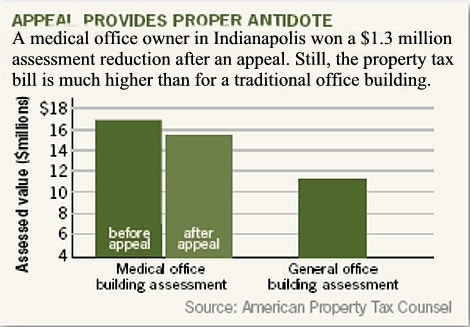
Let's examine a property tax appeal involving a medical office property in Indianapolis in 2007. The assessor valued a newly constructed building at $16.9 million. At the same time, the valuation on an Indianapolis general office building with the same square footage amounted to $11.3 million.

The cost to build the medical building was $15 million; the general office property cost $12.4 million to construct. The assessor valued the medical office building $5.6 million higher than the general office property, or nearly 50% more.

In preparation for the tax appeal, the taxpayer documented each construction component and compared it to general office buildings of similar size. This comparison showed that the real estate should be valued based on the basic components of a general office building.

Because each building has the exact same basic components, no justification exists for a larger tax assessment on the medical office building. In the appeal, the taxpayer also argued that an alternate or second user of the medical office building would likely purchase the property simply for office space.

PaulsgraphAs a result of this painstaking development and presentation of the relevant facts, the Appeal Board ruled in favor of the taxpayer and reduced the property's valuation by $1.3 million to $15.6 million. While this reduction was warranted, the medical office building remains valued higher than the general office building, proving that medical office buildings pay higher property taxes.

Lesson for assessors

Although the cost may be greater to construct medical office space, the added cost doesn't automatically justify higher property tax assessments. Because it is expensive to retrofit medical office space to fit general office needs, those costs should be deducted from construction costs to arrive at what would be market value for a general office building. Clearly, using the cost approach to value properties produces higher property valuations for medical office space than for general office space.

In a property tax appeal, the taxpayer must demonstrate that medical office property requires specialized construction and finishes, and lay out these facts to obtain an appropriate reduction in the property's assessment.


PaulPhoto90Stephen Paul is a partner in the Indianapolis law firm of Baker & Daniels, the Indiana member of American Property Tax Counsel (APTC), the national affiliation of property tax attorneys. He can be reached at stephen.paul@bakerd.com.

Continue reading
Oct
07

How Assessors Can Veer Off Course

"In a contracting economy, with real estate values falling, the differential between contract rent and market rent can become quite significant."

By John E. Garippa, Esq. as published by National Real Estate Investor, October 2008

In a faltering economy, tax authorities want to cling to contract rents — the amount agreed upon by the landlord and tenants — as the basis for valuing property. Instead, assessors should rely on market rent, the rental income a property would command in the open market. Relying on contract rents to determine a property's value results in increased revenues from property taxes, but causes owners to pay excessive taxes.

Most taxing jurisdictions in the United States are supposed to value property based on market evidence, which is essentially what a willing buyer would pay a willing seller for property with neither party being under duress to act. In a growing economy, most property owners grasp this concept.

However, when the economy weakens and real estate values become depressed, this same concept is not as easy to comprehend. More importantly, even some taxing authorities have difficulty understanding exactly how this concept should work in a recessionary climate.

Why rent isn't rent

Contract rent represents the actual rental income specified in a lease and can be greater or less than market rent, often referred to as economic rent. Market rent has become the basis for valuing property because it allows assessors to uniformly value all property based on the same standard of value.

In a contracting economy, with real estate values falling, the differential between contract rent and market rent can become quite significant. The differences between the two types of rent give rise to the need for diligence by property owners and managers.

This hypothetical example illustrates the point: Assume a 100,000 sq. ft. office building has been well managed for a significant period of time. As a result of superior management, the building is 100% occupied with an average rent of $30 per sq. ft. The leases were negotiated more than two years ago.

Since that time, the office market has deteriorated. Current market rents at similar properties reach no higher than $25 per sq. ft. net with a 10% capitalization rate.

Using contract rents, the value of the property comes to $30 million, but employing market rents, the value is only $20 million (rent multiplied by square footage divided by capitalization rate). Based on a 3% effective tax rate, the assessment at the contract rate comes to $900,000, while the market rate assessment is $600,000, a tax savings of $300,000 (see chart).

garripaGRaphAn owner or property manager examining the rental income from the office property above can rest easy because it's clear that no problem exists. Here's a well-managed property fully leased in a weak economy. However, taxpayers must not be lulled into ignoring the need for a review of any tax assessment received in an economy under duress.

If the taxing authorities are assessing on a market level, they should ignore contract rents and focus on appropriate market rent standards. The example shows that when valued properly the property — which by contract standards is correctly worth $30 million — should be assessed for tax purposes at no greater than $25 million, a significant differential.

Clearly, if the property's assessment comes in above $25 million, it has been over assessed and requires a tax appeal in order to establish its value at the current market level of other properties.


Make your case

The persuasiveness of a taxpayer's presentation to the assessor depends on differentiating the property's rental history from the marketplace realities. First, every available office rental comparable needs to be analyzed during the relevant time period.

Some of the physical elements of comparison should include security, HVAC, electrical systems, tenant finish, parking and location.

Second, the property owner should develop a scenario that explains why demand has eroded in the market. The owner should focus on factors such as changes in the workforce, the requisite space per worker, and analysis of vacancy rate changes over several years.

This study should cover the time period beginning with the building's lease-up. A study that demonstrates deteriorating market vacancy over a period of several years buttresses the argument that demand will naturally be weaker.

In a declining market, taxpayers must challenge property tax assessment based on contract rents. Unless your assessment is based on market rents, a tax appeal should be the next step.

GarippaJohn E. Garippa is senior partner of the law firm of Garippa, Lotz & Giannuario with offices in Montclair and Philadelphia. Mr. Garippa is also the president of the American Property Tax Counsel, the national affiliation of property tax attorneys, and can be reached at john@taxappeal.com.

Continue reading

American Property Tax Counsel

Recent Published Property Tax Articles

The Commercial Property Tax Rebellion

The property tax system in the United States, which traces its roots to colonial America, has long been the life blood of local government finance. Used to fund schools, infrastructure and vital municipal services, it is also a system fraught with controversy and mounting calls for reform.

Over the past...

Read more

How to Achieve Fair Valuation of Renewable Energy Facilities

As renewable energy assets become more prevalent in commercial real estate portfolios – especially among industrial and data center users – property owners face a critical challenge: ensuring that intangible assets are not mistakenly included in the taxable value of real and personal property.

Wind farms, solar installations, battery energy storage...

Read more

Taxing Real Estate On Redevelopment Prospects

When a property's current use isn't highest and best, New Jersey jurisdictions can assess and tax based on hypothetical redevelopment.

It's hard to imagine a more dystopian world than one in which governments base real estate tax upon a hypothetical use other than a property's current and actual use. Unfortunately, taxing...

Read more

Member Spotlight

Members

Forgot your password? / Forgot your username?